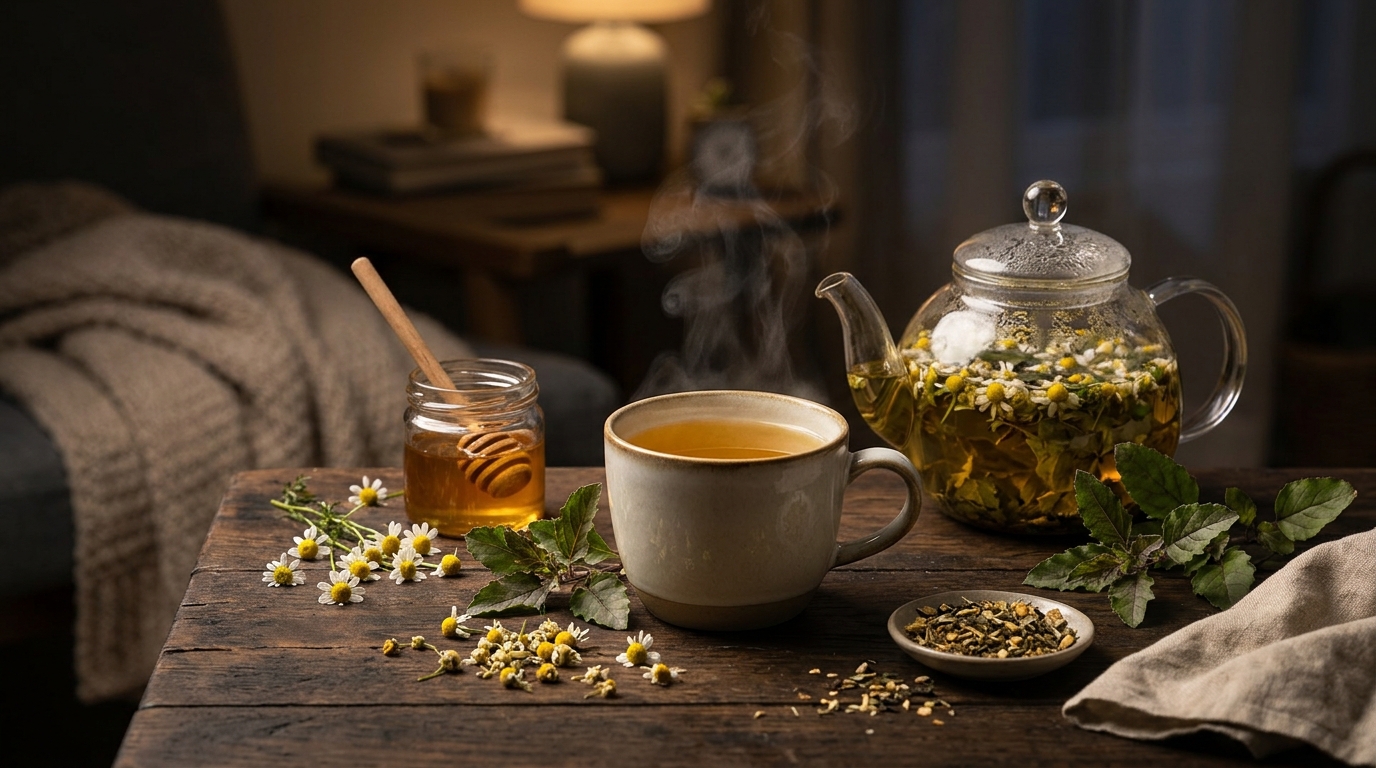
Holy basil, known as tulsi in India, has been grown in courtyards and temple gardens for thousands of years. Ayurvedic texts call it the ‘Queen of Herbs’ and the ‘Incomparable One,’ and many Hindu households keep a living tulsi plant as a sacred presence in the home. Traditionally, the leaves were brewed to ease tension, support the breath, and bring a sense of steadiness to the mind. Modern herbalists classify it as an adaptogen, a plant that helps the body respond more gracefully to everyday stressors.
Chamomile has an equally long story on the other side of the world. Ancient Egyptians dedicated it to their sun god, Roman physicians prescribed it for fevers and digestive upsets, and by the Middle Ages, European households relied on a cup of chamomile as the gentlest of evening remedies. Its apple-like fragrance and soft golden color have made it the world’s most recognizable bedtime tea.
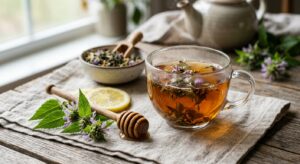
Blending the two creates a genuine meeting of herbal traditions. Holy basil brings a warm, clove-like spiciness and a clear-headed calm, while chamomile adds floral sweetness and a soothing, sedative softness. A little raw honey rounds the edges and adds its own traditional comfort. The result is a cup that tastes like twilight: fragrant, mellow, and quietly restorative.
2
cups
Ingredients
- 2 tspdried holy basil (tulsi) leaves
- 2 tspdried chamomile flowers
- 480 mlwater (90°C / 194°F)
- —raw honey to taste (about 1 tsp per cup)
- —thin slice of lemon or a pinch of cinnamon (optional)
How to Brew
Click on an item below to shop for the recommended items for this recipe on Amazon.
As an Amazon Associate, we earn from qualifying purchases.
- Bring fresh, filtered water to a boil, then let it rest for about 30 seconds so it settles near 90°C (194°F). Water that is too fiercely boiling can make chamomile taste bitter.
- Place the dried holy basil leaves and chamomile flowers in a teapot or directly into a mug with an infuser. Gently crush the tulsi leaves between your fingers first to release their oils.
- Pour the hot water over the herbs and cover immediately with a saucer or lid to trap the aromatic oils.
- Steep for 5 to 7 minutes. Closer to 5 minutes gives a lighter, floral cup, while 7 minutes brings out the spicy depth of the tulsi.
- Strain out the herbs. Let the tea cool for a minute or two, then stir in raw honey. Adding honey to slightly cooled tea helps preserve its delicate enzymes and flavor.
- Sip slowly, ideally 30 to 60 minutes before bed, in a dim and quiet space.
- Combine 3 tablespoons of dried holy basil and 3 tablespoons of dried chamomile in a clean glass jar. Cold extraction is gentler, so this recipe uses a slightly higher herb ratio per liter than the hot method.
- Fill the jar with 1 liter of cool, filtered water. Stir once to submerge all the herbs.
- Seal the jar and place it in the refrigerator. Allow it to steep for 8 to 12 hours, or overnight.
- Strain through a fine mesh sieve or cheesecloth into a clean pitcher, pressing lightly on the herbs to release the last of the liquid.
- Stir in raw honey at this stage, dissolving it fully in a small splash of warm water first so it blends smoothly into the cold tea.
- Serve over ice with a lemon slice. Consume within 48 hours for the best flavor.
- Heat 240 ml of water to about 95°C (203°F). You will brew this batch at double strength, so use 4 teaspoons of dried holy basil and 4 teaspoons of dried chamomile.
- Pour the hot water over the herbs in a heatproof jug and cover. Steep for a full 10 minutes to build a rich, concentrated infusion.
- While the tea steeps, fill two tall glasses generously with ice cubes.
- Strain the hot concentrate directly over the ice. The rapid cooling locks in the bright, floral aroma and prevents cloudiness.
- Stir in raw honey while the concentrate is still warm so it dissolves completely, then add a squeeze of fresh lemon.
- Garnish with a fresh holy basil leaf or a few chamomile blossoms, and serve immediately.
Health Benefits
Holy basil is classed as an adaptogen, and small clinical studies suggest regular use may lower perceived stress and improve feelings of well-being, possibly by modulating the body’s cortisol response.
Chamomile’s apigenin interacts with GABA-related pathways, and several trials link chamomile tea or extract to modest improvements in sleep quality and reduced nighttime restlessness.
Both herbs have been studied for anxiety-related symptoms. Chamomile extract showed benefit in trials of generalized anxiety, while holy basil has shown promising results for stress-related mood symptoms.
Chamomile’s bisabolol and flavonoids have traditionally been used to calm cramping and nervous stomach, while tulsi has long been used in Ayurveda as a digestive aid.
The rosmarinic acid, eugenol, and flavonoids in this blend help neutralize free radicals, supporting the body’s general defenses against oxidative stress.
🧪 Key Bioactive Compounds
The Science Behind Holy Basil
Holy basil (Ocimum tenuiflorum, also called Ocimum sanctum) is among the most studied adaptogens in Ayurvedic medicine. Its leaves contain eugenol, ursolic acid, rosmarinic acid, and a range of flavonoids. Small human trials and laboratory studies suggest these compounds may help moderate the body’s stress response, including cortisol regulation and markers of oxidative stress. The evidence is encouraging but still limited, with most studies being small, so tulsi is best viewed as a gentle daily support rather than a treatment.
Chamomile (Matricaria chamomilla) owes much of its calming reputation to apigenin, a flavonoid that attaches to benzodiazepine-like sites on GABA receptors in the brain. This interaction is far milder than a pharmaceutical sedative, which is why chamomile tends to relax rather than knock you out. Its essential oil, rich in alpha-bisabolol and chamazulene, adds anti-inflammatory and digestive-soothing effects. A number of clinical trials, including studies on generalized anxiety and sleep quality, have reported modest but consistent benefits.
Together, the two herbs address stress from complementary angles: tulsi works on the longer-term resilience of the stress response, while chamomile offers a more immediate soothing effect in the evening. Raw honey contributes a small amount of natural sugars and traditional comfort, and a little sweetness can make the ritual of the cup itself more relaxing, which is part of its value.
Brewing Tips
- Choose whole-leaf tulsi and whole chamomile flower heads over fine tea-bag dust. They hold far more aromatic oil and give a fuller, sweeter cup.
- Always cover your cup while steeping. The calming volatile oils in both herbs are quick to escape with the steam.
- For a milder, more floral blend, use a 2:1 ratio of chamomile to tulsi. For a spicier, more grounding cup, reverse the ratio.
- Make this tea part of a consistent evening ritual. Adaptogens like holy basil tend to work best when taken regularly over days and weeks rather than occasionally.