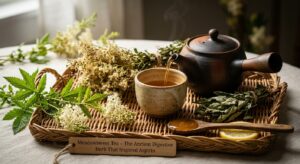
Anise (Pimpinella anisum) is one of the oldest cultivated spices in the world. Native to the eastern Mediterranean and southwest Asia, it was grown in ancient Egypt, where seeds were found in tombs, and prized by the Greeks and Romans. Roman banquets famously ended with a spiced cake called mustaceum, flavored with anise to prevent indigestion after a heavy feast. That tradition of a seed-based digestif has echoed through cultures ever since, from Greek ouzo and French pastis to the gentle seed teas served in Middle Eastern and Indian homes.
Folk herbalists in Europe and the Middle East have long reached for anise seed to soothe an unsettled stomach, calm colic in infants, and ease coughs. The seeds are technically the dried fruits of a small umbelliferous plant related to fennel, caraway, and dill. When crushed and steeped, they release a sweet, warm, unmistakably licorice-like aroma that comes primarily from the volatile oil anethole.
What makes anise especially suited to evening is the ritual. A small cup of fragrant tea after dinner signals the body to slow down, while the carminative qualities of the seed help settle the digestive tract so you can wind down comfortably. It is naturally caffeine-free, naturally sweet, and wonderfully simple to prepare.
2
cups
Ingredients
- 2 tspwhole dried anise seeds, lightly crushed
- 480 mlfreshly boiled water (95°C / 203°F)
- —raw honey to taste (optional)
- —1 thin slice of fresh ginger (optional)
How to Brew
Click on an item below to shop for the recommended items for this recipe on Amazon.
As an Amazon Associate, we earn from qualifying purchases.
- Measure the anise seeds into a mortar or onto a cutting board. Gently crush them with a pestle or the back of a spoon just until they crack. This opens the seed and releases the aromatic oils without turning them to powder.
- Bring fresh water to a full boil, then let it rest for about 30 seconds. Anise is a hardy seed, so near-boiling water extracts it well.
- Place the crushed seeds in a teapot or directly in a mug with an infuser. Pour the hot water over them.
- Cover immediately with a lid or small saucer and steep for 8 to 10 minutes. The longer steep gives a fuller, sweeter licorice flavor.
- Strain into your cup. If you like, stir in a little raw honey while the tea is still warm.
- Sip slowly about 30 to 60 minutes after your evening meal or just before bed.
- Lightly crush the anise seeds and place them in a clean glass jar. Use a slightly higher ratio than hot brew, about 1 heaping tablespoon of seeds per 500 ml of water, since cold water extracts more slowly.
- Pour cold, filtered water over the seeds and stir once to wet them all.
- Seal the jar and let it sit on the counter for 30 minutes, then move it to the refrigerator.
- Steep for 8 to 12 hours, or overnight, giving the jar a gentle shake once or twice if you remember.
- Strain through a fine mesh sieve or cheesecloth into a clean glass or pitcher, discarding the seeds.
- Serve chilled over ice with a thin slice of lemon or a sprig of fresh mint. Keeps for up to 2 days in the refrigerator.
- Lightly crush 1 tablespoon of anise seeds and add them to a small saucepan with 500 ml of cold water.
- Bring the water slowly to a gentle simmer over medium heat. Avoid a hard rolling boil, which can drive off the delicate aromatic oils.
- Reduce the heat to low, cover the pan with a lid, and simmer for 10 minutes.
- Remove from the heat and let the tea rest, still covered, for 5 minutes so the flavors deepen.
- Strain through a fine sieve into warmed mugs. Add a slice of ginger during the simmer or a drizzle of honey afterward if desired.
- Drink warm and unhurried. Leftover decoction can be gently reheated within a day.
Health Benefits
Anise is a classic carminative. Its anethole content appears to relax smooth muscle in the digestive tract, helping trapped gas move through and easing cramping, a use supported by long traditional practice and some small clinical studies.
The aromatic oils may stimulate digestive secretions and gently encourage gastric motility, which is why anise has been served as an after-dinner digestif for centuries.
Anise has a long history as an expectorant, and the warm steam and volatile oils may help loosen mucus and calm an irritated throat, making it a comforting evening drink during a cold.
The antispasmodic action of anethole has been studied in small trials for menstrual discomfort, with some participants reporting reduced cramp severity, though more research is needed.
Laboratory studies show anise extracts have antioxidant activity and can inhibit certain bacteria and fungi, though this does not translate directly into proven clinical effects from drinking tea.
🧪 Key Bioactive Compounds
The Science Behind Anise Seed
The defining compound in anise seed is trans-anethole, a phenylpropanoid that makes up roughly 80 to 90 percent of the essential oil. Anethole is responsible for the characteristic sweet, licorice-like flavor, and it is about 13 times sweeter than sugar by weight, which is why anise tea tastes naturally sweet even without any added sweetener. Pharmacologically, anethole shows spasmolytic activity in laboratory studies, meaning it can relax the smooth muscle lining the intestines. This is the likely basis for the traditional use of anise to relieve gas, colic, and cramping.
Anethole is also structurally similar to certain estrogenic compounds, and studies suggest it and its related dianethole may bind weakly to estrogen receptors. This explains both the traditional use of anise as a lactation-supporting herb and the cautions around hormone-sensitive conditions. Research on this effect is still limited, so the precautionary approach remains the sensible one.
Beyond the volatile oil, the seeds provide flavonoids and phenolic acids such as rosmarinic and caffeic acid, which contribute antioxidant activity. Several small clinical trials have examined anise for functional dyspepsia, constipation, and menstrual pain with encouraging but modest results. While anise tea is not a substitute for medical care, the combination of centuries of traditional use and a plausible mechanism makes it a reasonable, pleasant choice for occasional digestive discomfort.
Brewing Tips
- Crush the seeds just before brewing. Whole seeds steeped whole produce a much weaker tea, and pre-ground anise loses its aroma quickly.
- Keep the infusion covered while it steeps. The valuable volatile oils evaporate easily, and a lid traps them in your cup.
- Buy whole seeds in small quantities from a reputable spice seller and store them in an airtight jar away from light and heat, where they stay fragrant for up to a year.
- Avoid adding milk or sugar if you want the full licorice flavor. A little raw honey or a slice of ginger complements it without masking it.
- Do not confuse culinary anise (Pimpinella anisum) with star anise (Illicium verum). They share a flavor but are unrelated plants, and Japanese star anise is toxic.