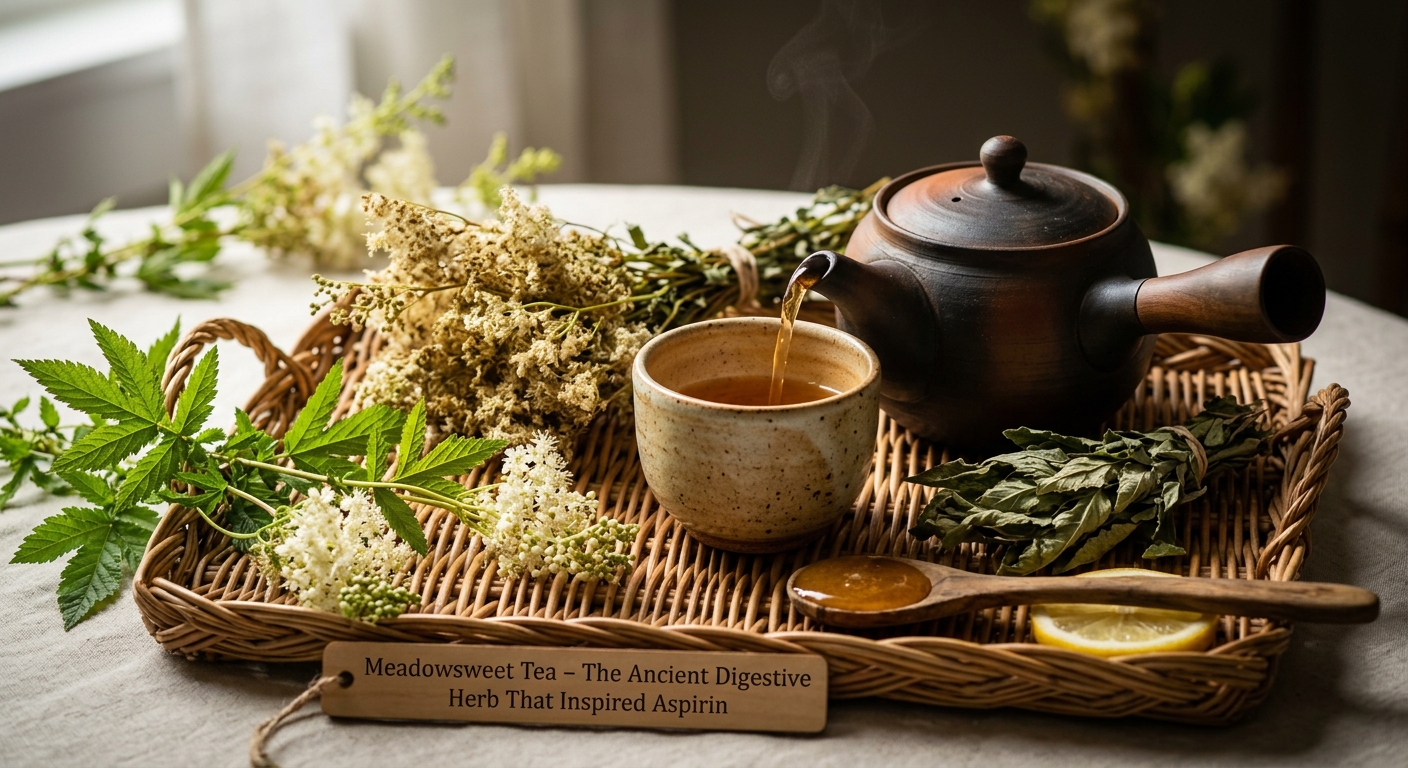
Long before the first aspirin tablet was manufactured by Bayer in 1899, meadowsweet was the plant that inspired it. The German chemist Felix Hoffmann synthesized acetylsalicylic acid partly by drawing on research into salicylates found in plants like meadowsweet, whose old botanical name Spirea ulmaria even gave aspirin its name. But unlike its pharmaceutical descendant, meadowsweet works gently with the body rather than against it. While aspirin can irritate the stomach lining, meadowsweet has long been used to soothe it, making it one of herbalism’s most fascinating paradoxes: a plant rich in aspirin-like compounds that actually protects the gut rather than inflaming it.
Meadowsweet (Filipendula ulmaria) is a tall, graceful perennial found growing in damp meadows, riverbanks, and hedgerows across Europe and western Asia. Its creamy white flower clusters have a distinctive sweet, almond-like fragrance, and the plant has been woven into European folk traditions for centuries. The ancient Celts held it as one of three sacred herbs alongside vervain and water mint. Medieval herbalists strewed it across floors to freshen rooms and laid it in bridal chambers for its intoxicating scent. Nicholas Culpeper, the 17th-century English herbalist, praised it for clearing the stomach and strengthening a weak digestion, and these traditional applications have since found meaningful scientific support.
Today, meadowsweet tea is experiencing a quiet revival among herbalists and wellness enthusiasts seeking natural, plant-based support for digestive health. Its dried flowers and leaves brew into a pale, golden cup with an aroma reminiscent of warm marzipan and fresh meadow grass. Sipped after a meal, it can help ease bloating, reduce excess acidity, and support the stomach’s protective mucous lining. Whether you come to it for its remarkable history, its gentle therapeutic action, or simply its exquisitely fragrant cup, meadowsweet is one of the most rewarding herbs to explore.
2
cups
Ingredients
- 2 tspdried meadowsweet flowers (or 3 tsp fresh flowers)
- 1 tspdried meadowsweet leaves (optional, adds body)
- 480 mlwater (85°C / 185°F)
- —raw honey to taste (optional)
- —slice of lemon (optional)
How to Brew
Click on an item below to shop for the recommended items for this recipe on Amazon.
As an Amazon Associate, we earn from qualifying purchases.
- Heat filtered water to 85°C (185°F). If you do not have a temperature-controlled kettle, bring water to a full boil and allow it to cool for 3 to 4 minutes before pouring.
- Place 2 teaspoons of dried meadowsweet flowers and 1 teaspoon of dried leaves per cup into a tea infuser, strainer, or teapot. The flowers carry the aroma and sweetness; the leaves add depth and additional tannins.
- Pour the hot water over the herb and cover your cup or teapot immediately with a lid or small saucer. Covering the brew traps the volatile aromatic compounds and prevents them from escaping with the steam.
- Steep for 7 to 10 minutes. For a lighter, more fragrant cup, steep closer to 7 minutes. For a fuller-bodied, more therapeutic infusion, allow the full 10 minutes.
- Remove the infuser and strain thoroughly. Taste before sweetening. Meadowsweet is naturally sweet, so many drinkers find honey unnecessary. Serve warm and sip slowly after a meal for best digestive results.
- Add 3 heaped teaspoons of dried meadowsweet flowers per 500 ml of water into a clean glass jar or cold brew pitcher. Cold brew extracts more slowly, so a slightly higher herb-to-water ratio ensures a well-developed flavor.
- Pour cold or room-temperature filtered water over the flowers. Do not use hot water, as this defeats the purpose of the cold brewing process and changes the extraction chemistry.
- Stir gently to ensure all plant material is submerged, then seal the jar with a lid. Allow it to sit at room temperature for 30 minutes to begin extraction, then transfer to the refrigerator.
- Refrigerate for 8 to 12 hours, or overnight. The long, slow, cold steep draws out meadowsweet’s sweeter, more soluble compounds while leaving behind some of the harsher tannins that hot water extracts.
- Strain through a fine mesh strainer or cheesecloth into a glass. Serve over ice, optionally garnished with a sprig of fresh mint or a slice of cucumber for a sophisticated digestive mocktail. Keeps refrigerated for up to 48 hours.
- On a warm, sunny day, add 4 teaspoons of dried meadowsweet flowers to a large, clean glass jar. A clear jar allows you to watch the gentle golden infusion develop as the sun does its work.
- Fill the jar with 700 ml of cold filtered water. Stir once to wet all the herb material, then seal the jar tightly with a lid.
- Place the sealed jar in direct sunlight, ideally on a south-facing windowsill or outdoors on a garden table. The warmth of the sun, staying well below boiling, gently encourages extraction without degrading the delicate volatile aromatic compounds.
- Steep for 3 to 5 hours, checking on it periodically. The tea is ready when it has turned a soft, pale gold and the floral almond fragrance is clearly present when you briefly open the lid.
- Strain the finished tea through a fine mesh strainer or muslin cloth. Transfer to the refrigerator to cool before serving. Serve over ice with a thin slice of lemon. Consume the same day for optimal freshness and safety.
Health Benefits
Meadowsweet’s mucilage and flavonoids work together to coat and protect the stomach lining from excess acid. Unlike conventional antacids, it addresses irritation at the tissue level rather than simply neutralizing stomach pH, making it particularly well-suited for chronic low-grade gastritis and heartburn.
Research into meadowsweet’s flavonoids, particularly spiraeoside and rutin, has demonstrated gastroprotective effects, including a reduction in ulcer formation in laboratory models. This finding aligns with centuries of traditional use and supports the herb as a genuine protector of stomach tissue integrity.
The combined action of salicylates, flavonoids, and tannins gives meadowsweet a broad anti-inflammatory profile within the gastrointestinal tract. It has been used traditionally to relieve discomfort associated with irritable bowel, nausea, and general digestive inflammation.
Meadowsweet helps reduce flatulence and bloating by calming gut motility and reducing gas-forming fermentation in the bowel. Its gentle antacid effect makes it a practical after-dinner herb for those prone to post-meal discomfort.
Rich in polyphenols including rutin, quercetin derivatives, and ellagitannins, meadowsweet tea provides meaningful antioxidant activity that helps protect gastrointestinal cells from oxidative stress, which plays a role in the development of chronic digestive conditions.
🧪 Key Bioactive Compounds
The Science Behind Meadowsweet
Meadowsweet’s remarkable ability to soothe the stomach while containing aspirin-like compounds is one of botanical medicine’s most compelling stories. The plant is rich in salicylate precursors, primarily salicylaldehyde and methyl salicylate, which are found predominantly in the essential oil of the flowers. These compounds contribute mild anti-inflammatory and analgesic effects, but crucially, they do not appear in the same bioavailable form as pharmaceutical acetylsalicylic acid. This distinction may explain why whole-plant meadowsweet preparations have historically been associated with gastric protection rather than gastric irritation: the complex matrix of mucilage, tannins, and flavonoids buffering the salicylates appears to fundamentally alter their behavior in the gut.
Among the most studied compounds in meadowsweet are its flavonoid glycosides, particularly spiraeoside (quercetin-4-glucoside) and rutin. A key study published in Phytotherapy Research found that meadowsweet flower extract significantly reduced ethanol-induced gastric ulcers in experimental models, with the flavonoid fraction identified as the primary gastroprotective agent. Spiraeoside in particular has demonstrated the ability to increase the production of prostaglandins that stimulate gastric mucus secretion, effectively reinforcing the stomach’s own protective lining. This mechanism is the biochemical basis for what traditional herbalists observed empirically over centuries of use.
The tannin content of meadowsweet, which includes ellagitannins and condensed tannins from the leaves, adds an important astringent dimension to the herb’s gut action. Tannins bind to proteins in the mucous membrane, creating a temporary tightening and toning effect on inflamed tissue. This action is particularly relevant in conditions involving loose stools, intestinal inflammation, or excess secretion. When combined with the herb’s mucilage, which coats and physically protects irritated epithelial cells, meadowsweet delivers a layered, complementary approach to digestive healing that no single isolated compound could replicate, illustrating the principle of herbal synergy that modern phytochemistry is only beginning to fully understand.
Brewing Tips
- Always cover your cup or pot while meadowsweet steeps. The most aromatic and therapeutically valuable volatile compounds, including salicylaldehyde, escape readily with steam and are lost if the brew is left uncovered.
- For digestive complaints, drink meadowsweet tea 15 to 20 minutes after a meal rather than during it. This timing allows the herb to reach the stomach when acid reflux or bloating is most likely to begin.
- Source meadowsweet flowers that are pale cream to white and still fragrant. Yellowed or scentless dried flowers have lost most of their essential oil content and will produce a flat, therapeutically diminished cup.