Peppermint and rosemary have both traveled a long road from the Mediterranean to the modern teacup. Peppermint is a natural hybrid of water mint and spearmint, and its leaves were found in Egyptian tombs dating back more than three thousand years. The Greeks and Romans wove it into crowns for feasts, rubbed it on tables to welcome guests, and sipped it to settle the stomach after rich meals. Rosemary, whose Latin name once meant ‘dew of the sea,’ grew wild along the sunny coastlines of southern Europe. Ancient Greek students reportedly wore rosemary garlands while studying, and Shakespeare’s Ophelia declared it ‘for remembrance,’ a line that captures centuries of folk belief about the herb and the mind.
What makes this pairing special is the way the two plants balance each other. Peppermint brings a cool, sweet, almost sparkling freshness, while rosemary adds a warm, woody, slightly camphorous depth that keeps the cup from tasting like plain mint candy. Together they create something that feels awake and grounded at the same time. Traditional herbalists reached for both plants when the mind felt foggy or the stomach felt heavy, which is a surprisingly common combination at the end of a long day.
Because neither herb contains caffeine, this blend fits neatly into an evening routine. It will not spike your heart rate or linger in your system until 2 a.m. Instead, it offers a quiet kind of invigoration: a sense of mental clarity and physical lightness that suits late reading, journaling, gentle study, or simply a calm transition from the busy day into the restful night.
2
cups
Ingredients
- 2 tbspdried peppermint leaves
- 1 tspdried rosemary needles, lightly crushed
- 480 mlwater (95°C / 203°F)
- —raw honey or a thin slice of lemon to taste (optional)
How to Brew
Click on an item below to shop for the recommended items for this recipe on Amazon.
As an Amazon Associate, we earn from qualifying purchases.
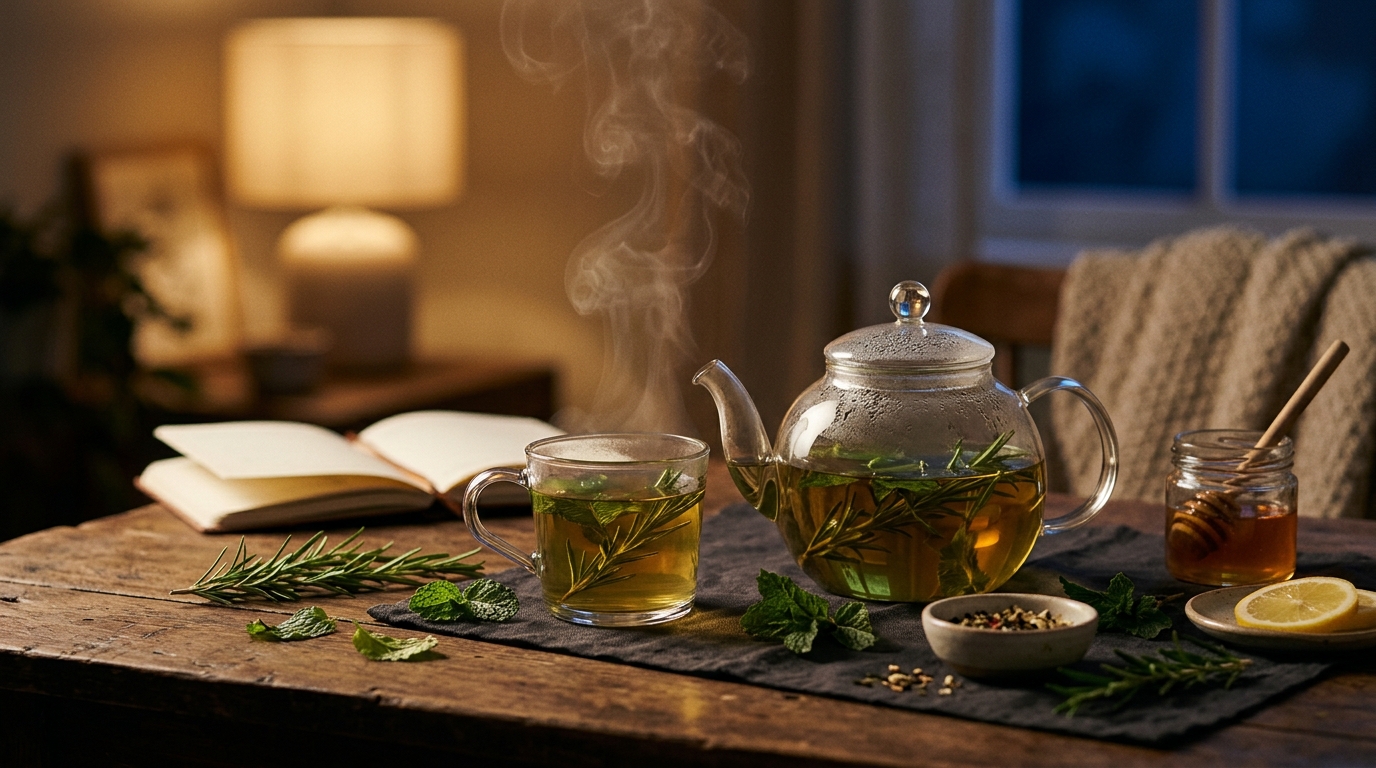
- Measure the dried peppermint and rosemary into a teapot or large mug. Rub the rosemary needles gently between your fingertips first to crack them slightly and release their oils.
- Bring fresh water to a full boil, then let it rest for about 30 seconds so it settles near 95°C (203°F). Water straight off a hard boil can make rosemary taste harsh and medicinal.
- Pour the hot water over the herbs, making sure all the leaves are submerged. Cover immediately with a lid or small saucer to trap the aromatic steam.
- Steep for 5 to 7 minutes. Taste at the 5-minute mark. Choose the shorter time for a lighter, mint-forward cup and the longer time for a more pronounced rosemary character.
- Strain through a fine mesh strainer into your cup, pressing the herbs lightly to extract the last of the liquid. Sweeten with honey or add a lemon slice if you like, and sip slowly while the aroma is at its peak.
- Add 3 tablespoons of dried peppermint and 1 teaspoon of lightly crushed dried rosemary to a clean glass jar. Cold water extracts more gently, so this ratio is slightly stronger than the hot method.
- Pour in 1 liter of cold, filtered water and stir once to wet all the herbs. Seal the jar with a tight lid.
- Place the jar in the refrigerator and steep for 8 to 12 hours. Overnight works perfectly, but avoid going past 14 hours, as the rosemary can begin to taste bitter and overly piney.
- Strain the tea through a fine mesh strainer or a coffee filter to remove every needle and leaf fragment, then transfer to a clean bottle or pitcher.
- Serve over ice or straight from the fridge in a chilled glass. The cold tea keeps well for up to 3 days when refrigerated.
- Combine 3 tablespoons of dried peppermint and 2 teaspoons of lightly crushed dried rosemary in a heatproof pitcher or measuring jug.
- Heat 240 ml of water to 95°C (203°F) and pour it over the herbs. This is a concentrate, so use only half the usual amount of water.
- Steep for exactly 4 minutes, keeping the pitcher covered. A short steep keeps the flavor lively and prevents the rosemary from dominating.
- Strain the concentrate into a second pitcher filled with 2 cups of ice cubes, stirring until the ice has mostly melted and the tea is fully chilled.
- Fill two tall glasses with fresh ice, pour the chilled tea over the top, and finish with a splash of sparkling water. Garnish with a fresh rosemary sprig and a lemon wheel.
Health Benefits
Rosemary’s aroma, particularly its 1,8-cineole content, has been linked to improved attention and memory performance in small human trials, while peppermint’s scent is associated with increased alertness. Neither herb contains caffeine, so the effect is gentle and does not interfere with sleep.
Menthol relaxes the smooth muscle of the gastrointestinal tract, which is why peppermint is well supported for bloating, gas, and cramping. A warm cup after dinner is one of the most traditional uses of this herb.
Rosmarinic acid, carnosic acid, and luteolin help neutralize free radicals in laboratory studies. While a cup of tea is not a medicine, these compounds contribute to a diet rich in plant polyphenols.
Topical and inhaled peppermint has some clinical support for easing tension-type headaches, and the steam from a hot cup can open the sinuses and relax tight facial muscles. Evidence for drinking the tea specifically is more limited, but many people find it comforting.
The ritual itself, along with the clean, cooling aroma, helps signal a shift in pace. It suits quiet evening tasks like reading or planning the next day without the jittery edge of coffee or black tea.
🧪 Key Bioactive Compounds
The Science Behind Peppermint
The effects of this blend rest largely on two families of compounds: the monoterpenes that give both herbs their scent, and the phenolic acids that give them antioxidant strength. Peppermint’s signature compound, menthol, binds to TRPM8 receptors on sensory nerves, which is why it feels cold on the tongue even when the tea is hot. In the gut, menthol blocks calcium channels in smooth muscle cells, producing a relaxing effect that is the basis for peppermint oil’s use in treating irritable bowel syndrome. Tea contains far less menthol than concentrated oil capsules, but a strong, well-covered infusion still delivers a meaningful amount of volatile oil.
Rosemary’s reputation for supporting memory has drawn modern research attention. In one frequently cited study, participants exposed to rosemary aroma performed better on certain memory tasks, and blood levels of 1,8-cineole correlated with performance. Researchers suggest this compound may influence acetylcholine, a neurotransmitter involved in learning and attention, by slowing its breakdown. These findings are promising but come from small trials, so rosemary is best seen as a gentle cognitive companion rather than a proven treatment.
Both plants are also rich in rosmarinic acid, a polyphenol named after rosemary though abundant in the mint family as well. It shows antioxidant and anti-inflammatory activity in laboratory and animal studies. Because tea is a water-based extraction, it captures a good portion of these compounds, along with the volatile oils when brewed under a lid. Importantly, since neither plant contains caffeine, the alertness people report likely comes from aroma-driven sensory stimulation and the ritual of a warm, flavorful cup rather than from any stimulant effect on the central nervous system.
Brewing Tips
- Use whole or coarsely broken dried peppermint leaves rather than fine powder in bags when possible, since larger pieces retain more volatile oil and give a cleaner flavor.
- Go easy on the rosemary. Too much quickly turns the cup medicinal and resinous, so start with 1 teaspoon per 480 ml and adjust upward only if you want a bolder taste.
- Always steep under a lid, even for a single mug. A small saucer works perfectly and noticeably improves the aroma and potency of the finished tea.
- If you grow your own herbs, use a small handful of fresh peppermint and one 5 cm sprig of fresh rosemary per cup, and bruise them lightly before steeping.