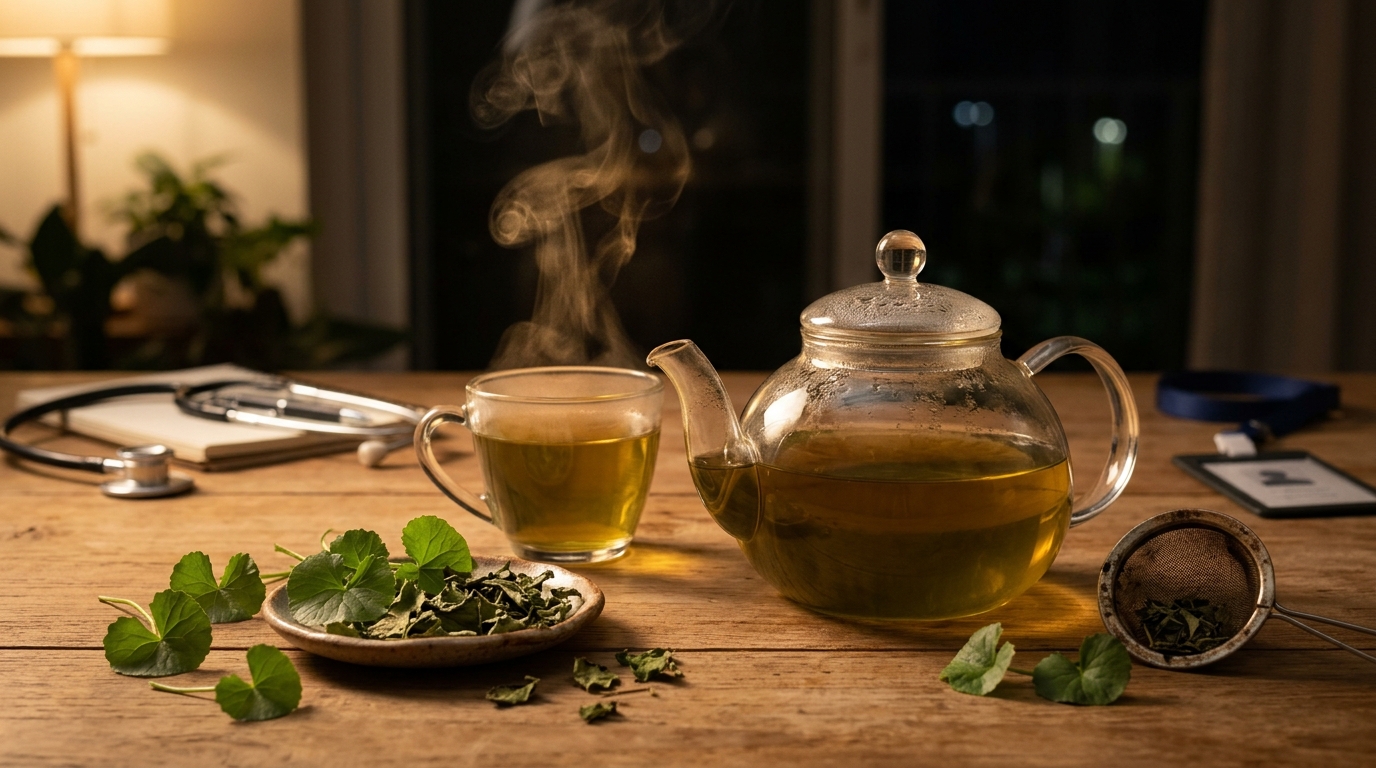
Few herbs carry as much quiet reverence as gotu kola. Known in Sanskrit as mandukaparni and in Sinhalese folklore as the herb that elephants eat to live long, Centella asiatica has been used for thousands of years across India, Sri Lanka, Indonesia, and China. In Ayurveda it is classified as a medhya rasayana, a rejuvenative for the mind, and traditional practitioners reached for it to support memory, concentration, and nervous system balance. In Traditional Chinese Medicine it is called ji xue cao, valued for cooling and soothing the body.
The plant itself is humble, a low-growing creeper with small, fan-shaped, scalloped leaves that thrive in damp, tropical ground. Do not confuse it with kola nut (Cola nitida), which contains caffeine. Gotu kola is completely caffeine-free, which is precisely what makes it so appealing for people who work through the night. A cup of caffeinated tea at 3 a.m. may get you through a shift, but it can leave you wired and unable to sleep when you finally get home. Gotu kola takes a different path, supporting alert but relaxed focus rather than stimulation.
For night shift nurses, security staff, bakers, truckers, and anyone whose schedule runs against the sun, an evening cup before or during the first half of a shift can become a grounding ritual. The flavor is mild, grassy, and faintly bitter, with a green, almost celery-like depth. Paired with a little mint or lemon balm and a touch of honey, it becomes a comforting, restorative brew for the small hours.
2
cups
Ingredients
- 2 tspdried gotu kola leaf
- 1 tspdried peppermint or lemon balm leaf (optional, for flavor)
- 480 mlwater (95°C / 203°F)
- —raw honey to taste (optional)
- —a thin slice of fresh ginger (optional)
How to Brew
Click on an item below to shop for the recommended items for this recipe on Amazon.
As an Amazon Associate, we earn from qualifying purchases.
- Bring fresh, filtered water to a full boil, then let it rest for about 30 seconds so it settles near 95°C (203°F). Gotu kola is a leafy herb, so you want hot water but not a violent rolling boil.
- Measure the dried gotu kola leaf and any optional mint or lemon balm into a teapot or large infuser. Crush the leaves gently between your fingers first to help release their compounds.
- Pour the hot water over the herbs, cover immediately with a lid or saucer, and steep for 7 to 10 minutes. The longer end gives a stronger, more bitter, more medicinal cup.
- Strain into two mugs, pressing the herbs lightly against the strainer to extract the last of the liquid.
- Sweeten with a little raw honey if desired and sip slowly, ideally 30 to 60 minutes before the start of your shift or during your first break.
- Add 4 teaspoons of dried gotu kola leaf and 1 teaspoon of peppermint to a clean glass jar. You use a slightly higher ratio here because cold water extracts more slowly.
- Pour in 1 liter of cold, filtered water, stir once, and seal the jar with a lid.
- Refrigerate for 8 to 12 hours, or overnight. Because you are working nights, set it up before you sleep during the day so it is ready when you wake.
- Strain through a fine mesh sieve or cheesecloth into a clean bottle, discarding the spent leaves.
- Serve over ice or straight from the fridge. Add a squeeze of lemon or a slice of cucumber for brightness. Drink within 24 hours for best freshness.
- Combine 2 teaspoons of dried gotu kola leaf, a thin slice of fresh ginger, and 500 ml of cold water in a small saucepan.
- Bring slowly to a gentle simmer over medium-low heat. Avoid a hard boil, which can make the tea harshly bitter.
- Reduce the heat to low, partially cover, and simmer for 10 to 15 minutes until the liquid is a deeper golden green and reduced slightly.
- Remove from the heat, add any optional lemon balm or mint, cover, and let rest for 5 minutes.
- Strain into a warmed mug or thermos. Stir in a teaspoon of honey and, if you like, a splash of warm milk or oat milk for a rounder, more soothing cup.
Health Benefits
Small human studies suggest gotu kola may reduce the startle response and ease subjective anxiety while preserving alertness, likely through modulation of GABA-related pathways. This is why it is traditionally described as calming without being sedating.
Research in older adults and animal models points to improved working memory and mood with Centella extracts, with triterpenoids such as asiatic acid showing neuroprotective activity. Evidence is promising but still early, and most trials use concentrated extracts rather than tea.
Classified in Ayurveda as a nervine and adaptogen-like herb, gotu kola is traditionally used to steady the nervous system during demanding periods. Preliminary research supports a mild anxiolytic effect, which may help with the cumulative strain of irregular schedules.
Centella extracts have been studied for chronic venous insufficiency, where they appear to improve vein tone and reduce swelling and heaviness. Nurses and other workers who spend long hours on their feet may find this traditional use especially relevant, though tea is milder than clinical extracts.
Its flavonoids and triterpenoids show antioxidant and anti-inflammatory activity in laboratory studies, which may contribute to its broad traditional reputation as a restorative herb.
🧪 Key Bioactive Compounds
The Science Behind Gotu Kola
Gotu kola’s reputation rests largely on a family of compounds called triterpenoid saponins, chiefly asiaticoside, madecassoside, asiatic acid, and madecassic acid. These molecules are concentrated in the leaves and are the focus of most modern Centella research. In cell and animal studies, they have shown the ability to reduce oxidative stress, calm inflammatory signaling, and protect neurons from damage. Some work also suggests they may influence neurotrophic factors involved in the growth and maintenance of nerve cells.
The plant’s calming-yet-clear quality may come from its interaction with the brain’s GABA system, the same inhibitory network targeted by many anti-anxiety agents. A small clinical study found that a single dose of gotu kola reduced the acoustic startle response in healthy volunteers, a physiological marker of anxiety, without producing noticeable sedation. Other trials in older adults have reported improvements in mood and certain measures of cognition, although effects vary and doses were often higher than a single cup of tea provides.
It is worth being honest about the limits of the evidence. Much of the supportive research uses standardized extracts, and the concentration of active triterpenoids in a home-brewed tea is lower and less predictable. Tea is best viewed as a gentle, supportive ritual rather than a clinical-strength remedy. Its real strength for shift workers may lie in the combination of mild nervine action, a caffeine-free routine, and the grounding comfort of a warm cup in the quiet hours of the night.
Brewing Tips
- Time your cup about 30 to 60 minutes before your shift or during your first break, rather than at the end, so it supports focus when you need it most.
- Buy dried gotu kola leaf that is green and fragrant, not brown and dusty, and store it in an airtight, opaque container away from light and heat.
- Start with one cup a day to see how your body responds, and take regular breaks from the herb every few weeks instead of drinking it nonstop.
- Prepare a batch of cold brew before your daytime sleep so a ready-to-drink bottle is waiting when you wake up for your next shift.