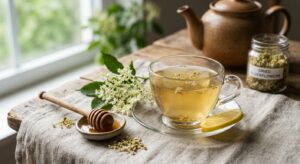
Valerian has been a trusted companion of restless sleepers for well over two thousand years. Hippocrates described its properties in ancient Greece, and Galen later prescribed it for insomnia. By the Middle Ages, European herbalists were weaving it into folk remedies for nervous agitation, and in the 16th century it earned the nickname “all-heal” across much of the continent. Its Latin root, valere, means “to be strong or healthy.”
The plant itself is deceptively lovely, producing clusters of tiny pale pink and white flowers on tall stems. But the real magic (and the famous smell) lives underground. The dried root has a deep, musky, almost cheesy aroma that people either learn to love or tolerate. Folklore even claims cats go wild for it, and the Pied Piper of Hamelin was said to have carried valerian root in his pockets to lure the rats from town.
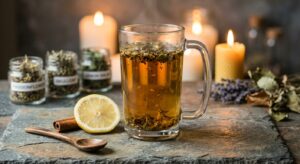
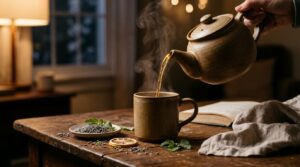
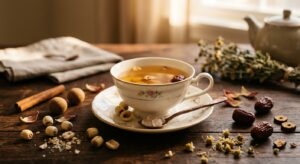
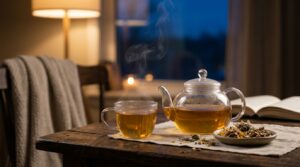
What makes valerian special is its reputation as a gentle sedative that does not leave most people groggy the next morning. Drinking it as a tea turns the whole process into a ritual: the warm cup, the strong earthy steam, the deliberate slowing down. For many, that ritual becomes as calming as the herb itself, signaling to a busy mind that the day is finished.
2
cups
Ingredients
- 2 tspdried valerian root, roughly chopped or cut
- 480 mlwater (95°C / 203°F)
- 1 tspdried lemon balm (optional, to soften the flavor)
- —raw honey to taste (optional)
- —a slice of fresh orange peel or a cinnamon stick (optional)
How to Brew
Click on an item below to shop for the recommended items for this recipe on Amazon.
As an Amazon Associate, we earn from qualifying purchases.
- Measure 2 teaspoons of dried valerian root into a tea infuser or a small teapot. Roughly chopped root works best because it exposes more surface area than whole pieces.
- Heat fresh water until it just comes to a boil, then let it rest for about 30 seconds so it settles near 95°C (203°F).
- Pour the hot water over the valerian root and immediately cover the vessel with a saucer or lid to keep the volatile oils from escaping with the steam.
- Steep for 10 to 15 minutes. Valerian is a root, so it needs more time than delicate leaves or flowers. Ten minutes gives a milder cup, fifteen a stronger, more medicinal one.
- Remove the infuser or strain the tea into your mug. Stir in honey or add lemon balm during the last 5 minutes of steeping if you want to soften the earthy flavor.
- Sip slowly about 30 to 45 minutes before bed, ideally in dim light and away from screens.
- Combine 2 tablespoons of dried valerian root with 1 liter of cold, filtered water in a clean glass jar. The ratio is higher than hot brew because cold water extracts more slowly.
- Stir gently to make sure all the root is submerged, then seal the jar with a tight lid.
- Place the jar in the refrigerator and let it steep for 8 to 12 hours, or overnight. Give it a gentle swirl once or twice if you happen to open the fridge.
- Strain the tea through a fine mesh sieve or a coffee filter to remove all the root particles, since small bits can continue extracting and turn bitter.
- Pour into a glass over ice, or drink it chilled as is. Add a squeeze of lemon, a few mint leaves, or a drizzle of honey to round out the earthy notes.
- Store any leftover cold brew in a sealed container in the refrigerator for up to 2 days.
- Add 1 tablespoon of dried valerian root to a small saucepan with 500 ml of cold water. Starting with cold water lets the root hydrate slowly and release its compounds gradually.
- Bring the water slowly to a gentle simmer over medium-low heat. Avoid a rolling boil, which can drive off the delicate volatile oils.
- Cover the saucepan with a lid, reduce the heat to low, and simmer gently for 15 to 20 minutes, until the liquid has reduced slightly and turned a deep amber.
- Remove the pan from the heat and let it sit covered for another 10 minutes so the flavors settle and the tea cools to a comfortable drinking temperature.
- Strain through a fine mesh sieve into a mug, pressing the root gently with the back of a spoon to release the last of the liquid.
- Sweeten with honey, a pinch of cinnamon, or a few drops of vanilla to balance the strong, earthy bitterness.
Health Benefits
Several clinical studies and meta-analyses suggest valerian can modestly reduce the time it takes to fall asleep, likely through its action on GABA signaling in the brain. Results vary between individuals and between preparations.
Participants in multiple trials report feeling that they slept more deeply and woke less often, even when objective measurements show only small changes. This perceived improvement is a large part of why valerian remains popular.
Valerian’s GABA-modulating compounds appear to reduce physiological arousal, helping quiet a racing mind. Small studies suggest benefits for mild stress, though larger trials are still needed.
Traditionally used for nervous agitation, valerian has been studied for restless legs and general physical tension, with some early evidence suggesting it may help muscles relax before sleep.
Unlike prescription sedatives, valerian has not been shown to cause dependence at typical doses. Pairing the tea with a consistent bedtime routine reinforces healthy sleep cues.
🧪 Key Bioactive Compounds
The Science Behind Valerian Root
The sedative reputation of valerian rests mainly on a group of compounds working together rather than a single active ingredient. Valerenic acid, found in the root’s essential oil, appears to bind to a specific site on the GABA-A receptor, the same receptor family targeted by many anti-anxiety medications, though far more gently. It may also slow the breakdown of GABA itself, leaving more of this calming neurotransmitter available in the brain.
Other constituents add to the picture. Flavonoids such as linarin and 6-methylapigenin appear to act on benzodiazepine-like and adenosine receptors, while the valepotriates contribute sedative activity but degrade rapidly when exposed to heat, moisture, and time. This instability is one reason that different valerian products can vary so much in strength, and why freshness of the dried root matters.
The clinical evidence is mixed but cautiously encouraging. Some systematic reviews report modest improvements in subjective sleep quality, while others find results inconsistent, largely because studies use different doses, extracts, and durations. Many researchers note that valerian seems to work best when taken regularly for two to four weeks rather than as a one-off remedy. Tea delivers a milder dose than concentrated extracts, so it is best viewed as a gentle, ritual-friendly support for sleep, not a powerful sedative.
Brewing Tips
- Buy valerian root from a reputable supplier and check that it smells strongly earthy; a faint or stale smell usually means the volatile oils have faded.
- Store dried valerian in an airtight, opaque container away from heat and light to protect the delicate valepotriates and essential oils.
- Drink your cup 30 to 45 minutes before bed and make it part of a consistent routine, since the ritual itself reinforces sleep cues.
- If the smell is too much, blend the root with lemon balm, chamomile, or peppermint rather than adding more sweetener.
- Give it two to four weeks of regular use before judging whether valerian works for you, since effects often build gradually.