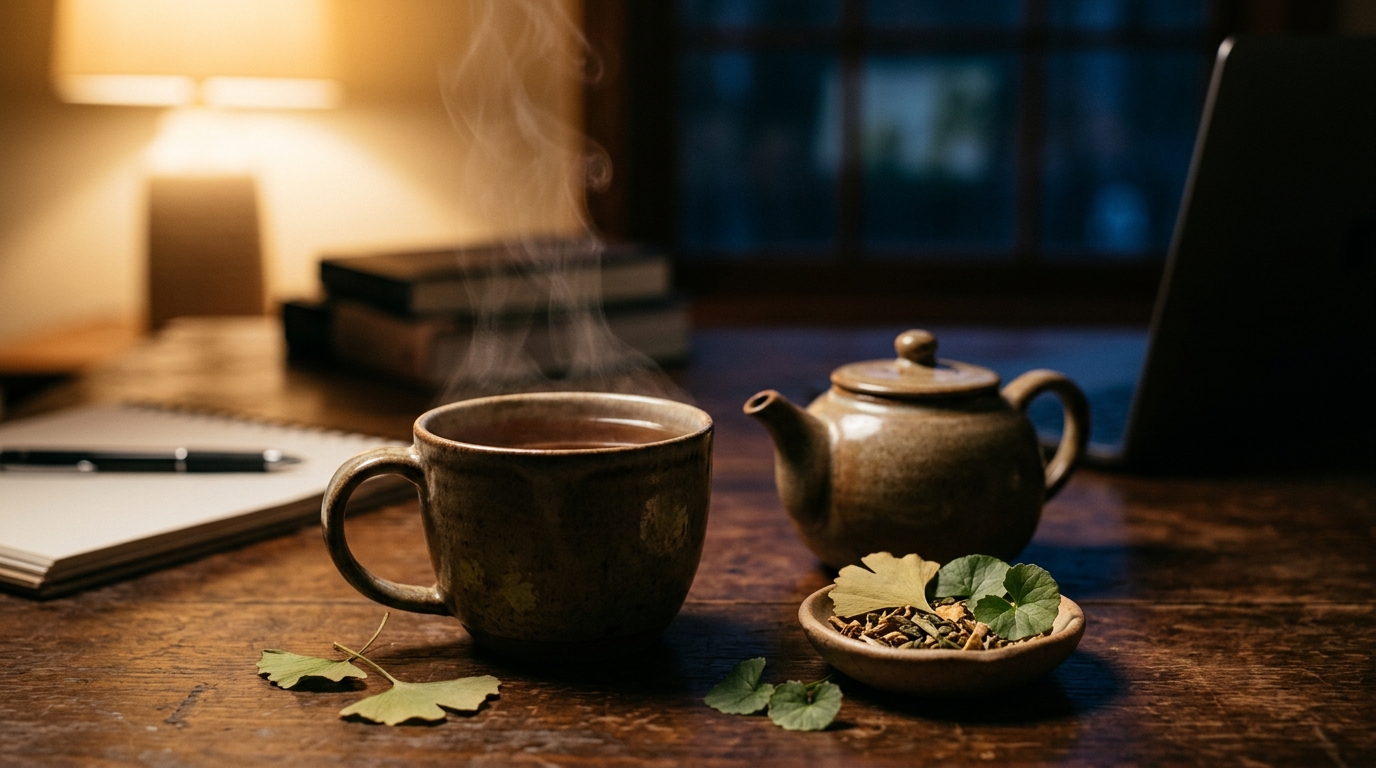
Ginkgo biloba is often called a living fossil. Fossils of its leaves date back more than 200 million years, and a single tree can live for over a thousand years. In Chinese medicine, ginkgo seeds have been used for centuries for respiratory complaints, while the leaves became a subject of modern research in the twentieth century, particularly in Germany and France, where standardized leaf extracts are widely studied for circulation and cognitive support. As a tea, the dried leaf is mild, slightly woody, and faintly bitter, with a golden color that hints at its flavonoid content.
Gotu kola (Centella asiatica) has a different story. It is a creeping, round-leaved plant that grows in damp places across Asia and Africa. In Ayurveda it is known as mandukaparni and is classed among the medhya rasayanas, herbs traditionally taken to sharpen memory and steady the mind. Sri Lankan folklore says elephants, famed for their memories and long lives, feed on its leaves. In Traditional Chinese Medicine it appears as ji xue cao. Its taste is green, grassy, and slightly bitter, a bit like a cross between parsley and cooked spinach.
For people who work nights, the challenge is rarely just staying awake. It is staying clear-headed without leaning on heavy caffeine that will wreck the daytime sleep that follows. This blend takes a different approach. Neither herb contains caffeine, and both have traditional and modern research associations with circulation, mental clarity, and a calm, attentive state. Think of it as a ritual as much as a remedy: a warm, deliberate cup at the start of your shift that signals your mind to settle into focus.
2
cups
Ingredients
- 2 tspdried ginkgo leaf, cut and sifted
- 2 tspdried gotu kola leaf
- 500 mlwater (90°C / 194°F)
- —a slice of fresh ginger or a pinch of dried peppermint (optional)
- —raw honey or a squeeze of lemon to taste (optional)
How to Brew
Click on an item below to shop for the recommended items for this recipe on Amazon.
As an Amazon Associate, we earn from qualifying purchases.
- Measure 2 teaspoons of dried ginkgo leaf and 2 teaspoons of dried gotu kola leaf into a teapot or large infuser basket. If your leaves are large, crumble them gently between your fingers so more surface area is exposed to the water.
- Heat fresh water to just off the boil, about 90 to 95°C (194 to 203°F). Boil, then let it rest for about a minute so the water does not scorch the delicate gotu kola.
- Pour 500 ml of hot water over the herbs and cover immediately. Steep for 7 to 10 minutes. The longer end of the range gives a stronger, more bitter cup that suits the start of a long shift.
- Strain into mugs, pressing the herbs lightly against the infuser to release the last of the liquid. The tea should be pale gold with a green tint.
- Sip slowly while you settle in to work. Add a little honey or lemon if the bitterness is stronger than you like, though many people enjoy it plain.
- Combine 3 tablespoons of dried ginkgo leaf and 3 tablespoons of dried gotu kola leaf in a large glass jar. Cold extraction is gentler, so this ratio is higher than the hot method.
- Pour 1 liter of cool filtered water over the herbs and stir once to wet all the leaf material. Seal the jar with its lid.
- Leave on the counter for 1 hour to let the leaves begin to hydrate, then transfer to the refrigerator for 8 to 12 hours.
- Strain through a fine mesh sieve or a coffee filter into a clean bottle or pitcher. Press the leaves lightly to extract the remaining liquid.
- Serve over ice with a lemon wedge or a sprig of fresh mint. Keep refrigerated and drink within 48 hours.
- Add 2 teaspoons of dried ginkgo leaf to a small saucepan with 500 ml of cold water. Starting with cold water allows the tougher leaf to release its compounds gradually.
- Bring to a bare simmer over medium-low heat. Reduce the heat as soon as small bubbles appear and keep the liquid just below a boil for 10 minutes, uncovered or partly covered.
- Remove the pan from the heat. Stir in 2 teaspoons of dried gotu kola leaf and cover with a lid. Let it steep for 5 minutes so the gotu kola infuses without turning harsh.
- Strain through a fine mesh sieve into a warmed mug or small thermos. The liquid will be a deeper gold than the hot brew and slightly more robust.
- Add a thin slice of fresh ginger during the simmer if you want a warming, slightly spicy edge. This version holds heat well in a thermos for a long shift.
Health Benefits
Ginkgolides help reduce platelet aggregation and flavonoids support vessel function, which together may improve peripheral and cerebral blood flow. Gotu kola’s triterpenes have also been studied for improving microcirculation and vein health.
Standardized ginkgo extract has shown modest benefits for attention and memory in some trials, particularly in older adults, though results vary. Gotu kola has traditional use as a memory herb and small human studies suggest benefits for alertness and mood.
Gotu kola is classified as an adaptogen-like nervine in traditional systems, and preliminary research suggests it may reduce the acoustic startle response and ease anxiety. This pairs well with ginkgo’s circulatory effects for a focused but unjittery state.
Both herbs contain flavonoids and triterpenoids with free-radical scavenging activity. This may help counter oxidative stress, a concern for night workers whose disrupted circadian rhythms are linked to higher oxidative load.
Asiaticoside and madecassoside from gotu kola stimulate collagen synthesis in laboratory studies, which is why the herb is widely used in topical wound-healing preparations and may contribute modest systemic benefits.
🧪 Key Bioactive Compounds
The Science Behind Ginkgo Leaf
Ginkgo leaf’s most distinctive compounds are the ginkgolides and bilobalide, terpene lactones found in almost no other plant. Ginkgolide B inhibits platelet-activating factor, a signaling molecule involved in clotting and inflammation, which helps explain ginkgo’s association with improved blood flow. The leaf is also rich in flavonol glycosides such as quercetin, kaempferol, and isorhamnetin, which act as antioxidants. Most clinical trials use a concentrated, standardized extract (often labeled EGb 761), so the effects of a simple leaf tea are likely gentler and should be viewed as supportive rather than therapeutic.
Gotu kola’s activity centers on a group of triterpenoid saponins called centellosides, including asiaticoside, madecassoside, asiatic acid, and madecassic acid. In laboratory and animal studies these compounds promote collagen synthesis, support nerve cell survival, and modulate inflammation. A small number of human studies have found that gotu kola extract may improve mood and reduce anxious responses, and one trial noted improved working memory in older adults. As with ginkgo, the evidence is promising but preliminary, and the dosages used in studies often exceed what a cup of tea delivers.
Why combine them? The pairing reflects a logic found in both Ayurvedic and modern herbalism: one herb supports the delivery of blood and oxygen to the brain, while the other supports the nervous system itself and tempers anxiety. For night workers, who face irregular circadian rhythms and elevated stress, a caffeine-free blend that supports alertness through circulation and calm rather than stimulation can be a useful alternative. It will not replace sleep or override fatigue, but it can make a long night feel steadier.
Brewing Tips
- Brew this tea 30 to 45 minutes before the most demanding part of your shift so the herbs have time to take effect, and avoid drinking it within a few hours of the sleep you plan to take afterward.
- Store both dried herbs in airtight, opaque containers away from light and heat. Gotu kola in particular loses its green color and potency quickly when exposed to air.
- If the bitterness is too strong, shorten the steep to 5 minutes or add a small amount of dried licorice root or a teaspoon of honey to round out the flavor.
- Look for organic, cut-and-sifted ginkgo leaf and gotu kola from reputable suppliers, since both are sometimes sourced from areas with heavy-metal contamination or heavy pesticide use.
- Take a break from this blend every few weeks, such as one week off after six weeks on, to give your body a rest and to reassess whether you still notice a benefit.