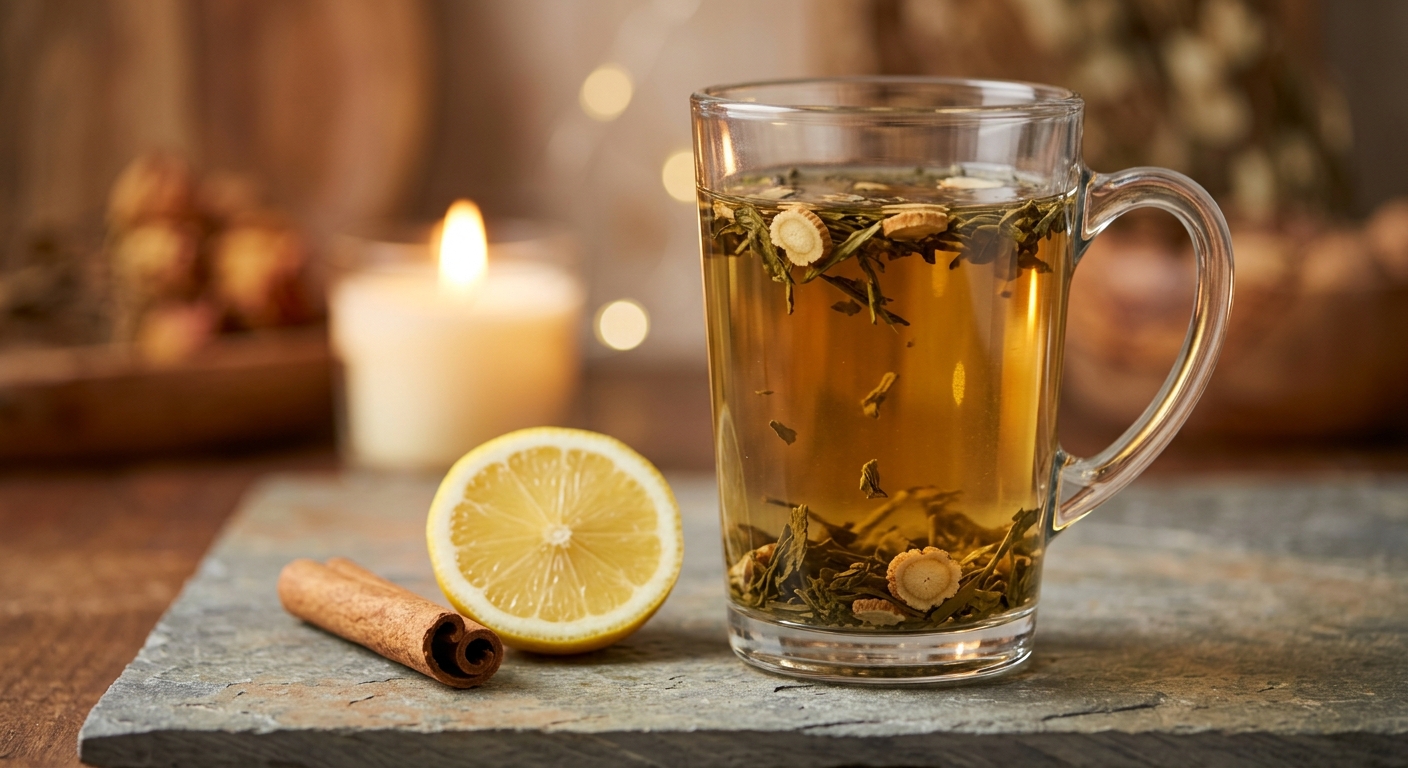
Few herbal pairings carry the combined weight of tradition and modern science that ginseng and green tea share. Ginseng, revered for over 2,000 years in Chinese, Korean, and Japanese medicine, was described in ancient texts as a root capable of replenishing vital energy, brightening the mind, and fortifying the body against fatigue. Green tea, cultivated in China since the Tang Dynasty and later adopted as a cornerstone of Japanese culture, was prized by monks, scholars, and warriors alike for its ability to sustain alert, calm concentration during long hours of meditation or study. When these two ingredients are combined in a single cup, the result is something greater than either achieves alone.
What makes this blend so compelling is the elegant interplay of its active compounds. Ginseng’s ginsenosides work through the adrenal axis to regulate cortisol and support the body’s natural stress response, while green tea’s L-theanine smooths out any stimulant edge, promoting a focused state of relaxed wakefulness. The modest caffeine in green tea provides a gentle lift that is modulated, rather than amplified, by the adaptogenic action of ginseng. This synergy is one reason the blend has been a staple in East Asian wellness traditions for centuries and why it is now gaining renewed attention from researchers studying cognitive performance and physical endurance.
Beyond its functional benefits, this tea is a pleasure to drink. Brewed well, it offers layered complexity: the clean, grassy brightness of quality green tea undercut by the subtle warmth and slight bitterness of ginseng root, with a finish that lingers gently on the palate. Whether you are preparing for a demanding workday, heading into a training session, or simply seeking a mindful morning ritual that does more than caffeinate, this blend rewards attention and repays the small effort of brewing it properly.
2
cups
Ingredients
- 2 tsploose-leaf green tea (sencha or dragonwell recommended)
- 1 tspdried ginseng root slices (or 1 g ginseng powder)
- 480 mlwater (75 to 80°C / 167 to 176°F for hot brew)
- —raw honey or rock sugar to taste (optional)
- —a few drops of fresh lemon juice (optional, brightens the flavor)
How to Brew
Click on an item below to shop for the recommended items for this recipe on Amazon.
As an Amazon Associate, we earn from qualifying purchases.
- Bring 480 ml of filtered water to a full boil, then remove from heat and allow it to cool for 3 to 5 minutes until it reaches 75 to 80°C (167 to 176°F). A kitchen thermometer gives the best accuracy here.
- If using dried ginseng root slices, add them to your infuser or teapot first and pour just enough cooled water over them to pre-wet the roots. Let them sit for 30 seconds. This softens the root and encourages the ginsenosides to begin releasing before the green tea is added.
- Add the loose-leaf green tea to the infuser alongside the ginseng. Place the infuser in your warmed mug or teapot. To warm your vessel, swirl a small amount of hot water inside and discard it before brewing.
- Pour the 75 to 80°C water over the herbs in a slow, circular motion to ensure even saturation. Place a small saucer or lid over your mug to trap the volatile aromatic compounds.
- Steep for 3 minutes for a lighter, more delicate cup, or extend to 5 minutes for a bolder, more pronounced ginseng character. Do not exceed 5 minutes or the green tea will become astringent.
- Remove the infuser, add honey or a drop of lemon juice if desired, and drink while warm. For best results, consume this blend in the morning or early afternoon rather than close to bedtime.
- Measure 2 teaspoons of loose-leaf green tea and 1 teaspoon of dried ginseng root slices into a clean glass jar. There is no need to pre-wet the herbs for cold brew.
- Pour 480 ml of room temperature filtered water over the herbs. Stir gently to ensure all the plant material is submerged and moistened.
- Seal the jar with a lid and place it in the refrigerator. Allow it to steep for a minimum of 8 hours and up to 12 hours. Steeping beyond 12 hours can introduce a slightly tannic quality even at cold temperatures.
- When ready, strain the liquid through a fine mesh strainer or cheesecloth into a glass, pressing gently on the ginseng pieces to extract their full content.
- Serve over ice. Sweeten lightly with a small amount of honey dissolved in warm water first (a simple syrup made with honey works best, as honey does not dissolve easily in cold liquid). Garnish with a thin lemon slice if desired.
- Place 1.5 teaspoons of dried ginseng root slices (or 3 to 4 grams of whole sliced root) into a small saucepan with 600 ml of cold filtered water. Starting in cold water allows a more gradual and complete extraction of the root’s complex saponins.
- Bring the water slowly to a gentle simmer over medium-low heat. Do not boil aggressively. Maintain a low, steady simmer at around 90 to 95°C (194 to 203°F) for 20 minutes. The liquid will reduce and take on a pale amber color with a distinctly earthy, warm aroma.
- Remove the saucepan from the heat and allow the decoction to cool undisturbed for 5 to 7 minutes until the temperature drops to approximately 75 to 80°C (167 to 176°F). This step is critical to protect the green tea in the next stage.
- Strain the ginseng decoction into a warmed teapot, discarding the spent root pieces. Add 2 teaspoons of loose-leaf green tea directly into the strained liquid or into an infuser placed in the teapot.
- Steep the green tea in the ginseng decoction for exactly 3 minutes. The already-extracted ginseng liquid will infuse with the fresh grassy brightness of the green tea, creating a layered, complex cup with depth from the root and freshness from the tea.
- Pour into cups, add raw honey to taste, and serve immediately. This method yields a more concentrated brew, so you may wish to slightly dilute each cup with a small splash of hot water.
Health Benefits
The combination of L-theanine and caffeine from green tea is among the most studied cognitive pairings in nutritional science, with trials consistently showing improvements in attention, reaction time, and working memory. Ginseng ginsenosides layer on additional nootropic effects by supporting neurotransmitter balance and cerebral glucose metabolism, resulting in focus that tends to outlast what caffeine alone provides.
Ginseng is classified as a true adaptogen, meaning its compounds help normalize the body’s stress response regardless of the direction of imbalance. Studies on Panax ginseng show that regular consumption can reduce circulating cortisol levels and improve the hypothalamic-pituitary-adrenal axis function, helping the body handle both physical and psychological stressors more effectively.
Multiple clinical trials, including a notable 2013 study published in the Journal of the International Society of Sports Nutrition, found that Panax ginseng supplementation significantly reduced feelings of fatigue and improved physical performance in healthy adults. When paired with the mild stimulant action of green tea caffeine, this blend may support sustained physical output during exercise or demanding work.
Green tea’s EGCG is one of the most potent naturally occurring antioxidants identified, capable of neutralizing free radicals and reducing oxidative stress markers in the bloodstream. Ginseng’s polysaccharides and saponins contribute complementary antioxidant and anti-inflammatory activity, offering meaningful protection against cellular aging and inflammation-related conditions.
Both green tea and ginseng have been independently studied for their immunomodulatory effects. Ginseng polysaccharides have been shown to enhance natural killer cell activity and macrophage function, while EGCG from green tea has demonstrated antiviral properties in laboratory settings. Together, they may help prime the immune system for more effective daily defense.
🧪 Key Bioactive Compounds
The Science Behind Ginseng
The scientific case for this blend begins with the ginsenosides, a family of over 100 identified triterpenoid saponins unique to the genus Panax. The two most studied, Rg1 and Rb1, exert opposing yet complementary effects on the central nervous system. Rg1 behaves as a mild stimulant by upregulating dopamine and serotonin pathways and enhancing nerve growth factor expression, supporting both immediate cognitive performance and longer-term neuroplasticity. Rb1, by contrast, has a calming, neuroprotective action, reducing excitotoxicity and stabilizing mood. This internal balance within the root itself is part of what defines ginseng as an adaptogen: rather than pushing the system in one direction, it tends to normalize it.
Green tea contributes two compounds that have been studied extensively in combination: caffeine and L-theanine. While caffeine blocks adenosine receptors to reduce fatigue signals and sharpen alertness, L-theanine simultaneously promotes alpha-wave brain activity, the same relaxed-but-focused state associated with meditation. A landmark double-blind, placebo-controlled study published in Biological Psychology found that the combination of these two compounds produced significantly greater improvements in attention and reaction time than either compound alone. This synergistic relationship means that even the modest caffeine content of green tea, roughly 20 to 35 mg per cup, can produce pronounced cognitive effects when L-theanine is present in the right ratio.
The antioxidant layer provided by EGCG adds a dimension that extends beyond immediate energy and focus. EGCG has been shown in cell and animal studies to cross the blood-brain barrier and exert neuroprotective effects, scavenging reactive oxygen species that can damage neurons over time. It also supports endothelial function in cerebral blood vessels, improving the delivery of oxygen and glucose to brain tissue. When the ginsenosides’ mitochondrial support and EGCG’s vascular effects are combined, the result is a cup that appears to support not just today’s focus but the longer-term health of the cognitive architecture that makes focus possible.
Brewing Tips
- Always use filtered water for this blend. Chlorinated tap water can react with the delicate catechins in green tea and produce a flat, slightly chemical taste that masks the nuanced flavor of the ginseng.
- Source your ginseng carefully. Korean red ginseng (Panax ginseng that has been steamed and dried) has a stronger, more robust flavor and higher ginsenoside concentration than white or American ginseng, making it better suited to the decoction method. For the hot or cold brew, white ginseng root slices or a light Korean ginseng tea bag will integrate more gently with the green tea.
- Do not rebrew the ginseng root after a single hot steep and discard it. Ginseng roots, particularly when using whole slices, can yield a second or even third steeping with meaningful ginsenoside content remaining. Simply re-steep the root alone with fresh cooled water for 5 to 7 minutes to extract a lighter follow-up cup.