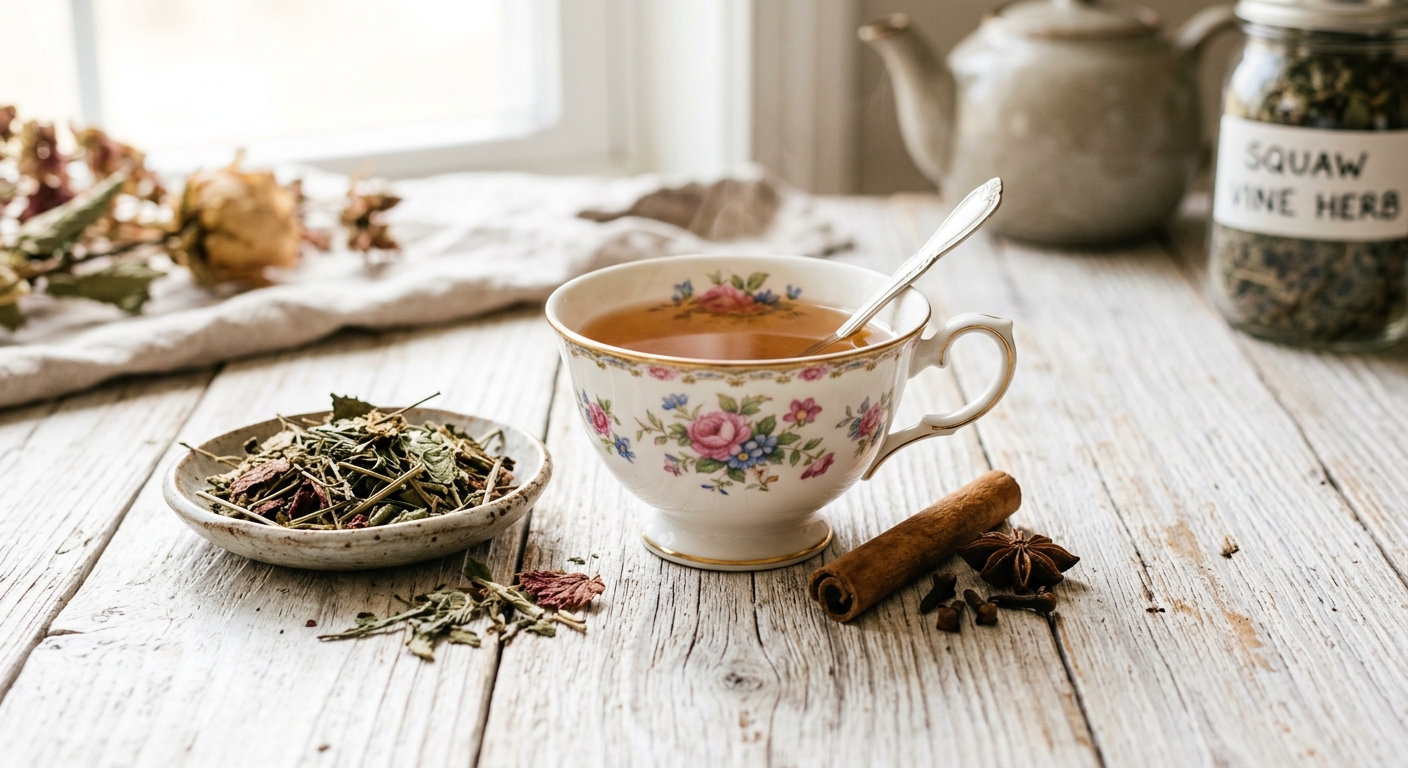
Squaw vine (Mitchella repens) is a small, evergreen, creeping herb native to the woodlands of eastern North America. Known by many names including partridgeberry, twinberry, and running box, it has been a cornerstone of women’s folk medicine for centuries. Indigenous nations including the Cherokee, Ojibwe, Mohegan, and Penobscot used preparations of this plant to ease menstrual discomfort, tone the uterus in the weeks before childbirth, and support recovery in the postpartum period. European settlers adopted these uses quickly, and squaw vine became a staple of 19th-century Eclectic medicine, often combined with red raspberry leaf in formulas designed for women’s reproductive health.
The plant itself is delicate and quietly beautiful, with paired, round, dark-green leaves veined in white and bright red berries that persist through winter. It grows low along the forest floor, often carpeting the ground beneath oaks and pines. In traditional preparations, the whole aerial plant including leaves, stems, and occasionally berries was simmered or steeped into a tea, and midwives and herbalists recommended it during the last four to six weeks of pregnancy to prepare the uterus for labor. It was also valued as a uterine tonic for women experiencing pelvic congestion, irregular cycles, and the discomfort of dysmenorrhea.
Today, squaw vine tea occupies a respected but cautious place in modern herbalism. Practitioners and midwives who work with plant medicine still reach for it as a gentle uterine tonic, though its use during pregnancy is approached with care and ideally under the guidance of a qualified healthcare provider. Its flavor is mild and earthy with a faint astringency, making it easy to blend with other supportive herbs. Whether you are exploring its rich history or seeking a traditional ally for women’s wellness, this tea offers a meaningful connection to an unbroken lineage of plant knowledge passed from generation to generation.
2
cups
Ingredients
- 2 tbspdried squaw vine herb (leaves and stems)
- 480 mlwater (95°C / 203°F)
- —raw honey or maple syrup to taste (optional)
- —dried red raspberry leaf (optional, for blending)
How to Brew
Click on an item below to shop for the recommended items for this recipe on Amazon.
As an Amazon Associate, we earn from qualifying purchases.
- Bring 480 ml of fresh, filtered water to 95°C (203°F). Avoid a full rolling boil, as excessive heat can degrade delicate tannins and volatile aromatic compounds.
- Measure 2 tablespoons of dried squaw vine herb (leaves and stems combined) and place it into a tea infuser or directly into a small teapot or heatproof vessel.
- Pour the hot water over the herb, cover the vessel immediately with a lid or a small saucer to trap steam and prevent the loss of volatile constituents.
- Steep for 15 to 20 minutes. The longer steep is important for this woody herb, as its bioactive compounds require sustained heat and time to fully release into the water.
- Strain the tea carefully through a fine mesh strainer into your mug. Press the spent herbs gently with the back of a spoon to release any remaining liquid.
- Allow to cool for 1 to 2 minutes, then sweeten lightly with raw honey or maple syrup if desired. Drink 1 to 2 cups per day, ideally in the evening.
- Measure 3 tablespoons of dried squaw vine herb into a clean glass jar. Use slightly more herb than you would for hot brewing, as cold water extracts less efficiently from this woody plant material.
- Pour 480 ml of room-temperature filtered water over the herbs. Stir gently to ensure all plant material is submerged.
- Place a breathable cloth, cheesecloth, or loosely fitting lid over the jar to allow minimal airflow while keeping debris out. Leave at room temperature for 1 hour to begin the initial extraction, then transfer to the refrigerator.
- Refrigerate for a total of 10 to 14 hours, or overnight. The slow, cold extraction draws a mellow, earthy infusion with noticeably less bitterness than the hot brew.
- Strain through a fine mesh strainer or cheesecloth into a clean pitcher or jar, pressing the herbs to recover all the liquid. Discard or compost the spent herb.
- Serve over ice or chilled, and consume within 48 hours. Sweeten with honey stirred in after straining, or add a slice of fresh ginger for brightness.
- Measure 3 tablespoons of dried squaw vine herb (leaves and stems) and place directly into a small stainless steel or ceramic saucepan. Avoid aluminum cookware, which can react with plant tannins.
- Add 600 ml of cold, filtered water to the saucepan. Starting with cold water and bringing the herb up to temperature together allows for a more complete and gradual extraction of constituents.
- Bring the water to a gentle simmer over medium heat, then reduce to a low simmer. The surface should show gentle movement but not a hard boil. Cover the pan with a lid to minimize evaporation and retain volatile compounds.
- Simmer on low heat for 20 to 30 minutes. Check occasionally and add a small amount of water if the liquid reduces significantly below 400 ml.
- Remove from heat and allow the decoction to rest, still covered, for an additional 10 minutes. This resting period allows the herbs to continue releasing constituents as the liquid cools slightly.
- Strain through a fine mesh strainer into a mug or jar, pressing firmly on the herbs. The resulting decoction will be darker, more amber, and noticeably more robust in flavor than the hot brew. Sweeten if needed and sip slowly. Traditional use called for half a cup two to three times daily.
Health Benefits
Squaw vine has been used for centuries as a uterine tonic, particularly in the final four to six weeks of pregnancy. Its alkaloid and tannin content is thought to tone uterine muscle tissue, potentially supporting more efficient contractions during labor. This use has deep roots in Indigenous midwifery and was formally adopted by 19th-century Eclectic physicians who prescribed it alongside red raspberry leaf.
Traditional herbalists used squaw vine to address irregular, painful, or suppressed menstruation. Its antispasmodic and anti-inflammatory compounds, particularly ursolic acid, may help relax uterine spasms and reduce the intensity of menstrual cramps, offering a gentler alternative to over-the-counter analgesics for mild dysmenorrhea.
Eclectic medicine classified squaw vine as a pelvic decongestant, indicating its traditional role in improving circulation to the pelvic organs. It was prescribed for conditions associated with chronic pelvic heaviness, sluggish circulation, and a sense of pelvic fullness, all symptoms historically grouped under the term pelvic congestion.
Following childbirth, squaw vine was brewed into a strong tea or combined with other herbs and used topically as a wash to support healing of sore or cracked nipples. Internally, the tea was believed to support uterine involution, the process by which the uterus returns to its pre-pregnancy size, and to ease postpartum discomfort.
Chlorogenic acid and other polyphenols present in squaw vine contribute measurable antioxidant activity, helping to neutralize oxidative stress in reproductive tissues. While direct clinical trials are limited, the plant’s polyphenol content compares favorably to other established medicinal herbs used for reproductive support.
🧪 Key Bioactive Compounds
The Science Behind Squaw Vine (Mitchella Repens)
Squaw vine (Mitchella repens) contains a complex array of bioactive constituents that help explain its longstanding reputation as a women’s tonic herb. Among the most pharmacologically significant are its alkaloids, believed to include a compound sometimes referred to as mitchelline, which traditional and Eclectic herbalists identified as the primary agent responsible for the herb’s uterotonic action. Alkaloids of this type can interact with smooth muscle tissue, supporting the rhythmic contractions of the uterus. This mechanism aligns with the traditional midwifery use of squaw vine in the weeks leading up to labor, where the goal was to tone rather than stimulate, creating a more responsive and coordinated uterine muscle. While robust modern clinical trials are still limited, the traditional evidence base is substantial and consistent across multiple independent cultures.
The herb’s tannin content, particularly gallotannins, contributes to its astringent and tissue-firming properties. Tannins work by binding to proteins in mucous membranes and soft tissues, temporarily tightening them. This action underpins the traditional use of squaw vine for excessive menstrual flow and topical applications for postpartum tissue healing. Complementing the tannins is ursolic acid, a pentacyclic triterpenoid documented in a growing body of research for its anti-inflammatory and antispasmodic effects. By modulating inflammatory pathways and relaxing smooth muscle spasms, ursolic acid provides a plausible biochemical basis for squaw vine’s traditional role in relieving menstrual cramping and pelvic discomfort.
Phytosterols such as daucosterol, found in squaw vine, are structurally similar to human estrogen and may exert mild estrogenic modulating effects by competing for estrogen receptor binding sites. This adaptogenic-like hormonal influence could help explain the herb’s historical use for irregular cycles and symptoms associated with hormonal fluctuation. Chlorogenic acid adds further value as a polyphenolic antioxidant that supports tissue integrity and reduces oxidative burden in the reproductive organs. Taken together, these compounds paint a picture of a botanically sophisticated herb whose traditional applications in women’s health are rooted in genuine, multi-targeted biochemical activity, even as modern researchers continue to fully characterize and clinically validate its mechanisms.
Brewing Tips
- Always use dried aerial parts (leaves and stems) of squaw vine rather than fresh plant material, as drying concentrates the bioactive compounds and reduces the risk of microbial contamination.
- Cover your mug or teapot during steeping with a lid or saucer. Squaw vine’s aromatic compounds are delicate and can escape with rising steam, reducing both the flavor and the beneficial volatile constituents in your cup.
- Source squaw vine from reputable ethical suppliers who practice sustainable wildcrafting or cultivation. Mitchella repens is not currently endangered, but it grows slowly in fragile woodland ecosystems and should not be harvested indiscriminately from the wild.