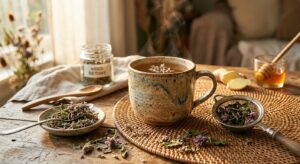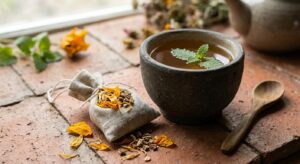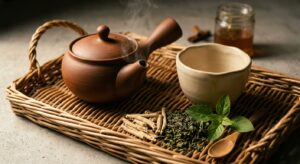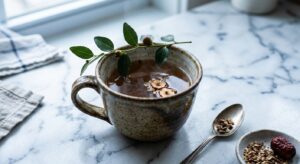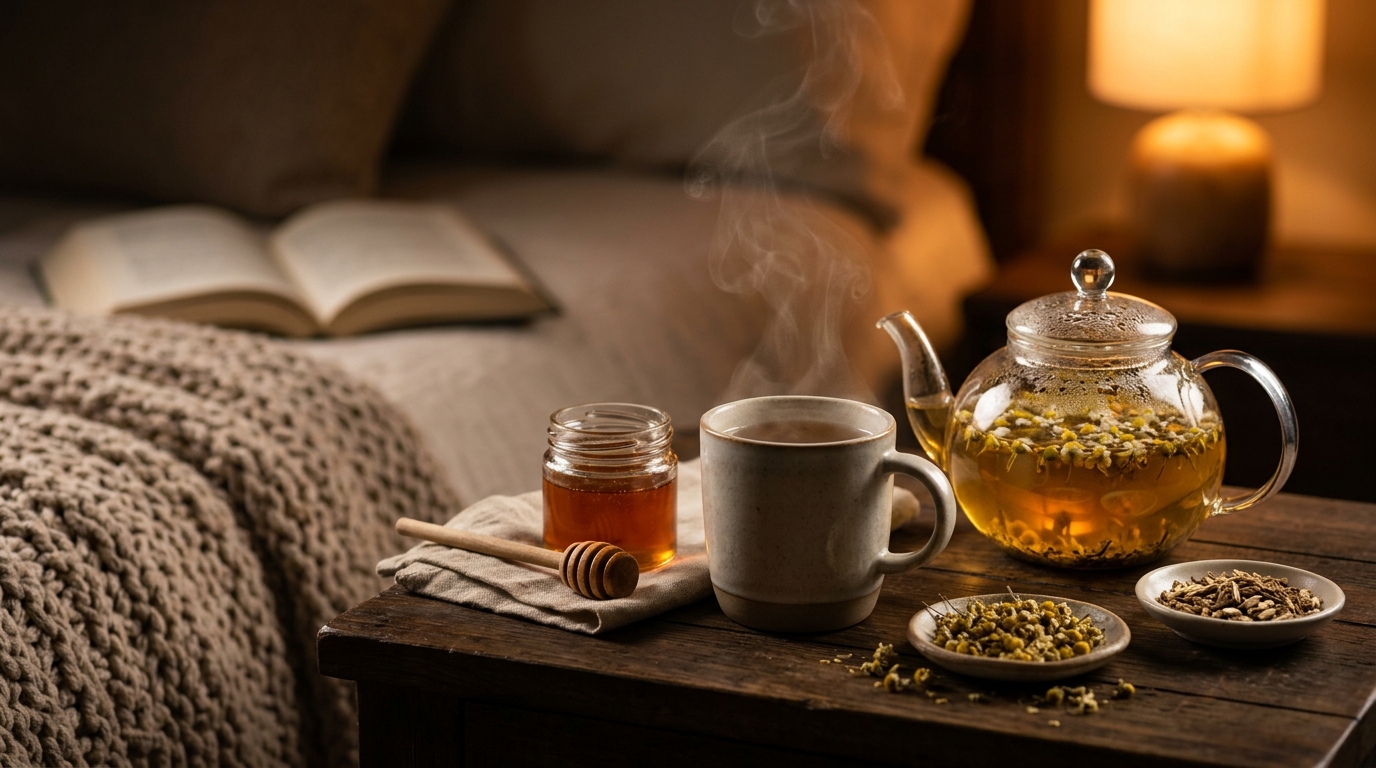
Few herbal pairings have as long a pedigree as valerian and chamomile. Valerian (Valeriana officinalis) was prescribed by Hippocrates and Galen, and by the Middle Ages it was so widely used for nervous complaints that it earned the folk name “all-heal.” Its root has a famously pungent smell, often compared to old socks or damp earth, which is exactly the part of the plant that carries its sleep-supporting reputation. Chamomile, by contrast, is one of the most beloved gentle herbs in the world. Ancient Egyptians dedicated it to their sun god, and the Greeks named it kamai melon, meaning “ground apple,” for its sweet, fruity fragrance.
Put the two together and you get a tea that balances strength with softness. Valerian provides the heavy lifting, while chamomile rounds off its rough edges with floral sweetness and adds its own relaxing, stomach-settling qualities. A little raw honey completes the trio, taming the root’s earthy bitterness and adding a mellow sweetness that makes the cup feel like a true evening treat. Traditional herbalists have long combined these plants for restless nights, nervous tension, and the kind of tired-but-wired feeling that keeps people staring at the ceiling.
What makes this blend special is how it works as a ritual as much as a remedy. The warm cup, the slow aroma, and the deliberate pause before bed all signal to your nervous system that the day is over. Even before the herbs do their work, the act of brewing and sipping encourages you to slow down.
2
cups
Ingredients
- 2 tspdried valerian root, roughly chopped
- 2 tbspdried chamomile flowers
- 480 mlwater (95°C / 203°F)
- —raw honey to taste, about 1 tsp per cup
- —a thin slice of lemon or a pinch of dried lemon balm (optional)
How to Brew
Click on an item below to shop for the recommended items for this recipe on Amazon.
As an Amazon Associate, we earn from qualifying purchases.
- Bring fresh, cold water to a near boil, then let it rest for about 30 seconds so it settles at roughly 95°C (203°F). Water that is too violently boiling can drive off delicate chamomile oils.
- Measure the valerian root and chamomile flowers into a large tea infuser or directly into a teapot. Gently crush the valerian root between your fingers first to help release its compounds.
- Pour the hot water over the herbs, then immediately cover the pot or place a saucer over the mug to hold in the steam and volatile oils.
- Steep for 10 minutes. Valerian root needs this longer window to extract properly, unlike chamomile alone, which is often ready in 5 minutes.
- Remove the infuser or strain the tea into your cup. Stir in raw honey while the tea is still hot so it dissolves fully.
- Sip slowly about 30 to 45 minutes before bed, in dim light and away from screens.
- Combine 2 tsp of valerian root and 2 tbsp of chamomile flowers in a large glass jar. Use the same herb quantities as the hot method but double the water for a gentler infusion.
- Add 960 ml of cold, filtered water, stir once, and seal the jar with its lid.
- Refrigerate for 8 to 10 hours, or overnight. Because no heat is involved, the long steep is essential to draw out the root’s compounds.
- Strain through a fine mesh sieve or a coffee filter to catch all the small root fragments and flower petals.
- Stir in a little raw honey. Since honey dissolves poorly in cold liquid, first whisk it with a tablespoon of warm water to make a quick syrup, then stir that in.
- Serve over ice or straight from the fridge. Store any leftovers in a sealed container for up to 2 days.
- Place 2 tsp of chopped valerian root and 480 ml of cold water into a small saucepan. Starting with cold water allows the root to release its compounds gradually as it heats.
- Bring the water to a gentle simmer over medium-low heat, then reduce to low and cover with a lid. Do not let it boil hard, which can scatter the aromatic oils.
- Simmer gently for 15 minutes, until the liquid darkens to a deep amber and the earthy aroma fills the kitchen.
- Remove the pan from the heat and add the chamomile flowers, since they are delicate and would turn bitter if simmered. Cover again and steep for 5 minutes.
- Strain through a fine mesh sieve into your cup, pressing the herbs gently with the back of a spoon to release the last of the liquid.
- Stir in raw honey to taste and enjoy warm. Expect a bolder, more robust brew than the standard hot method.
Health Benefits
Valerian root has been studied for its ability to shorten the time it takes to fall asleep, likely through its action on GABA signaling. Results across trials are mixed, but many people report subjective improvements in sleep quality.
Chamomile’s apigenin and valerian’s valerenic acid both interact with calming neurotransmitter pathways. Small clinical studies on chamomile have shown modest reductions in generalized anxiety symptoms.
Chamomile has a long traditional use as a carminative, relaxing smooth muscle in the digestive tract and reducing bloating and cramping that can interfere with sleep.
Beyond the plant chemistry, the warmth, aroma, and routine of sipping a calming tea helps cue the body for rest, an effect supported by sleep hygiene research.
Valerian has traditional use as a mild muscle relaxant, and the warmth of the tea combined with chamomile’s gentle antispasmodic properties may help release physical tightness at the end of the day.
🧪 Key Bioactive Compounds
The Science Behind Valerian
Valerian’s reputation rests largely on a handful of compounds, chiefly valerenic acid and its relatives. Laboratory research suggests valerenic acid acts on GABA-A receptors, the same inhibitory system targeted by many prescription sleep and anti-anxiety medications, although valerian does so far more gently. Valerian also appears to inhibit the enzyme that breaks down GABA, allowing more of this calming neurotransmitter to remain active in the brain. Clinical evidence is honest but mixed: some meta-analyses show small improvements in subjective sleep quality, while others find the effect hard to distinguish from placebo, which is a reminder that individual responses vary.
Chamomile contributes a different kind of calm. Its flavonoid apigenin binds to benzodiazepine-site receptors in the brain with a mild affinity, helping explain the herb’s gentle sedative reputation. Chamomile also contains essential oils such as alpha-bisabolol and chamazulene, which have anti-inflammatory and antispasmodic properties that ease digestive tension. A small randomized trial in older adults and several studies on generalized anxiety have found modest benefits, though more research is needed.
Preparation matters for the chemistry. Valepotriates in valerian are heat-sensitive and unstable in water, which is why most of the sedative activity of a tea is thought to come from valerenic acid and other more stable constituents. Covering your cup preserves chamomile’s volatile oils, and a longer steep or gentle simmer is needed to extract valerian’s dense root compounds. Honey adds a small amount of sweetness that makes the bitter root palatable without needing refined sugar, and it may offer its own mild soothing effect on the throat.
Brewing Tips
- Buy cut-and-sifted valerian root from a reputable source and store it in an airtight, opaque jar, since old or poorly stored root loses potency and can smell unpleasantly sharp.
- Start with a smaller amount of valerian, about 1 tsp, the first few times you try this tea to see how your body responds before using the full recipe.
- Drink the tea 30 to 60 minutes before bed rather than right as you lie down, giving the herbs time to settle in and avoiding a late-night trip to the bathroom.
- If the earthy smell of valerian puts you off, try the cold brew method, which mellows the aroma considerably, or add a small slice of fresh ginger or a strip of orange peel to the pot.
- Use valerian as an occasional or short-term aid rather than a nightly habit, and take a few nights off each week to see how your natural sleep is doing.