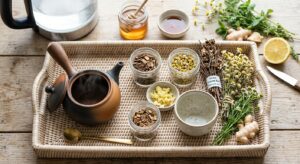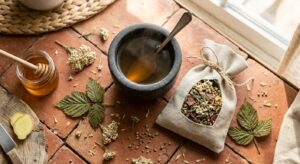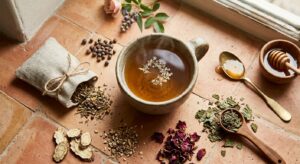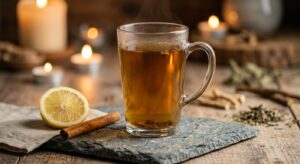
In Sanskrit, shatavari is often translated as ‘she who possesses a hundred husbands,’ a poetic nod to its reputation for supporting feminine vitality and fertility. This climbing, thorny perennial is native to India, Sri Lanka, and the Himalayan foothills, and its tuberous roots have been used in Ayurvedic medicine for thousands of years. Classical texts such as the Charaka Samhita describe it as a premier rasayana, a rejuvenating tonic for the reproductive system, and as a remedy for dryness, heat, and depletion in the body.
Ayurveda classifies shatavari as sweet, bitter, and cooling, which is why it is traditionally prescribed for imbalances involving excess heat and dryness. Women across South Asia have long turned to it during menstruation, postpartum recovery, breastfeeding, and menopause. It is also considered a gentle adaptogen that nourishes the nervous system, making it a natural fit for an evening ritual meant to release the stress of the day.
The tea itself is a quiet pleasure. Shatavari root has a mellow, faintly sweet, slightly earthy flavor with a velvety mouthfeel that comes from its natural saponins and mucilage. Brewed warm in the hour before bed, it becomes more than a beverage. It is a small, deliberate pause that tells the body the day is done.
2
cups
Ingredients
- 2 tspdried shatavari root pieces or cut and sifted root
- 500 mlwater (95°C / 203°F)
- 0.5 tspdried rose petals (optional)
- —raw honey or a splash of warm oat milk to taste (optional)
How to Brew
Click on an item below to shop for the recommended items for this recipe on Amazon.
As an Amazon Associate, we earn from qualifying purchases.
- Measure 2 teaspoons of dried shatavari root pieces into a teapot or a large mug with a lid. If your root is in large chunks, crush it lightly with a mortar and pestle first to expose more surface area.
- Bring fresh water to a full boil, then let it rest for about 30 seconds so it settles near 95°C (203°F). Pour the water over the root.
- Add the dried rose petals if using, then cover the vessel with a lid or saucer to hold in the steam.
- Steep for 10 to 15 minutes. The longer you steep, the richer and more mucilaginous the tea becomes, so taste at 10 minutes and decide.
- Strain into your favorite evening mug. Stir in raw honey or a splash of warm oat milk if desired, and sip slowly in dim light about 30 to 60 minutes before bed.
- Add 3 tablespoons of dried shatavari root pieces to a clean 1-liter glass jar. Use a slightly higher ratio than the hot method because cold water extracts more slowly.
- Pour 1 liter of cool filtered water over the root and stir gently. Add a few dried rose petals or a small strip of orange peel if you like a floral or citrus note.
- Seal the jar and refrigerate for 8 to 12 hours, ideally overnight, giving it a gentle swirl once if you remember.
- Strain through a fine mesh sieve or a nut milk bag, pressing lightly on the root to release the remaining liquid.
- Serve over a few ice cubes or at refrigerator temperature. Drink within 48 hours and keep refrigerated, as the natural sugars in the root can spoil if left out.
- Combine 2 teaspoons of dried shatavari root pieces with 250 ml of water and 250 ml of milk or oat milk in a small saucepan. Dairy and plant milks both work, though full-fat milk is the traditional choice.
- Add a small pinch of ground cardamom and, if you like, a thin slice of fresh ginger to round out the flavor and aid digestion.
- Bring slowly to a gentle simmer over medium-low heat. Do not let it boil hard, which can scorch the milk and toughen the flavor.
- Simmer uncovered for 15 to 20 minutes, stirring occasionally, until the liquid has reduced by roughly a third and turned a creamy pale gold.
- Strain into a mug, sweeten with a little jaggery, honey, or date syrup, and drink warm as a bedtime tonic.
Health Benefits
Shatavari contains phytoestrogenic saponins that may gently modulate estrogen activity, which is why it is traditionally used for menstrual irregularity and menopausal transition. Human trials are still limited, but early studies on menopausal symptoms are encouraging.
Small clinical studies suggest shatavari may reduce hot flashes, night sweats, and vaginal dryness. Its cooling and moistening qualities align closely with the traditional Ayurvedic description of its effects.
As a nourishing adaptogen, shatavari is thought to temper the body’s stress response, and animal studies show it may lower stress-related markers. The warm bedtime ritual itself also supports relaxation and sleep readiness.
The mucilage in the root coats and calms irritated gastrointestinal tissue, and Ayurvedic practitioners use it for acidity and gastric discomfort. Preliminary research supports a protective effect on the stomach lining.
Shatavari is one of the most traditional galactagogues in Ayurveda, used to support breast milk production. Some small studies point to a beneficial effect, though evidence remains modest and should be discussed with a healthcare provider.
🧪 Key Bioactive Compounds
The Science Behind Shatavari
The bioactivity of shatavari is attributed largely to its steroidal saponins, collectively called shatavarins. These compounds share structural similarities with certain plant sterols and are believed to interact with hormone-signaling pathways, which may explain the root’s traditional reputation as a female tonic. Laboratory and animal studies suggest shatavari extracts can influence estrogen-responsive tissues and may modulate the stress axis, though much of this work has not yet been replicated in large human trials.
Beyond its saponins, shatavari offers a mix of flavonoids such as quercetin and rutin, along with phenolic compounds like racemosol, which contribute to its antioxidant capacity. These molecules help neutralize reactive oxygen species and may support a healthy inflammatory response. The root is also rich in mucilaginous polysaccharides, which give the tea its silky body and likely account for the soothing effect on dry or irritated tissues that Ayurvedic practitioners have observed for centuries.
It is important to keep the evidence in perspective. Clinical research on shatavari is promising but still modest in scale, with small studies on menopausal symptoms, lactation, and digestive comfort. A daily cup of tea delivers a gentler dose than concentrated extracts, so it is best viewed as a supportive, ritual-based practice rather than a treatment for any medical condition.
Brewing Tips
- Choose organic, sustainably harvested root when possible, as wild shatavari is increasingly pressured by overharvesting in parts of India.
- Brew it consistently in the evening for several weeks, since adaptogenic and tonic herbs tend to work gradually rather than overnight.
- Store dried root in an airtight glass jar away from light and moisture, and use within 12 months for the best flavor and potency.
- If the earthy flavor feels too plain, a small amount of warm milk, a pinch of cardamom, or a drizzle of honey makes it more comforting without overpowering the root.