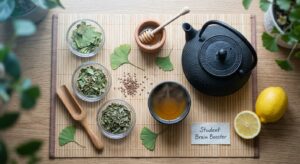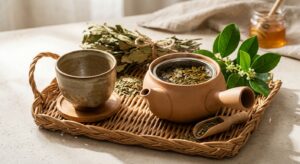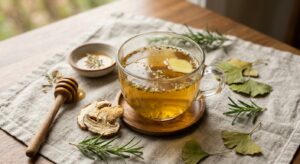
Lion’s Mane (Hericium erinaceus) looks like nothing else in the forest: a cascade of soft, white spines that tumble down from the trunk of a hardwood tree like a frozen waterfall. In China it is known as hou tou gu, or monkey head mushroom, and in Japan as yamabushitake, named after the mountain ascetics whose robes carry a similar tassel. Traditional Chinese medicine texts describe it as a tonic for the spleen and stomach, and for centuries it was prepared for both the kitchen and the apothecary. Buddhist monks in particular were said to drink it to support concentration during long hours of meditation and study.
What makes it so appealing for evening work is what it does not contain: caffeine. Most of us reach for coffee or black tea when a project runs past dinner, then pay for it with a restless night. Lion’s Mane offers a different kind of ritual. There is no stimulant to spike and crash, just a warm, grounding cup that pairs naturally with the quiet focus of an evening desk. The taste is mellow, faintly sweet, and savory in the way of a good broth, which makes it surprisingly soothing after a long day.
Lion’s Mane is a medicinal mushroom, so it is brewed differently from leafy herbs. Its tough cell walls are made of chitin, which means a quick steep barely releases anything. Gentle simmering, or a long cold soak, coaxes out its water-soluble compounds. Once you learn that small technique, this becomes one of the most rewarding and comforting teas in the herbal cabinet.
2
cups
Ingredients
- 6 gdried Lion’s Mane mushroom slices or chunks (about 2 tbsp)
- 500 mlfiltered water
- 1 tspdried peppermint or lemon balm leaf (optional, added at the end)
- —raw honey or a thin slice of fresh ginger to taste (optional)
How to Brew
Click on an item below to shop for the recommended items for this recipe on Amazon.
As an Amazon Associate, we earn from qualifying purchases.
- Rinse the dried Lion’s Mane pieces briefly under cool water to remove any dust, then place them in a small saucepan with 500 ml of filtered water.
- Bring the water to a boil over medium heat, then immediately reduce to the lowest setting so it holds a gentle simmer with only small bubbles breaking the surface.
- Partially cover the pot and simmer for 15 to 20 minutes. The liquid will deepen to a pale golden tan and the kitchen will smell lightly of toasted forest mushrooms.
- If using peppermint or lemon balm, remove the pot from heat and stir in the dried leaves, then let them steep for 3 minutes.
- Strain through a fine mesh sieve into two mugs, pressing the mushroom pieces gently against the sieve to release the last of the liquid.
- Sweeten with a little raw honey if you like, and sip slowly at your desk. The strained mushroom pieces can be simmered a second time with fresh water for a lighter second cup.
- Lightly crush or break 8 g of dried Lion’s Mane into smaller pieces. Smaller fragments expose more surface area, which matters because no heat is helping to open the tough cell walls.
- Add the pieces to a clean glass jar with 500 ml of cold filtered water and stir once to submerge everything.
- Seal the jar and refrigerate for 10 to 12 hours, or overnight. Give it a gentle shake once or twice if you pass by.
- Strain the liquid through a fine mesh sieve or a nut-milk cloth into a clean glass, discarding or reserving the mushroom pieces.
- Serve over ice with a slice of lemon or a sprig of fresh mint, or sip it chilled straight from the glass. Drink within 48 hours and keep refrigerated.
- Place 12 g of dried Lion’s Mane pieces in a heavy-bottomed pot with 1 liter of filtered water and let the mushroom soak for 20 minutes to begin softening.
- Bring the pot just to a boil, then reduce the heat so the water barely trembles, around 85 to 90°C. Cover with the lid slightly ajar.
- Simmer for 45 to 60 minutes, stirring occasionally, until the liquid has reduced by about one third and turned a rich amber gold.
- If you like, add a few slices of fresh ginger or a small piece of cinnamon bark for the final 10 minutes to round out the flavor.
- Strain through a fine sieve and let the concentrate cool. Store it in a sealed glass jar in the refrigerator for up to 4 days.
- To serve, dilute 120 ml of concentrate with 120 ml of hot water, or warm it gently on the stove. Avoid microwaving on high, which can scorch the delicate flavor.
Health Benefits
Small human trials, including one in older adults with mild cognitive impairment, have reported modest improvements in cognitive scores with Lion’s Mane supplementation. Larger studies are still needed, and effects in healthy adults are less well established.
Hericenones and erinacines have been shown in laboratory and animal studies to stimulate NGF, a protein essential for the maintenance of neurons. This is promising but largely preclinical, so it should be viewed as supportive rather than proven.
A small human trial in menopausal women found reductions in self-reported irritability and anxiety after several weeks of Lion’s Mane, and animal studies suggest anti-inflammatory effects in the brain. More research is needed to confirm these findings.
Lion’s Mane has a long traditional use for soothing the stomach, and early research suggests its polysaccharides may help protect the gut lining and support beneficial gut bacteria.
Its ergothioneine and polyphenol content contributes to antioxidant activity, which may help the body manage everyday oxidative stress.
🧪 Key Bioactive Compounds
The Science Behind Lion’S Mane Mushroom
The most intriguing research on Lion’s Mane centers on two families of compounds. Hericenones, found in the fruiting body (the part you see), and erinacines, found mostly in the mycelium (the root-like network), have both been shown in laboratory studies to stimulate the production of nerve growth factor. NGF is a protein that helps neurons grow, survive, and maintain their connections. Because the brain has limited ability to repair itself, there is considerable scientific interest in anything that might support this system.
Human evidence is still early. A frequently cited Japanese trial gave older adults with mild cognitive impairment a Lion’s Mane preparation for 16 weeks and observed improvements in cognitive scores that faded after they stopped. Other small trials have looked at mood and stress. These results are encouraging but come from small studies, often using concentrated extracts rather than tea, so it is fair to describe Lion’s Mane as a promising traditional ally rather than a proven nootropic.
Preparation matters for what ends up in your cup. The chitin in mushroom cell walls is indigestible and locks compounds inside, so heat and time are needed to release water-soluble components like beta-glucans. Some of the compounds linked to nerve growth, such as hericenones, are thought to be more soluble in alcohol than in water, which means a simple tea captures only part of the mushroom’s profile. Even so, simmering delivers beta-glucans, ergothioneine, and polyphenols, along with a deeply satisfying flavor that makes the evening ritual itself worthwhile.
Brewing Tips
- Buy dried Lion’s Mane from a reputable source that identifies the species as Hericium erinaceus and ideally tests for purity. Look for pale cream pieces rather than dark or musty ones.
- Save the strained mushroom pieces and simmer them a second time, or chop and add them to soups, stir-fries, or scrambled eggs so nothing goes to waste.
- Brew a larger batch of the long decoction on Sunday and keep it refrigerated, then gently reheat a cup each evening for an effortless work-night ritual.
- Drink it earlier in your evening work session, rather than right before bed, to pair the experience with focus and then let the caffeine-free calm carry you into rest.
- If the earthy flavor is new to you, start with the cold brew version, which is naturally sweeter and gentler, then work up to the hot simmered cup.