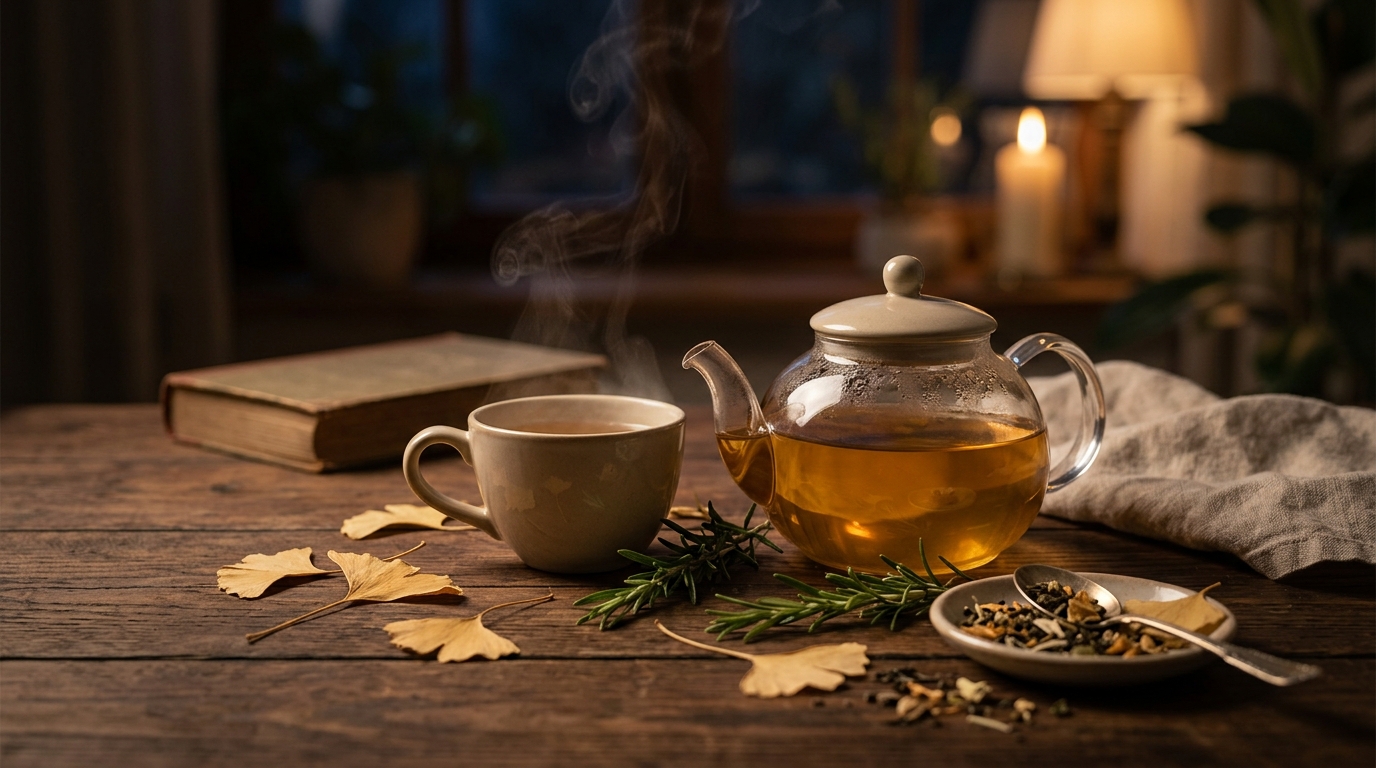
Ginkgo biloba is often called a living fossil. Fossils of near-identical leaves date back more than 200 million years, and the species survived the Hiroshima bombing in 1945, with several trees sprouting again within months. In Traditional Chinese Medicine, the seeds were long used for lung and bladder complaints, while the fan-shaped leaves became the focus of European phytotherapy in the twentieth century, where standardized extracts were studied for circulation and cognitive support.
Rosemary has an equally storied past. Ancient Greek students reportedly wore rosemary garlands while studying, and Shakespeare’s Ophelia declared it the herb “for remembrance.” Across the Mediterranean it was burned, steeped, and strewn through homes as a plant of memory, protection, and vitality. Modern interest centers on its aromatic compounds, which have been explored in small studies for effects on alertness and mood.
Together, the two make a tea that feels both grounding and bright. Ginkgo leaf lends a mellow, woody, faintly bitter base, while rosemary adds piney, camphor-like lift. Neither contains caffeine, which makes this an appealing evening ritual for anyone who wants a mentally clear, warming cup without disrupting sleep. Think of it as a companion for winding down with a book, journaling, or gentle evening planning.
2
cups
Ingredients
- 2 tspdried ginkgo biloba leaf (cut and sifted)
- 1 tspdried rosemary leaves
- 480 mlwater (95°C / 203°F)
- —a thin strip of lemon peel (optional)
- —raw honey to taste (optional)
How to Brew
Click on an item below to shop for the recommended items for this recipe on Amazon.
As an Amazon Associate, we earn from qualifying purchases.
- Measure 2 teaspoons of dried ginkgo leaf and 1 teaspoon of dried rosemary into a teapot or large infuser. Gently crush the rosemary between your fingertips first to wake up its oils.
- Bring fresh water to a near boil, then let it rest for about 30 seconds so it settles around 95°C (203°F).
- Pour the hot water over the herbs, cover the pot or mug with a saucer to trap the volatile rosemary aromatics, and steep for 7 to 10 minutes. Closer to 7 minutes gives a lighter cup, closer to 10 gives a deeper, woodier one.
- Strain thoroughly, pressing the herbs lightly against the strainer to release the last of the liquid.
- Add a strip of lemon peel or a little honey if desired, and sip slowly while still warm.
- Combine 3 teaspoons of dried ginkgo leaf and 1.5 teaspoons of dried rosemary in a clean glass jar. This is a slightly higher ratio than hot brew to compensate for the gentler extraction.
- Add 750 ml of cold, filtered water and stir once with a long spoon so all the herbs are wet.
- Seal the jar and refrigerate for 10 to 12 hours. Give it a gentle shake once or twice if you remember.
- Strain through a fine mesh sieve or a coffee filter into a clean pitcher. Ginkgo leaf fragments are small, so a double strain gives a clearer tea.
- Serve over a few ice cubes or straight from the fridge, and consume within 48 hours.
- Add 2 teaspoons of dried ginkgo leaf to a small saucepan with 500 ml of cold water. Starting cold helps coax the compounds out gradually.
- Bring the pot slowly to a bare simmer over medium-low heat, then reduce the heat so only a few small bubbles rise. Simmer uncovered for 10 minutes.
- Remove the pan from the heat and add 1 teaspoon of rosemary. Adding it at the end protects its volatile aromatic oils from boiling away.
- Cover the pan and let everything rest for 5 minutes to infuse.
- Strain through a fine sieve into warmed mugs. The tea will be slightly darker and more robust than a standard steep. Sweeten lightly if you like.
Health Benefits
Ginkgo flavonoids and ginkgolides have been studied for their effects on blood vessel tone and platelet behavior, and ginkgo has long been used traditionally to support peripheral blood flow. Evidence in humans is mixed, but circulation support remains its most consistent traditional use.
Some clinical trials of standardized ginkgo extracts suggest modest improvements in attention and memory, while rosemary aroma has been linked in small studies to improved alertness. A tea is far milder than an extract, so expect gentle support rather than dramatic effects.
Both herbs are rich in polyphenols such as quercetin and rosmarinic acid, which help neutralize free radicals in laboratory models.
Rosemary has a long history as a carminative, traditionally used to relieve bloating and gas after meals, making this a pleasant tea after dinner.
The warming, aromatic experience of this blend can serve as a calming cue for evening concentration without interfering with sleep the way caffeinated drinks can.
🧪 Key Bioactive Compounds
The Science Behind Ginkgo Biloba
Ginkgo leaf extracts are among the most researched herbal preparations in the world. Their activity is attributed mainly to two compound families: flavonoid glycosides, which provide antioxidant effects, and terpene lactones (ginkgolides and bilobalide), which are found almost exclusively in this species. Ginkgolide B in particular has been shown to block platelet-activating factor receptors, a mechanism that may explain ginkgo’s effects on blood flow and its bleeding-related cautions.
Clinical results for cognitive benefits are mixed. Several trials using standardized extracts such as EGb 761 reported modest improvements in attention and memory in people with age-related cognitive concerns, while large prevention trials found no clear effect on dementia risk. It is important to note that these studies used concentrated, standardized extracts at specific doses. A cup of ginkgo tea delivers a much smaller and less predictable amount of active compounds, so it is best viewed as a gentle traditional ritual rather than a therapeutic dose.
Rosemary’s aromatic compounds add a complementary angle. Research on 1,8-cineole has found associations between inhaled or ingested rosemary aroma and improved speed and accuracy on cognitive tasks, and rosmarinic acid and carnosic acid show antioxidant and anti-inflammatory activity in laboratory studies. Much of this work is preliminary and conducted in small groups or cell models, but it supports the centuries-old reputation of rosemary as the herb of remembrance.
Brewing Tips
- Choose ginkgo leaf that is green to golden and smells hay-like and fresh. Dull brown or dusty leaf has lost much of its character.
- Crush rosemary lightly just before brewing to release its oils, and always cover your cup while steeping so the aroma stays in the tea rather than drifting away.
- Ginkgo has a naturally dry, slightly bitter edge. A touch of honey, a lemon peel, or a pinch of dried peppermint rounds it out beautifully.
- Start with one cup in the early evening and see how you feel before making it a daily habit, and let your healthcare provider know if you take any medications.
- Store both dried herbs in airtight, opaque containers away from heat and light to protect the volatile oils in the rosemary.