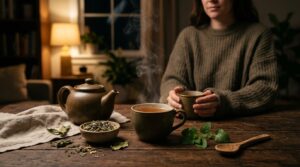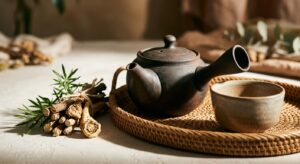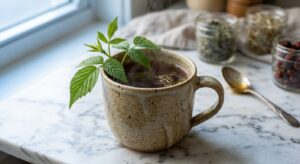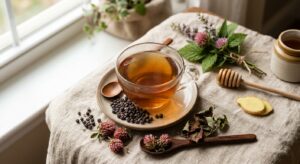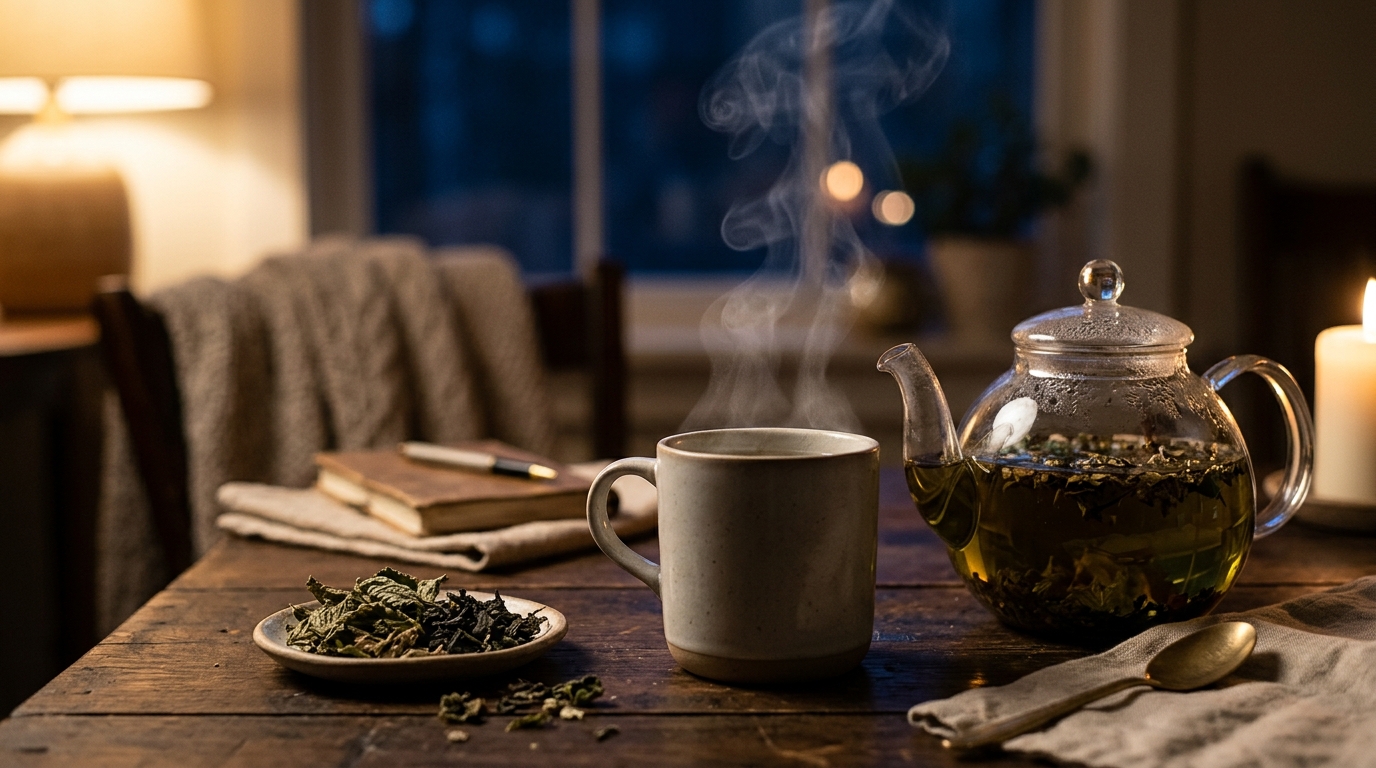
Red raspberry leaf (Rubus idaeus) has been steeped by women for centuries. European herbalists recommended it as a uterine tonic, and midwives in Britain and North America passed down the practice of drinking it through the later stages of pregnancy. The leaves, not the fruit, are the medicine here: pale green and slightly fuzzy, they brew into a gentle, tannic tea with a flavor reminiscent of mild black tea without the caffeine.
Stinging nettle (Urtica dioica) has an equally long history. Roman soldiers reportedly rubbed nettle on their limbs to stay warm, and medieval cooks simmered the young shoots into spring tonics after a long winter of preserved food. Once dried or cooked, the sting disappears entirely, leaving behind a deep green leaf rich in calcium, magnesium, potassium, iron, and vitamins A, C, and K. Traditional herbalists called nettle a blood builder and a nourishing tonic for good reason.
Brewed together, these two herbs create a quietly nourishing evening ritual. The raspberry leaf brings a soft, slightly astringent backbone, while the nettle adds a savory, almost spinach-like depth. Many women drink this blend nightly as a mineral-rich replacement for a caffeinated evening cup, especially around the menstrual cycle, though it is a gentle tea that suits almost anyone looking for a calming, grounding routine.
2
cups
Ingredients
- 2 tspdried red raspberry leaf
- 2 tspdried stinging nettle leaf
- 480 mlwater (95°C / 203°F)
- —raw honey to taste (optional)
- —a slice of lemon (optional)
How to Brew
Click on an item below to shop for the recommended items for this recipe on Amazon.
As an Amazon Associate, we earn from qualifying purchases.
- Bring fresh water to a boil, then let it rest for about 30 seconds so it settles near 95°C (203°F).
- Add the dried raspberry leaf and nettle to a teapot or large mug, using about 1 teaspoon of each herb per 240 ml of water.
- Pour the hot water over the herbs, then cover the vessel with a lid or saucer to trap the steam and aromatic oils.
- Steep for 10 to 15 minutes. Because both herbs are leafy and fibrous, they need a longer infusion than delicate flowers to release their minerals.
- Strain through a fine mesh strainer, pressing the herbs gently against the sieve to extract the last of the liquid.
- Sweeten with a little raw honey if desired, and sip slowly as part of your evening wind-down.
- Combine 4 tablespoons of raspberry leaf and 4 tablespoons of nettle in a large glass jar, which makes about 1 liter of finished tea.
- Fill the jar with cool, filtered water and stir well so all the leaves are fully saturated and not clumped on the surface.
- Seal the jar and place it in the refrigerator, letting the herbs steep slowly for 8 to 12 hours or overnight.
- In the morning, strain through a fine mesh strainer or a double layer of cheesecloth, discarding the spent leaves.
- Store the finished tea in a sealed bottle in the refrigerator and drink within 48 hours. Serve over ice with a squeeze of lemon if you like.
- Measure 1 ounce (about 28 g, or roughly 1 cup loosely packed) of combined dried raspberry leaf and nettle into a clean quart-sized (1 liter) glass jar.
- Pour boiling water over the herbs until the jar is full, then stir briefly to make sure no dry clumps remain.
- Screw on the lid tightly and let the jar sit on the counter, allowing the water to cool gradually while the herbs steep for 4 to 8 hours or overnight.
- Strain thoroughly through a fine mesh strainer, pressing the herb mass to release every drop of the dark, concentrated liquid.
- Drink the infusion at room temperature, or gently rewarm it on the stove without boiling. Refrigerate leftovers and finish within 24 hours.
Health Benefits
Nettle is among the richest herbal sources of calcium, magnesium, potassium, and iron, and a long infusion extracts a meaningful amount of these into the water. A nightly cup can complement a balanced diet, though it should not replace it.
Raspberry leaf’s astringent tannins and traditional muscle-toning reputation make it a popular choice for easing cramping and heavy flow, while nettle’s iron may help offset losses. Evidence is mostly traditional and observational, but many women report a noticeable benefit.
Midwives have long recommended raspberry leaf in the later stages of pregnancy to prepare the uterus for labor. Small studies suggest it is generally well tolerated, but it should only be used under the guidance of a healthcare provider.
Both herbs contain flavonoids and polyphenols that act as antioxidants in laboratory studies. These compounds may help the body manage everyday oxidative stress.
The warm, earthy, tea-like flavor makes this blend a satisfying alternative to caffeinated drinks at night. The ritual of a slow, warm cup also supports relaxation and a calmer transition to sleep.
🧪 Key Bioactive Compounds
The Science Behind Red Raspberry Leaf
Red raspberry leaf contains a mix of tannins (especially ellagitannins), flavonoids such as quercetin and kaempferol, and a small amount of the alkaloid fragarine. The tannins are responsible for the tea’s mild astringency and are thought to have a tightening, toning effect on tissues. Laboratory studies show that raspberry leaf extracts can influence smooth muscle activity, which offers a plausible explanation for its traditional use in the uterus, but clinical trials in humans remain small and inconclusive, so claims should be viewed as traditional rather than proven.
Nettle’s reputation as a nutritive herb is better supported. Analyses of dried nettle leaf show high concentrations of calcium, magnesium, potassium, and iron, along with vitamins A, C, and K and a notable amount of plant protein for a leaf. Minerals dissolve readily into hot water, which is why herbalists favor long infusions over a quick five-minute steep. Nettle also contains flavonoids and phenolic acids with antioxidant activity, and extracts have been studied for mild anti-inflammatory and diuretic effects.
Brewing method meaningfully changes the cup. A short hot steep yields a lighter, more aromatic tea, while a long overnight infusion produces a darker liquid with substantially more dissolved minerals. Cold brewing pulls out fewer tannins, which results in a smoother and less bitter flavor. Adding a source of vitamin C, such as lemon, can improve the absorption of the non-heme iron found in plants.
Brewing Tips
- Source organic, ethically harvested dried leaf from a reputable herb supplier, since nettle and raspberry leaf are often grown near roadsides where contamination is possible.
- Store both herbs in airtight glass jars away from light and heat, and use them within 12 months for the best flavor and potency.
- If the tea tastes too grassy, shorten the steep or add a pinch of dried peppermint, spearmint, or lemon balm to brighten the flavor.
- For a nourishing infusion, use more herb and a longer steep rather than drinking multiple weak cups, and make a fresh jar each evening.
- Start with one cup a day and see how your body responds before increasing to two or three, especially if you are new to nettle.