Long before productivity apps and nootropic supplements crowded the wellness market, herbalists across China, Greece, and medieval Europe were reaching for specific plants to sharpen the mind. Ginkgo biloba, one of the oldest living tree species on Earth, has been used in Traditional Chinese Medicine for over 2,000 years to support memory and mental clarity. Rosemary, revered by ancient Greek scholars who wore garlands of it during examinations, has a equally storied reputation as an herb of remembrance and intellectual vitality. Lion’s mane mushroom, known in Japanese as yamabushitake, was traditionally consumed by Buddhist monks seeking mental stillness and clarity during long meditation sessions. These three ingredients form the backbone of what we call Executive Function Tea, a purposeful blend designed to support the cognitive processes that govern focus, planning, working memory, and mental flexibility.
What makes this blend genuinely compelling is that all three primary ingredients have attracted serious scientific interest in recent decades. Researchers have identified specific bioactive compounds in each one that interact with the nervous system in complementary, non-stimulant ways. Rather than flooding the brain with caffeine and triggering an inevitable crash, Executive Function Tea works by supporting cerebral blood flow, encouraging nerve growth factor production, and protecting neurons from oxidative stress. The result is a kind of sustained, grounded alertness that feels different from caffeinated focus: cleaner, calmer, and more durable across a long work session or study block.
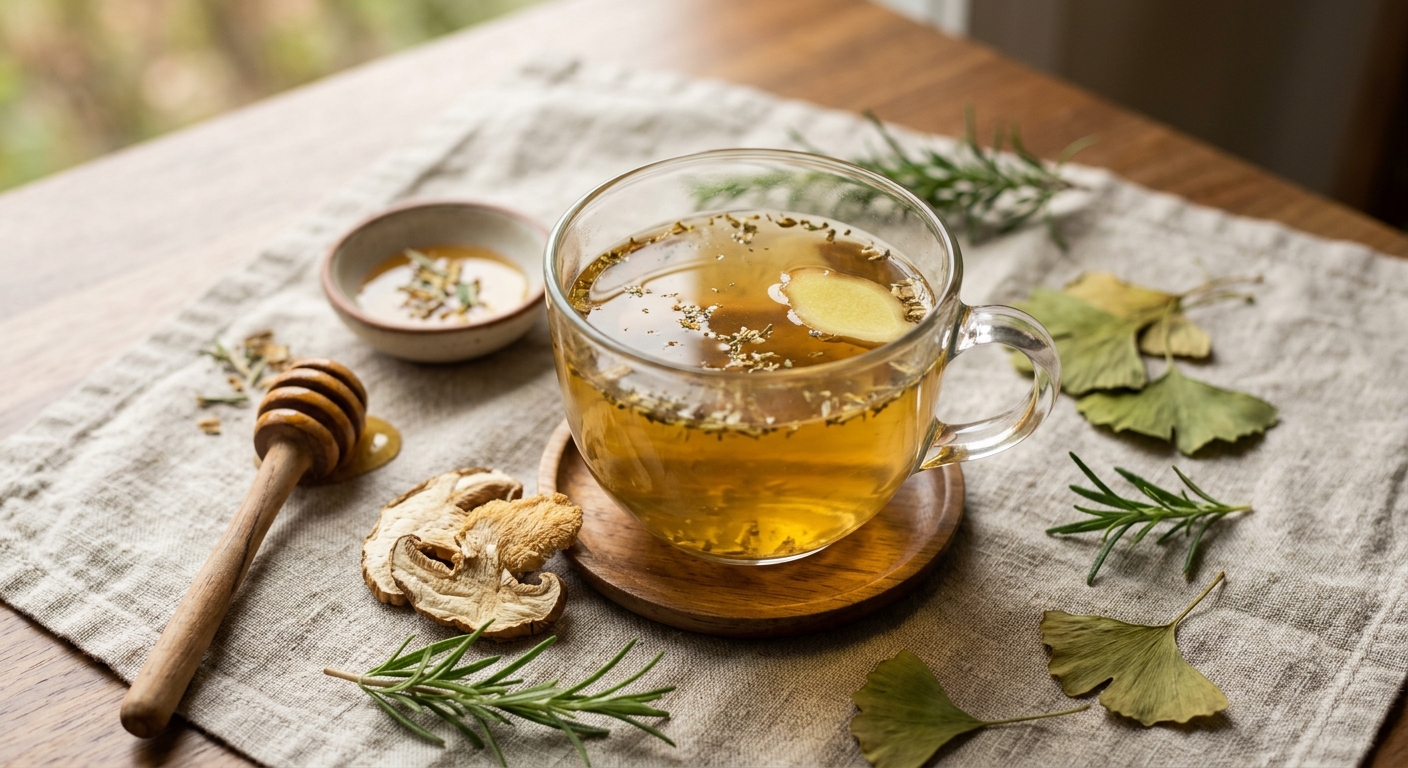
Sensory experience matters too. This tea is a pleasure to prepare and drink. Hot-brewed, it opens with a bold, piney rosemary aroma that transitions into earthy, umami-tinged depth from the lion’s mane, while ginkgo leaf adds a faintly green, slightly bitter finish. Cold-brewed overnight, the bitterness softens and a subtle sweetness emerges, making it an excellent morning drink served over ice. Whether you are settling in for deep work, preparing for an important meeting, or simply seeking a mindful midday ritual, this blend rewards attention with attention.
2
cups
Ingredients
- 2 tspdried lion’s mane mushroom (sliced or powdered)
- 1 tspdried ginkgo biloba leaves
- 1 tspfresh or dried rosemary leaves
- 500 mlwater (90°C / 194°F)
- —raw honey or maple syrup to taste (optional)
- —a thin slice of fresh ginger (optional, for warmth and digestion support)
How to Brew
Click on an item below to shop for the recommended items for this recipe on Amazon.
As an Amazon Associate, we earn from qualifying purchases.
- Bring 500 ml of filtered water to 90 to 95°C (194 to 203°F). Avoid a full rolling boil, which can degrade delicate ginkgo flavonoids and make rosemary turn harsh and bitter.
- Add 2 tsp dried lion’s mane mushroom, 1 tsp dried ginkgo biloba leaves, and 1 tsp rosemary (fresh or dried) to a tea infuser, muslin bag, or teapot with a built-in strainer.
- Pour the hot water over the herbs, cover the vessel with a lid or small saucer to trap volatile aromatic compounds from the rosemary, and steep for 10 to 15 minutes.
- At the 10-minute mark, taste the brew. If you prefer a more pronounced earthiness and stronger ginkgo character, continue steeping up to 15 minutes. Remove the infuser promptly at your preferred strength to prevent excess bitterness.
- Pour into a pre-warmed mug and sweeten lightly with raw honey or maple syrup if desired. Add a slice of fresh ginger to the cup for an optional warming note that also aids digestion. Drink while working or studying for best effect.
- Measure 2 tsp dried lion’s mane mushroom, 1 tsp dried ginkgo biloba leaves, and 1 tsp rosemary into a clean glass jar or cold brew pitcher. Use a slightly higher ratio of lion’s mane (up to 3 tsp) if you prefer a richer, more earthy cold brew.
- Add 600 ml of cold, filtered water to the jar. Cold brewing uses slightly more water than hot brewing because no volume is lost to steam evaporation and the extraction is gentler.
- Stir gently to ensure all herbs are fully submerged. Place a loose lid or breathable cover on the jar and leave it at room temperature for 1 hour, then transfer to the refrigerator.
- Allow to steep in the refrigerator for a total of 8 to 12 hours. Overnight is ideal. The slow, cold extraction pulls polysaccharides from the lion’s mane and flavonoids from the ginkgo without releasing as many harsh bitter compounds.
- Strain the brew through a fine-mesh sieve lined with a coffee filter or cheesecloth to remove all mushroom and herb particles. Pour over a glass filled with ice and sweeten with a small drizzle of honey or a splash of apple juice for a lighter, refreshing morning ritual.
- Add 2 to 3 tsp dried lion’s mane mushroom to a small saucepan with 600 ml of cold, filtered water. Begin with the mushroom in cold water before applying heat, which helps open the fibrous cell walls more effectively than adding it to already-hot water.
- Bring the water to a full boil over medium-high heat, then immediately reduce the heat to a gentle simmer. You want small, lazy bubbles, not a rolling boil that will cause too much evaporation.
- Simmer the lion’s mane uncovered for 15 minutes, allowing the liquid to reduce slightly and deepen in color to a rich amber-brown. This extended heat exposure is necessary to break down the tough chitin cell walls and liberate beta-glucan polysaccharides.
- Add the dried ginkgo biloba leaves and rosemary to the simmering decoction during the final 5 to 8 minutes only. These more delicate botanicals should not be boiled for the full duration, as prolonged heat degrades their key flavonoids and volatile oils.
- Remove from heat, cover the saucepan, and allow to rest for 5 minutes. Strain through a fine-mesh sieve into a teapot or heat-proof pitcher. Pour into a mug, add honey to taste, and sip slowly. Store leftover decoction in the refrigerator in a sealed glass jar for up to 3 days and reheat gently as needed.
Health Benefits
Lion’s mane’s hericenones and erinacines stimulate Nerve Growth Factor synthesis, which supports hippocampal neurogenesis and synaptic plasticity, the biological foundations of working memory. A 2009 double-blind trial published in Phytotherapy Research found that older adults who consumed lion’s mane daily for 16 weeks showed significantly improved cognitive function scores compared to placebo.
Ginkgo biloba’s ginkgolides inhibit platelet-activating factor and improve microcirculation in the brain, ensuring that neurons receive adequate oxygen and glucose during cognitively demanding tasks. This mechanism is particularly well-supported by clinical evidence in populations experiencing age-related cognitive slowing.
Rosemary’s 1,8-cineole has been shown in inhalation and ingestion studies to improve sustained attention and reduce mental fatigue during prolonged cognitive tasks, in part by preserving acetylcholine availability at the synaptic level. A 2012 study in Therapeutic Advances in Psychopharmacology found that blood levels of 1,8-cineole correlated directly with improved cognitive performance scores.
All three key ingredients contribute antioxidant activity through different mechanisms: ginkgo flavonol glycosides scavenge free radicals at neuronal membranes, lion’s mane beta-glucans modulate neuroinflammatory pathways, and rosemary’s rosmarinic acid inhibits lipid peroxidation in brain tissue, collectively supporting long-term neuronal health.
Lion’s mane has shown anxiolytic and antidepressant-like effects in preliminary human research, with a 2010 study finding that women who consumed lion’s mane cookies for four weeks reported reduced irritability and anxiety compared to controls. Since anxiety and low mood are among the most common disruptors of executive function, this benefit directly supports the blend’s cognitive goals.
🧪 Key Bioactive Compounds
The Science Behind Lion’S Mane Mushroom
The cognitive benefits of this blend are grounded in three distinct but complementary mechanisms. Lion’s mane mushroom’s most celebrated action centers on its ability to upregulate Nerve Growth Factor (NGF), a protein essential for the survival, maintenance, and growth of neurons in the brain and peripheral nervous system. The hericenones found in the mushroom’s fruiting body and the erinacines found in its mycelium both independently promote NGF synthesis, though through slightly different pathways. Erinacines are particularly notable because they are small enough to cross the blood-brain barrier directly, allowing them to stimulate NGF production within the central nervous system itself. This neurotropic activity makes lion’s mane uniquely interesting among edible fungi and has driven a growing body of clinical research into its potential applications for mild cognitive impairment and neurodegenerative conditions.
Ginkgo biloba acts on the vascular side of cognitive performance. Its terpene lactones, specifically ginkgolides A and B, are potent and selective antagonists of platelet-activating factor (PAF), a signaling molecule involved in platelet clumping and inflammation. By moderating PAF activity, ginkgolides help maintain healthy blood viscosity and improve capillary circulation throughout the brain, ensuring that metabolically active neurons receive a consistent supply of oxygen and glucose. Simultaneously, ginkgo’s flavonol glycosides (derivatives of quercetin, kaempferol, and isorhamnetin) provide broad-spectrum antioxidant protection at the level of neuronal membranes, neutralizing reactive oxygen species before they can trigger the lipid peroxidation cascade that damages cell integrity. This dual vascular and antioxidant action explains why ginkgo has accumulated one of the largest bodies of clinical evidence of any botanical nootropic.
Rosemary contributes its cognitive benefits primarily through 1,8-cineole, a volatile monoterpene that is both inhaled during brewing and absorbed through the gastrointestinal tract when the tea is consumed. Mechanistically, 1,8-cineole acts as a reversible inhibitor of acetylcholinesterase, the enzyme responsible for breaking down acetylcholine in synaptic clefts. By slowing acetylcholine degradation, rosemary effectively raises cholinergic tone in brain regions associated with attention and memory encoding, including the hippocampus and prefrontal cortex. This is the same general mechanism targeted by certain pharmaceutical drugs used to treat Alzheimer’s disease, which makes rosemary’s traditional reputation as an herb of memory and remembrance genuinely prescient. The compound is also lipophilic, meaning it crosses the blood-brain barrier efficiently and begins acting relatively quickly after consumption, which aligns with the near-immediate aromatic clarity many people report when drinking rosemary tea.
Brewing Tips
- If using powdered lion’s mane rather than sliced dried mushroom, reduce the amount to 1 teaspoon per serving and whisk it directly into hot water before adding the other herbs, as powder can clump in an infuser and block flow.
- Source your ginkgo biloba leaves from a reputable herbal supplier and ensure they are leaves, not seeds. Ginkgo seeds contain ginkgotoxin and are toxic when consumed raw or in large quantities; the leaves used in herbal tea preparations do not carry this risk at standard doses.
- Prepare a batch of the decoction on Sunday evening and refrigerate it in a sealed glass jar to enjoy as a ready-to-reheat or pour-over-ice focus tea throughout the work week, which makes the more time-intensive decoction method practical for daily use.