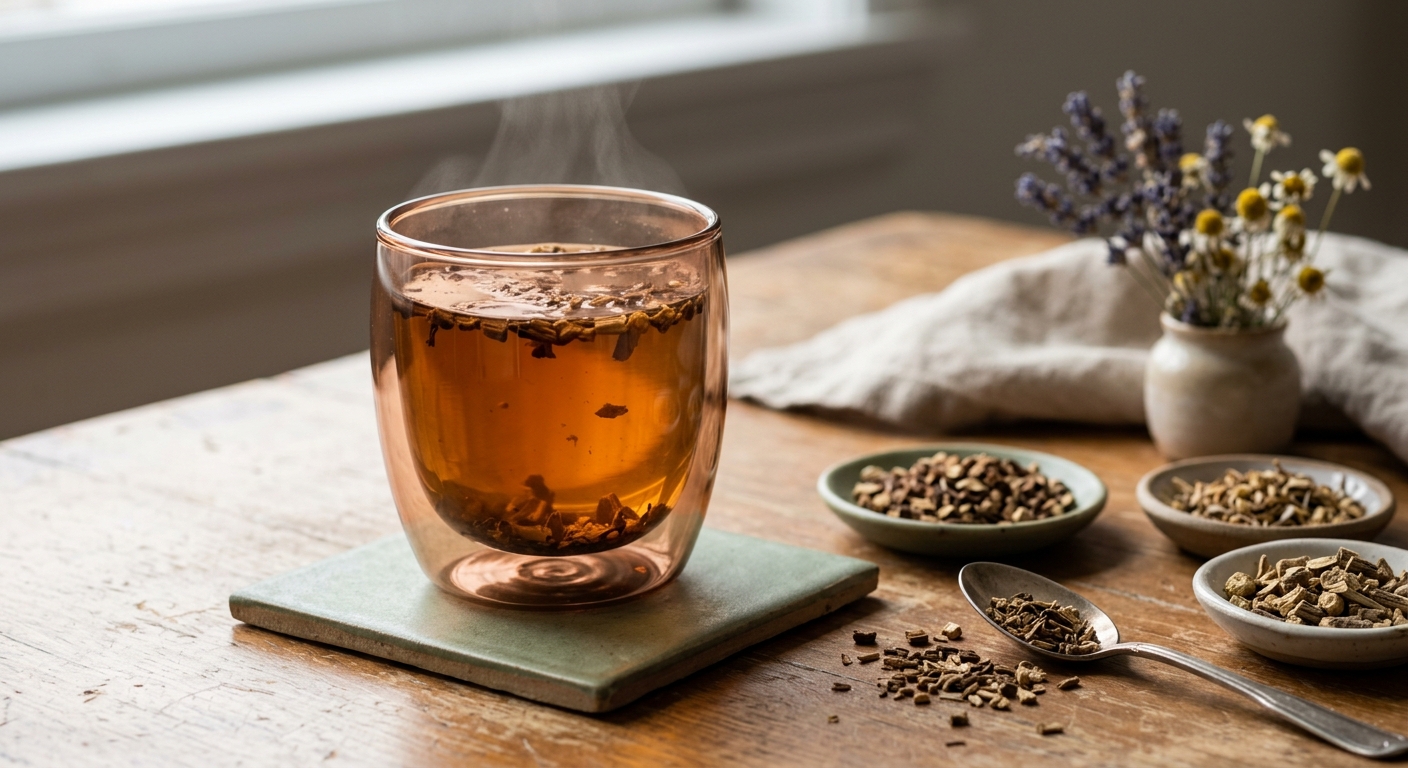
For centuries, people around the world have turned to roasted roots and adaptogenic herbs when coffee was scarce or simply not suited to their bodies. During the Napoleonic blockades of the early 1800s, Europeans roasted chicory root as a coffee substitute, and the tradition took such firm hold in places like New Orleans and northern France that it never disappeared. Dandelion root, meanwhile, was prized in European and Chinese herbal traditions for its liver-supportive and digestive properties, and its deep, earthy flavor when roasted bears a striking resemblance to dark-roasted arabica. These are not desperate stand-ins for the real thing; they are herbs with their own rich histories and genuine functional benefits.
What makes this blend truly special is the addition of eleuthero, also known as Siberian ginseng, a revered adaptogen used for thousands of years in Traditional Chinese Medicine and extensively studied by Soviet researchers during the mid-twentieth century. Unlike caffeine, which stimulates the central nervous system by blocking adenosine receptors and eventually depletes your adrenal reserves, eleuthero works by modulating the stress response at the level of the HPA axis. The result is a smoother, more sustained sense of alertness that does not end in an afternoon crash or disrupt nighttime sleep. A touch of licorice root rounds out the blend, adding natural sweetness and supporting the adrenal glands that eleuthero protects.
This tea is ideal for anyone reducing caffeine intake, managing adrenal fatigue, or simply seeking a morning ritual that feels as grounding and intentional as a proper coffee ceremony. The roasted roots create a deep amber to dark brown brew with genuine body and bitterness, while the adaptogenic herbs work quietly in the background to support your energy systems over time rather than borrowing from tomorrow to pay for today.
2
cups
Ingredients
- 2 tsproasted chicory root (chopped or granulated)
- 1 tsproasted dandelion root (chopped)
- 1 tspeleuthero root (dried, chopped)
- 0.5 tsplicorice root (dried, chopped)
- 480 mlwater (95 to 100°C / 203 to 212°F)
- —oat milk or coconut milk to taste (optional)
- —raw honey or maple syrup to taste (optional)
How to Brew
Click on an item below to shop for the recommended items for this recipe on Amazon.
As an Amazon Associate, we earn from qualifying purchases.
- Measure 2 tsp roasted chicory root, 1 tsp roasted dandelion root, 1 tsp eleuthero root, and 0.5 tsp licorice root into a small saucepan. These are all hard, woody root pieces that need direct heat to release their compounds properly.
- Add 560 ml of cold, filtered water to the saucepan to account for evaporation during simmering. Place over medium-high heat and bring just to a boil.
- Once the water reaches a full boil, reduce heat to medium-low to maintain a gentle simmer. Allow the roots to simmer uncovered for 10 to 15 minutes. The liquid will deepen in color to a rich mahogany and the aroma will become boldly roasted.
- Remove the saucepan from heat and let the blend rest off the heat for 2 additional minutes. This allows a final passive infusion of more delicate aromatic compounds.
- Pour the decoction through a fine-mesh strainer into two mugs, pressing the spent roots gently with the back of a spoon to extract every last drop of liquid.
- Taste before adding any sweetener. The licorice root provides background sweetness, so you may need less honey than expected. Add oat milk or coconut milk if desired for a latte-like body that closely mimics a flat white.
- Combine 3 tsp roasted chicory root, 1.5 tsp roasted dandelion root, 1 tsp eleuthero root, and 0.5 tsp licorice root in a glass jar. Use a slightly higher ratio of roots than the hot method because cold water extracts less intensely over the same volume.
- Add 600 ml of cold, filtered water to the jar and stir thoroughly to ensure all root pieces are fully submerged. Do not use ice water, as water that is too cold will slow extraction excessively.
- Cover the jar loosely with a cloth or lid and leave at room temperature for the first 2 hours to initiate extraction before the cold environment slows the process.
- Transfer the jar to the refrigerator and let it steep for a further 10 to 14 hours, ideally overnight. The long, slow cold extraction draws out inulin-rich, naturally sweet compounds while leaving behind much of the harsh bitterness.
- The following morning, strain through a fine-mesh strainer lined with a paper coffee filter into a clean jar or pitcher. The paper filter removes fine root sediment for a clean, coffee-like clarity.
- Serve over ice with cold oat milk or drink straight. The cold brew concentrate keeps refrigerated for up to 3 days. If the flavor is too concentrated, dilute with additional cold water at a 1:1 ratio.
- Combine 6 tsp roasted chicory root, 3 tsp roasted dandelion root, 2 tsp eleuthero root, and 1 tsp licorice root in a medium saucepan. This quantity yields enough concentrate for approximately 6 to 8 servings.
- Add 700 ml of cold, filtered water. Bring to a full boil over high heat, then reduce to a medium simmer. Simmer uncovered for 20 to 25 minutes, stirring occasionally. You are intentionally reducing the liquid and intensifying the extraction.
- Keep a close eye on the liquid level after the 15-minute mark. You are aiming to reduce it by roughly one-third, ending with approximately 450 to 500 ml of concentrate. If it reduces too far, add a small splash of hot water.
- Remove from heat and strain immediately through a fine-mesh strainer into a heatproof glass jar or measuring jug, pressing the roots firmly to extract all liquid. Discard the spent roots.
- Allow the concentrate to cool to room temperature, then seal the jar and refrigerate. The concentrate will keep for up to 5 days.
- To serve, mix 60 to 80 ml of concentrate with 120 to 150 ml of hot water or steamed oat milk for a hot drink, or pour over ice and top with cold milk. Adjust the dilution ratio to your preferred strength, using a higher concentrate ratio for an espresso-style intensity.
Health Benefits
Eleuthero root supports the HPA axis rather than stimulating the central nervous system directly, meaning energy levels rise gradually and remain stable without the adenosine rebound crash that follows caffeine. Multiple clinical trials in Soviet sports medicine and modern adaptogen research consistently show improved endurance and reduced perceived fatigue with eleuthero supplementation.
Roasted dandelion root contains taraxacin and taraxacerin, bitter compounds that stimulate bile secretion from the gallbladder and improve fat digestion and liver detoxification. Traditional Western herbalism has used dandelion root as a primary liver tonic for hundreds of years, and modern research supports its hepatoprotective and cholagogue activity.
Chicory root is one of the richest natural sources of inulin, a prebiotic fiber that selectively feeds Lactobacillus and Bifidobacterium species in the gut. Regular consumption has been shown in clinical studies to improve bowel regularity, increase beneficial bacterial populations, and reduce markers of gut inflammation.
The combination of eleuthero and licorice root forms a well-established adaptogenic pair in both Traditional Chinese Medicine and modern herbal practice. Eleuthero helps regulate cortisol secretion patterns, while glycyrrhizin in licorice supports the enzyme that converts active cortisol to its inactive form, helping maintain appropriate cortisol tone during periods of chronic stress.
Chlorogenic acid, present in significant quantities in both roasted chicory and dandelion root, has been studied for its ability to reduce LDL oxidation and support healthy blood pressure. The roasting process modifies but does not eliminate these polyphenols, and the resulting compounds retain meaningful free-radical scavenging activity.
🧪 Key Bioactive Compounds
The Science Behind Chicory Root
The energy-supporting properties of this blend operate through fundamentally different mechanisms than caffeine, and understanding that difference explains why users report a cleaner, more sustained alertness. Eleuthero root’s primary active compounds, eleutherosides B and E, are classified as adaptogens because they help normalize physiological stress responses rather than simply overriding them. Research, including Soviet-era studies conducted under rigorous athletic performance conditions and more recent placebo-controlled trials, shows that eleuthero reduces the elevation of stress hormones like cortisol and adrenaline during acute physical and mental strain. This means the body uses its energy reserves more efficiently rather than depleting them rapidly, resulting in endurance that outlasts the effects of caffeine by hours without the subsequent crash.
Chicory and dandelion roots contribute to the blend’s functional profile primarily through their bitter compounds and prebiotic fiber content. Taraxacin and taraxacerin in dandelion root act as cholagogues, stimulating the liver to produce and release bile more effectively. This improves fat emulsification and nutrient absorption in the small intestine, which has indirect but meaningful effects on energy metabolism. Inulin from chicory root, meanwhile, undergoes fermentation in the large intestine, producing short-chain fatty acids such as butyrate. Butyrate is not only the preferred fuel source for colonocytes but also plays a role in reducing systemic inflammation and improving the gut-brain signaling pathways that influence mood and cognitive clarity.
Glycyrrhizin from licorice root adds a layer of endocrine support that makes this blend particularly appropriate for people experiencing burnout or adrenal fatigue. Glycyrrhizin inhibits the enzyme 11-beta-hydroxysteroid dehydrogenase type 2, which converts active cortisol into inactive cortisone in peripheral tissues. At moderate intakes, this action helps maintain appropriate cortisol signaling in people whose adrenal output has become blunted by chronic stress, supporting the natural circadian rhythm of cortisol that produces alertness in the morning and winds down toward evening. The chlorogenic acids present in both roasted chicory and dandelion add antioxidant activity and have been independently associated with improved insulin sensitivity, helping to maintain the stable blood glucose levels that underpin consistent mental focus throughout the day.
Brewing Tips
- Dry-toast the chopped chicory and dandelion roots in a skillet over medium heat for 3 to 5 minutes before brewing if you want a deeper, more intensely roasted flavor that mimics espresso. Stir constantly and pull from heat the moment they darken and release a chocolate-like aroma.
- Grind the dried roots coarsely in a dedicated coffee grinder before brewing. This dramatically increases the surface area exposed to water, reducing your required simmer time by 4 to 5 minutes and producing a more evenly extracted, balanced cup.
- Batch-prep the dry herb blend in a sealed glass jar and store away from heat and light. Pre-mixed blends stay fresh for up to 6 months, making your morning routine as quick and effortless as scooping ground coffee.