Long before sports medicine existed, athletes and warriors across Asia and the Middle East reached for ginger and turmeric to recover from physical exertion. In Ayurvedic medicine, the practice of drinking a warm turmeric preparation, often called “golden milk” or haldi doodh, dates back over 4,000 years. Ginger, known in Sanskrit as “vishwabheshaj” or the universal medicine, was pressed into service for everything from inflammation to muscle fatigue. These two rhizomes have traveled together through centuries of traditional healing, and modern sports science is beginning to confirm what ancient practitioners knew intuitively.
What makes this blend particularly well suited to post-workout recovery is the complementary nature of its two hero ingredients. Turmeric delivers curcumin, one of the most extensively studied natural anti-inflammatory compounds in existence, while ginger contributes gingerols and shogaols that directly inhibit the same inflammatory pathways targeted by common NSAIDs like ibuprofen. Together, they work on delayed onset muscle soreness (DOMS), oxidative stress, and joint inflammation simultaneously, covering the full spectrum of post-exercise discomfort.
This recipe goes a step further by adding black pepper, which dramatically increases curcumin bioavailability, along with a small measure of coconut oil to bind the fat-soluble curcuminoids. A touch of cinnamon rounds out the flavor with its own anti-inflammatory bonus. The result is a rich, warming, slightly spicy tea that tastes like something between a chai and a golden latte, and works hard beneath the surface while you rest and recover.
2
cups
Ingredients
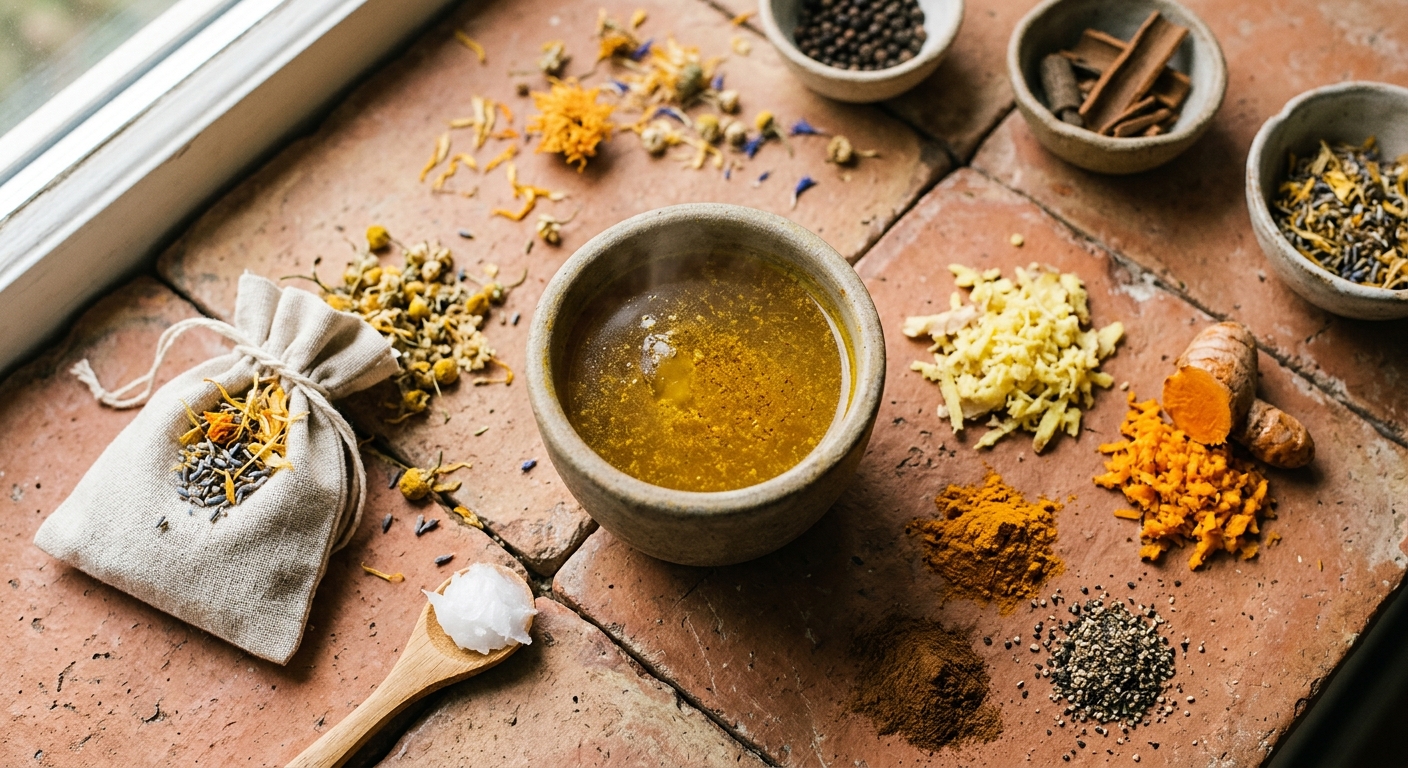
- 2 tspground turmeric or 1-inch fresh turmeric root, grated
- 1 tspfresh ginger root, finely grated
- 0.5 tspground cinnamon
- 0.25 tspfreshly cracked black pepper
- 1 tspvirgin coconut oil or MCT oil
- 480 mlwater (95°C / 203°F)
- —raw honey or maple syrup to taste (optional)
- —splash of oat milk or coconut milk (optional)
How to Brew
Click on an item below to shop for the recommended items for this recipe on Amazon.
As an Amazon Associate, we earn from qualifying purchases.
- Bring 480 ml of water to 90 to 95°C. If using a standard kettle, bring to boil then let it rest for 90 seconds before proceeding.
- Add the grated or ground turmeric, grated ginger, cinnamon, and cracked black pepper directly to a small saucepan. Pour the hot water over the spices.
- Simmer gently on the lowest heat setting for 10 to 12 minutes, stirring occasionally. This gentle decoction extracts the fat-soluble curcuminoids more effectively than a simple steep.
- Remove from heat and whisk in the coconut oil until fully emulsified. The oil helps bind curcumin for better absorption in your gut.
- Strain through a fine mesh strainer into two mugs, pressing the solids firmly with the back of a spoon to extract every drop.
- Sweeten with raw honey or maple syrup if desired, and add a splash of oat milk or coconut milk for a creamier, latte-style finish. Drink while warm, ideally within 30 to 45 minutes of finishing your workout.
- Combine turmeric, ginger, cinnamon, and black pepper in a large glass jar. For cold brew, increase turmeric to 3 tsp and ginger to 1.5 tsp to compensate for the lower extraction efficiency of cold water.
- Pour 600 ml of room-temperature filtered water over the spices. Stir briefly to distribute the ingredients, then seal the jar with a lid.
- Leave the jar on the counter for 1 hour at room temperature to allow initial extraction, then transfer to the refrigerator.
- Cold brew for 10 to 12 hours or overnight. The slow, cold extraction draws out a different balance of compounds, yielding a less bitter and more subtly flavored liquid.
- Strain through a fine mesh strainer or cheesecloth into a clean bottle or pitcher. Add the coconut oil and blend briefly with an immersion blender or shake vigorously to emulsify.
- Serve over ice in tall glasses. Add a squeeze of fresh lemon juice for brightness and extra antioxidant support. Sweeten if desired. Store any remaining portion in the refrigerator for up to 48 hours.
- Scale up all spice ingredients by four: use 8 tsp turmeric, 4 tsp grated ginger, 2 tsp cinnamon, and 1 tsp cracked black pepper. Combine in a medium saucepan with 500 ml of water.
- Bring to a gentle simmer over medium-low heat and cook uncovered for 20 to 25 minutes, stirring regularly. The concentrate will reduce by roughly 30 percent, becoming deep, intensely golden, and slightly syrupy.
- Remove from heat and stir in 4 tsp coconut oil until dissolved. Add 2 tablespoons of raw honey directly into the warm concentrate and stir to combine, as it will dissolve more evenly while hot.
- Strain through a fine mesh strainer into a clean glass jar, pressing the solids firmly. You should yield approximately 300 to 350 ml of concentrate.
- Once cooled to room temperature, seal the jar and store in the refrigerator for up to 7 days.
- To serve, combine 60 to 80 ml of concentrate with 200 ml of hot water, oat milk, or coconut milk. Stir well and drink immediately after training. For an iced version, mix concentrate with cold water and pour over ice.
Health Benefits
A 2015 randomized controlled trial published in the European Journal of Applied Physiology found that 2.5 g of curcumin taken twice daily significantly reduced muscle soreness and damage markers after eccentric exercise. Ginger supplementation has shown similar results across multiple trials, with participants reporting up to 25 percent reduction in DOMS 24 to 72 hours post-exercise.
Both turmeric and ginger inhibit the NF-kB inflammatory pathway and suppress pro-inflammatory cytokines including IL-6 and TNF-alpha, which spike after intense training. This helps shift the body from an inflammatory state into the recovery and tissue-rebuilding phase more quickly.
High-intensity exercise generates reactive oxygen species (ROS) that damage muscle cells and slow recovery. Curcumin is a powerful free radical scavenger and also upregulates the body’s own antioxidant enzymes, including superoxide dismutase and glutathione peroxidase, providing a two-pronged defense against oxidative damage.
Regular consumption of ginger and turmeric has been shown in clinical trials to reduce joint pain comparable in some studies to low doses of ibuprofen. For athletes who train high-impact sports, this translates to improved joint comfort during and between sessions, without the gastrointestinal side effects associated with NSAIDs.
Intense physical exertion diverts blood flow away from the gut, which can cause post-workout nausea and digestive discomfort. Ginger is one of the most clinically validated herbs for nausea and gut motility, helping to restore normal digestive function rapidly after exercise and making nutrient absorption from post-workout meals more efficient.
🧪 Key Bioactive Compounds
The Science Behind Turmeric
The anti-inflammatory power of this recovery blend rests on a well-mapped molecular mechanism. Curcumin, the primary curcuminoid in turmeric, works by blocking NF-kB, a master regulator of the inflammatory response that controls the expression of over 200 genes related to inflammation, immunity, and cell survival. When you exercise intensely, muscle microtrauma triggers NF-kB activation, flooding tissues with pro-inflammatory cytokines like IL-1beta, IL-6, and TNF-alpha. Curcumin directly intercepts this signaling cascade, reducing the magnitude of the inflammatory surge without fully suppressing it, since some inflammation is necessary for adaptation and muscle growth. This nuanced modulation is one reason researchers consider curcumin a more elegant recovery tool than blanket anti-inflammatory drugs.
Ginger’s active compounds, particularly 6-gingerol and 6-shogaol, work through a related but distinct mechanism. They inhibit both COX-1, COX-2, and 5-LOX enzymes, the same targets as NSAIDs and corticosteroids, reducing the synthesis of prostaglandins and leukotrienes that drive pain and swelling. Shogaol, which forms when fresh ginger is dried or heated, has been shown in several in vitro studies to be more potent than gingerol in this regard, which is one reason using a combination of fresh and dried ginger extracts, or simmering fresh ginger to promote the conversion, can enhance the blend’s efficacy. A 2020 meta-analysis in Phytotherapy Research, which reviewed 11 randomized controlled trials, confirmed that ginger supplementation significantly reduced both subjective muscle soreness and objective inflammatory biomarkers in athletes.
The inclusion of black pepper is not merely culinary. Piperine, the compound that gives black pepper its sharp bite, inhibits the enzyme UDP-glucuronosyltransferase in the intestinal wall and liver. This enzyme is responsible for glucuronidation, the process by which curcumin is rapidly conjugated and excreted before it can enter systemic circulation. By inhibiting this process, even a small amount of piperine (5 mg alongside 500 mg curcumin) has been shown in human pharmacokinetic studies to increase serum curcumin levels by up to 2,000 percent, turning a poorly bioavailable compound into one that genuinely reaches target tissues at therapeutic concentrations. The coconut oil plays a similar supporting role: curcumin is fat-soluble, and consuming it with a dietary fat dramatically increases its absorption through the lymphatic system, bypassing the first-pass metabolism that degrades so much of what is taken without fat.
Brewing Tips
- Always crack or grind your black pepper fresh immediately before adding it to the brew. Pre-ground pepper loses piperine potency quickly after grinding, and the whole point of including it is to maximize curcumin absorption.
- Fresh turmeric root, available in health food stores and Asian grocery stores, delivers a brighter, less bitter flavor than ground powder and contains higher concentrations of volatile oils including ar-turmerone. Use roughly a 3-to-1 ratio of fresh to dried when substituting: 1 tablespoon of freshly grated turmeric equals approximately 1 teaspoon of ground.
- Time your tea strategically. The anti-inflammatory window matters. Consuming this blend within 30 to 60 minutes after training, when inflammatory signaling is peaking, gives the active compounds the best opportunity to intercept the cascade before DOMS sets in fully over the following 24 to 48 hours.
- If you train first thing in the morning, prepare your cold brew batch the night before and store it in a bottle in the fridge. You can grab and go, pour it over ice when you return, and have a ready-made recovery drink without the need to cook or wait while your muscles are already asking for support.