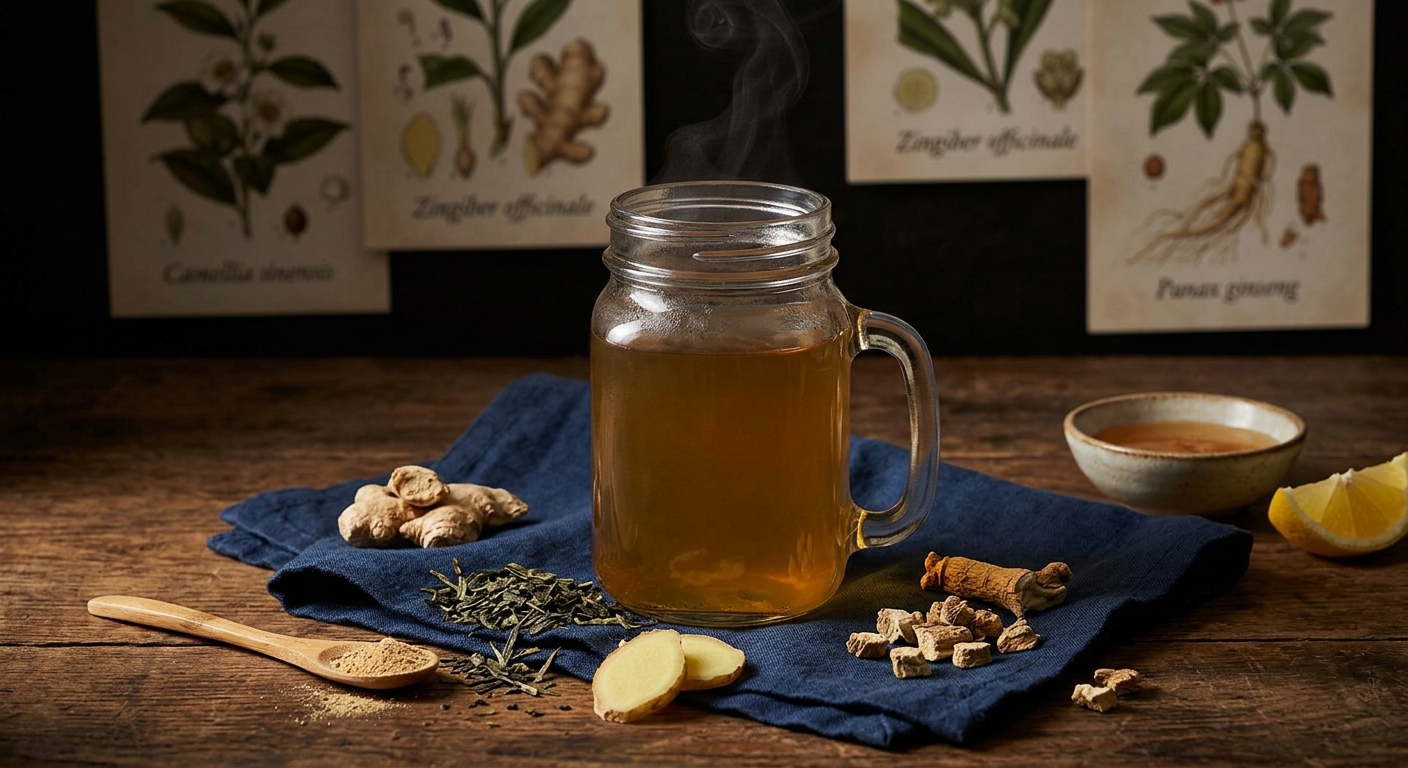
Long before the age of espresso shots and energy drinks, healers and scholars across China, Japan, and Korea were reaching for a very different kind of morning tonic. Green tea, revered for over four thousand years, formed the backbone of daily rituals that prized alertness and calm in equal measure. Paired with ginger root, a warming circulatory stimulant used in Ayurvedic and Traditional Chinese Medicine for millennia, and Panax ginseng, the legendary adaptogenic root known as the “king of herbs,” this blend represents one of the most time-tested approaches to natural energy support on the planet.
What makes this trio so compelling is the way each ingredient complements the others. Green tea provides a gentle lift through caffeine and the remarkable amino acid L-theanine, which smooths out any edginess the caffeine might produce. Ginger ignites digestion, warms the body from within, and improves circulation, helping to deliver oxygen and nutrients more efficiently to the brain. Ginseng brings its adaptogenic power to the equation, helping the body regulate cortisol and sustain mental stamina across the hours of the morning without a sharp peak-and-crash cycle.
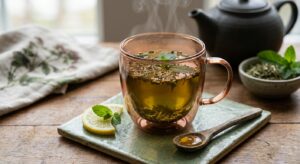
The result in the cup is a bright, slightly vegetal tea with a warm spicy undercurrent and an earthy, rooty depth that evolves as you sip. It is complex without being fussy, invigorating without being aggressive, and deeply satisfying as a daily ritual. Whether you brew it hot on a slow morning or cold-brew it overnight for a grab-and-go option, this blend rewards attention to technique, because the temperature and timing of green tea in particular make a meaningful difference in flavor and bioactive yield.
2
cups
Ingredients
- 2 tsploose-leaf green tea (sencha or gunpowder)
- 1 tspdried ginger root pieces (or 4 to 5 thin slices fresh ginger)
- 0.5 tspdried Panax ginseng root pieces (or 1 tsp ginseng powder)
- 480 mlwater (75 to 80°C / 167 to 176°F)
- —raw honey or maple syrup to taste (optional)
- —a squeeze of fresh lemon juice (optional)
How to Brew
Click on an item below to shop for the recommended items for this recipe on Amazon.
As an Amazon Associate, we earn from qualifying purchases.
- Heat your kettle to 75 to 80°C (167 to 176°F). If you do not have a temperature-controlled kettle, bring water to a full boil, then let it rest uncovered for 4 to 5 minutes to cool to the correct range.
- While water heats, preheat your teapot or mug by rinsing it with a small splash of hot water. Discard the water. This keeps your brew temperature stable throughout steeping.
- Place 2 tsp loose-leaf green tea, 1 tsp dried ginger root, and 0.5 tsp ginseng pieces together into your tea infuser or directly into the teapot. If using a teapot, you will strain when pouring.
- Pour the 75 to 80°C water slowly and evenly over the herbs, making sure all the plant material is saturated. Cover with a lid or small saucer to trap volatile aromatic compounds and maintain temperature.
- Steep for exactly 2 to 3 minutes. Watch your timer carefully. Two minutes produces a lighter, sweeter cup; three minutes gives more body and a slightly more assertive bitterness from the ginseng.
- Remove the infuser or strain into warmed mugs immediately. Do not allow the green tea to continue steeping, as over-extraction turns it astringent. Add honey or a squeeze of lemon if desired, and drink while fragrant and warm.
- Combine 2 tsp loose-leaf green tea, 1 tsp dried ginger pieces, and 0.5 tsp ginseng pieces in a clean glass jar. For cold brew, slightly increasing the green tea to 2.5 tsp helps compensate for the slower cold extraction.
- Pour 480 ml of cold or room-temperature filtered water over the herbs. Do not use warm water, as this will alter the cold extraction chemistry and introduce unwanted bitterness.
- Stir gently to ensure all the plant material is submerged and in contact with the water. Seal the jar with a lid or cover tightly with plastic wrap.
- Refrigerate for 8 to 12 hours. Eight hours yields a lighter, more delicate flavor; twelve hours produces a fuller, more complex brew with more pronounced ginger warmth and ginseng earthiness.
- When ready, strain the tea through a fine-mesh strainer or cheesecloth into a clean pitcher or directly into glasses filled with ice. Discard the spent herbs.
- Taste before sweetening. Cold brew green tea is often sweet enough on its own. Add honey dissolved in a teaspoon of warm water first if sweetening, as cold liquid does not dissolve granular sweeteners easily. Serve over ice and drink within 48 hours.
- Prepare a double-strength batch by combining 4 tsp loose-leaf green tea, 2 tsp dried ginger root, and 1 tsp ginseng pieces in a teapot or heatproof pitcher. This quantity will yield enough concentrate for approximately 4 servings.
- Heat 480 ml of water to 75 to 80°C (167 to 176°F) using the same cooling method as the hot brew. Pour evenly over the herbs, cover, and steep for 4 to 5 minutes. The extra minute is acceptable here because the concentrate will be heavily diluted, softening the bitterness in the final cup.
- Strain immediately and thoroughly through a fine-mesh strainer into a clean glass jar or pitcher, pressing gently on the solids to extract full flavor without introducing excessive sediment.
- Allow the concentrate to cool to room temperature, uncovered, for no more than 20 minutes. Then seal and refrigerate. The concentrate keeps well for up to 3 days.
- Each morning, pour approximately 120 ml of cold concentrate into your mug. Add 120 ml of hot water (75 to 80°C) for a hot cup, or 120 ml of cold water over ice for an iced version. Stir, adjust sweetness, and add lemon if desired. Your morning ritual is ready in under two minutes.
Health Benefits
The combination of caffeine and L-theanine in green tea is one of the most studied cognitive pairings in nutrition science. Research published in Nutritional Neuroscience demonstrates that this combination improves attention, reaction time, and working memory more effectively than caffeine alone, while significantly reducing the anxiety and heart rate elevation that caffeine can produce on its own.
Panax ginseng’s ginsenosides act on the hypothalamic-pituitary-adrenal (HPA) axis to moderate cortisol release during psychological and physical stress. A randomized controlled trial in the Journal of Psychiatric Research found that participants taking standardized ginseng extract reported significantly lower mental fatigue and improved calmness scores during demanding cognitive tasks.
Ginger’s 6-gingerol and shogaol compounds are vasodilatory and thermogenic, meaning they stimulate blood flow and raise peripheral circulation. Improved cerebral blood flow is directly linked to better oxygen delivery to the prefrontal cortex, supporting sharper focus and quicker information processing in the morning hours.
EGCG from green tea crosses the blood-brain barrier and scavenges reactive oxygen species that accumulate during neuronal activity. Long-term consumption has been associated in epidemiological studies with a reduced risk of neurodegenerative conditions, and short-term intake shows measurable reductions in markers of oxidative stress within hours of consumption.
Ginger is a well-documented prokinetic agent, meaning it accelerates gastric emptying and stimulates digestive enzyme secretion. Drinking this blend first thing in the morning helps awaken the digestive system, reduces morning nausea (particularly relevant for those sensitive to caffeine on an empty stomach), and prepares the gut to absorb nutrients from breakfast more efficiently.
🧪 Key Bioactive Compounds
The Science Behind Green Tea (Camellia Sinensis)
The science behind this energy blend begins with one of the most well-documented pairings in nutritional neuroscience: caffeine and L-theanine. Caffeine works primarily by blocking adenosine receptors in the brain. Adenosine is the neurotransmitter responsible for the progressive buildup of mental fatigue throughout the day, and by competitively occupying its receptors, caffeine prevents this fatigue signal from being received, resulting in sustained wakefulness and improved reaction time. L-theanine, a non-protein amino acid found almost exclusively in Camellia sinensis, promotes the production of alpha brain waves and modulates GABA and glutamate activity, creating a state of calm, focused alertness. Multiple randomized controlled trials, including a landmark 2008 study in Biological Psychology, have confirmed that the combined intake of these two compounds produces superior attention and cognitive performance compared to either compound alone, while measurably reducing the anxiety and cardiovascular side effects of caffeine consumed in isolation.
Panax ginseng contributes a separate but complementary mechanism through its triterpenoid saponins, collectively called ginsenosides. The two most studied, Rb1 and Rg1, exert opposing but balancing effects on the central nervous system: Rg1 is mildly stimulating and neuroprotective, while Rb1 is calming and anti-stress. Together they act on the hypothalamic-pituitary-adrenal (HPA) axis, the body’s master stress response system, to normalize cortisol secretion during periods of cognitive or physical demand. This is the defining feature of an adaptogen: not simply stimulating the system, but helping it respond to stress more efficiently. Clinical research published in the Journal of Psychopharmacology demonstrated that a single dose of standardized Panax ginseng extract significantly improved working memory and calmness scores in healthy adults performing sustained mental workload tasks.
Ginger’s bioactive phenolic compounds add a third dimension to this formula. Fresh ginger is rich in 6-gingerol, while dried ginger converts much of this compound to the more potent shogaols through dehydration. Both compounds are potent inhibitors of cyclooxygenase (COX) and lipoxygenase (LOX) enzymes, the same inflammatory pathways targeted by non-steroidal anti-inflammatory drugs, meaning that even at tea quantities, ginger reduces low-grade systemic inflammation that can impair neurological function and contribute to brain fog. Additionally, ginger’s thermogenic effect increases peripheral blood flow, which in the context of a morning cup translates to faster delivery of oxygen and glucose to the prefrontal cortex, the brain region most responsible for planning, attention, and executive function. EGCG from the green tea base adds a final layer of neuroprotective antioxidant activity by crossing the blood-brain barrier and neutralizing reactive oxygen species produced during intense cognitive work.
Brewing Tips
- Always use a temperature-controlled kettle or a simple cooking thermometer when brewing green tea. A difference of just 10°C can mean the difference between a smooth, sweet cup and a sharp, astringent one that masks the complexity of the ginger and ginseng.
- Source your ginseng carefully. Look for dried Panax ginseng (Asian or Korean ginseng), not Siberian ginseng (Eleutherococcus senticosus), which is a different plant with a different compound profile. The roots should be firm, pale cream to beige in color, and have a distinctly earthy, slightly sweet aroma.
- If you find the ginseng flavor too assertive in your first few brews, start with a smaller amount, around 0.25 tsp per serving, and build up gradually. Your palate will adapt, and it also gives you a chance to observe how your body responds to the adaptogen before consuming a full dose daily.
- For maximum L-theanine extraction from the green tea, cover the vessel while steeping. L-theanine is volatile and heat-sensitive, and trapping the steam inside the cup or pot preserves both the aromatic compounds and the bioactive amino acid content.
- This blend is best consumed in the first two to three hours after waking, and ideally not on a completely empty stomach if you are new to ginseng or sensitive to caffeine. A small handful of nuts or a piece of whole fruit eaten just before is sufficient to buffer any gastric sensitivity.