Rose hips, the round scarlet fruits left behind when a wild rose (Rosa canina) drops its petals, have been gathered for centuries. During World War II, British schoolchildren were sent into hedgerows to collect them for a national syrup, because citrus was scarce and rose hips offered one of the richest wild sources of vitamin C in Europe. Long before that, Native American and European folk herbalists brewed them into winter tonics for colds, sore throats, and general weakness.
Elderberry (Sambucus nigra) has an equally storied past. Hippocrates reportedly called the elder tree his medicine chest, and for generations European households simmered the dark purple berries into syrups, cordials, and warming wintertime drinks. The berries must be dried or cooked before use, which is exactly why they shine in a simmered or steeped tea.
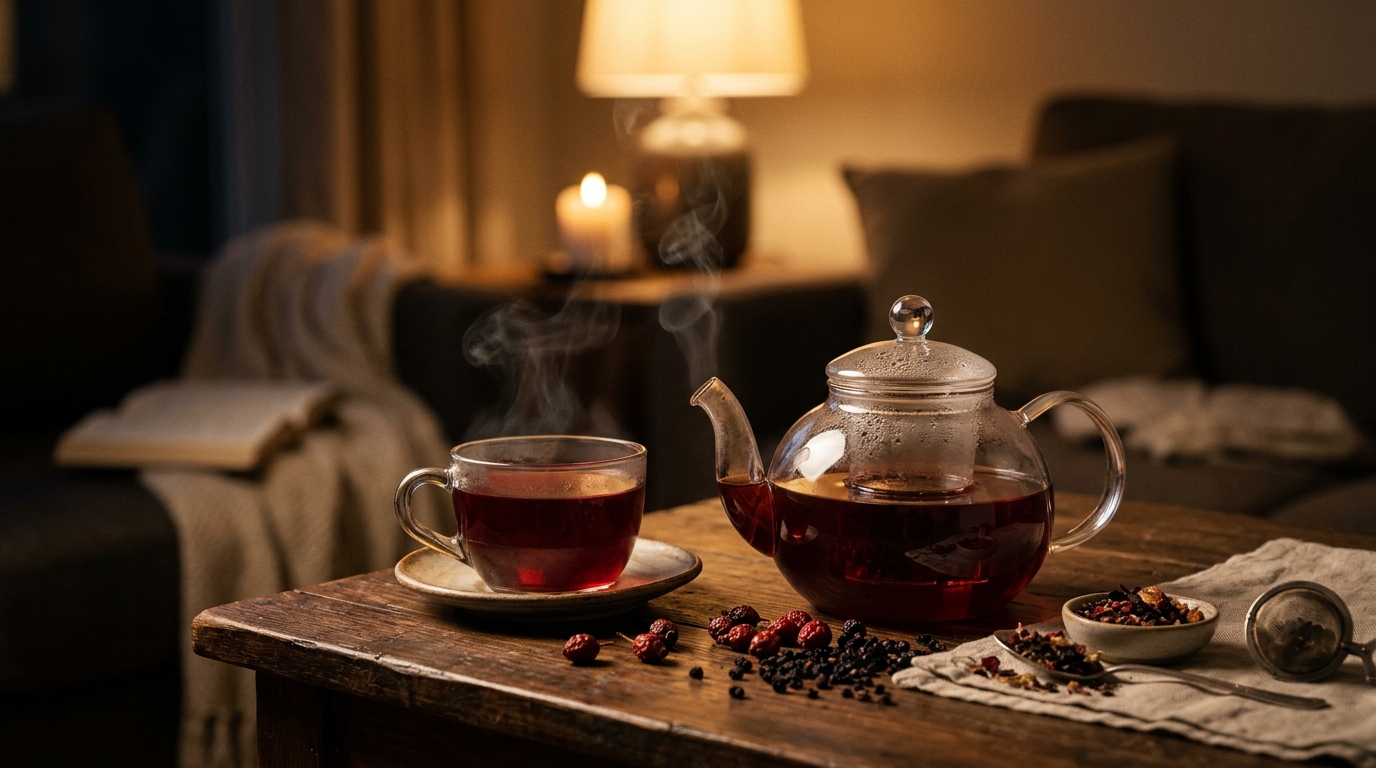
Together, the two fruits make a nightcap that is tart, gently sweet, and deeply colored, with a flavor somewhere between cranberry and blackcurrant. It is caffeine-free, comforting in a mug, and just as refreshing chilled, which makes it a rewarding blend to keep in your pantry all year.
2
cups
Ingredients
- 2 tbspdried rose hips, cut and sifted
- 1 tbspdried elderberries
- 480 mlwater (95°C / 203°F for hot brew)
- 1 tspdried orange peel (optional)
- —raw honey or maple syrup to taste (optional)
- —1 cinnamon stick (optional, for the simmer method)
How to Brew
Click on an item below to shop for the recommended items for this recipe on Amazon.
As an Amazon Associate, we earn from qualifying purchases.
- Measure 2 tablespoons of cut rose hips and 1 tablespoon of dried elderberries into a teapot or large mug. If your rose hips are whole rather than cut, gently crush them with the back of a spoon to open them and release more flavor.
- Bring fresh water to a near boil, then let it rest for about 30 seconds so it sits at roughly 95°C (203°F). Pour 480 ml over the fruit.
- Cover the pot or mug with a saucer or lid and steep for 10 to 15 minutes. Rose hips are dense and need a long steep to give up their color and tang.
- Strain through a fine mesh strainer to catch the small seeds and any rose hip fibers, which can be mildly irritating to the throat.
- Sweeten with a teaspoon of honey or maple syrup if you like, and sip slowly while still warm.
- Add 2 tablespoons of cut rose hips and 1 tablespoon of dried elderberries to a clean glass jar. Lightly crush the rose hips first to expose more surface area.
- Pour in 700 ml of cold filtered water. Cold extraction is slower, so the water-to-herb ratio is slightly more generous than the hot method.
- Stir gently, seal the jar, and refrigerate for 8 to 12 hours, or overnight.
- Strain through a fine mesh strainer or a double layer of cheesecloth, pressing lightly on the fruit to release the last of the liquid.
- Serve over ice with a slice of orange or a few fresh mint leaves. The tea keeps in the refrigerator for up to 2 days.
- Combine 2 tablespoons of rose hips, 1 tablespoon of elderberries, and 480 ml of cold water in a small saucepan. Add a cinnamon stick or a few strips of orange peel if you want a spiced winter version.
- Bring slowly to a boil over medium heat, then immediately lower the heat to the gentlest simmer. Do not let it boil hard, as vigorous boiling can drive off flavor and reduce delicate nutrients.
- Simmer uncovered for 15 minutes, stirring once or twice. The liquid will deepen to a dark garnet and the berries will soften and plump.
- Remove from the heat, cover, and let the tea rest for 10 minutes so the flavors meld.
- Strain into a mug, pressing the softened fruit against the strainer to extract every drop. Stir in honey while the tea is hot so it dissolves fully.
Health Benefits
Vitamin C contributes to the normal function of immune cells, and elderberry extracts have been studied for shortening the duration of cold and flu symptoms in small clinical trials, although more research is needed.
Anthocyanins from elderberry and carotenoids and flavonoids from rose hip help neutralize free radicals, which are linked to cellular stress and inflammation.
Served warm, the tea hydrates and comforts irritated throat tissue, while the astringent tannins in rose hip provide a mildly tightening, soothing effect.
Several studies on rose hip powder, particularly those involving its galactolipid fraction, have reported modest reductions in joint pain in people with osteoarthritis, though tea delivers a lower dose than concentrated extracts.
Because the blend contains no caffeine, it can be enjoyed close to bedtime as a warming ritual that supports hydration without interfering with sleep.
🧪 Key Bioactive Compounds
The Science Behind Rose Hip
The immune reputation of this blend rests on two complementary plant chemistries. Rose hips are a concentrated source of ascorbic acid, a nutrient that accumulates in immune cells such as neutrophils and lymphocytes and supports their ability to fight infection. They also deliver carotenoids like lycopene and beta-carotene, along with flavonoids such as quercetin, which together create a broad antioxidant profile. It is worth noting that vitamin C is sensitive to heat, light, and oxygen, so a brewed cup will contain less than the raw fruit; gentle brewing and covering the cup help preserve more.
Elderberries bring a different set of compounds, chiefly anthocyanins such as cyanidin-3-glucoside and cyanidin-3-sambubioside. These pigments are potent antioxidants, and laboratory research suggests that elderberry extracts may interfere with the ability of certain viruses to attach to and enter cells. Small clinical trials in travelers and in people with influenza-like illness have reported reduced symptom duration, but these studies were limited in size, and elderberry should be viewed as supportive rather than a cure.
The pairing is also pleasing in practical terms. The tartness of rose hips balances the deep, almost wine-like sweetness of elderberries, and their tannins and acids give the cup structure that holds up well to honey, citrus, and warming spices. Because the benefits are cumulative and gentle, this tea is best understood as a nourishing seasonal habit rather than an acute treatment.
Brewing Tips
- Buy cut and sifted rose hips rather than whole ones for a faster, more flavorful extraction, and look for a bright red-orange color, since brown or dusty hips are likely old.
- Strain thoroughly or use a very fine mesh, because the tiny hairs surrounding rose hip seeds can irritate the throat.
- Store dried rose hips and elderberries in airtight, opaque containers away from light and heat to protect their vitamin C and pigments.
- For a quick immune-season batch, simmer a larger pot, refrigerate it, and gently rewarm single servings through the week.