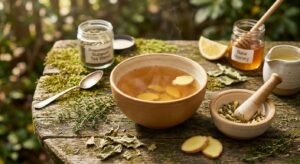
Sage and thyme have been kitchen and apothecary companions for thousands of years. The botanical name for sage, Salvia officinalis, comes from the Latin salvere, meaning “to be saved” or “to heal,” and medieval European households grew it by the doorstep for exactly that reason. An old proverb asks, “Why should a man die while sage grows in his garden?” Gargles and infusions of sage were a standard remedy for sore throats, hoarseness, and inflamed gums long before modern pharmacology existed.
Thyme (Thymus vulgaris) holds a similar place in folk medicine. Ancient Egyptians used it in embalming, Greek and Roman physicians prescribed it for respiratory complaints, and European herbalists steeped it into syrups and teas for coughs and chest congestion. Its aromatic oils, especially thymol, are what give thyme its sharp, warming scent and its long reputation as a respiratory ally. Modern herbal practice still reaches for thyme when a cough settles in at night.
Together, the two herbs make a tea that is savory, resinous, and deeply comforting, a very different experience from sweet floral blends. A generous spoonful of raw honey rounds out the edges and adds its own throat-coating, soothing quality. Drunk warm in the evening, this three-ingredient remedy turns the first scratchy hint of a cold into a small, grounding ritual before bed.
2
cups
Ingredients
- 2 tspdried sage leaves (or 4 fresh leaves)
- 1 tspdried thyme (or 4 fresh sprigs)
- 480 mlwater (95°C / 203°F)
- 2 tspraw honey, or to taste
- —a thin slice of fresh lemon (optional)
How to Brew
Click on an item below to shop for the recommended items for this recipe on Amazon.
As an Amazon Associate, we earn from qualifying purchases.
- Bring fresh water to a full boil, then let it rest for about 30 seconds so it settles near 95°C (203°F).
- Place the dried sage and thyme into a teapot or large mug. If using fresh herbs, gently bruise the leaves between your fingers first to release their oils.
- Pour the hot water over the herbs and immediately cover with a saucer or lid to trap the aromatic vapors.
- Steep for 7 to 10 minutes. Closer to 7 gives a milder cup, while 10 gives a stronger, more medicinal brew.
- Strain into your mug, pressing the herbs lightly against the strainer to extract the last of the liquid.
- Let the tea cool for a minute or two until comfortably warm, then stir in the honey. Adding honey to very hot water can diminish some of its delicate enzymes and aroma.
- Lightly crush the dried sage and thyme between your fingers or with a mortar to break the leaf surface without turning it to powder.
- Combine 2 teaspoons of sage and 1 teaspoon of thyme in a glass jar with 480 ml of cool, filtered water.
- Stir well, seal the jar, and let it sit on the counter for 30 minutes to begin the infusion before refrigerating.
- Move the jar to the refrigerator and steep for 8 to 12 hours, or overnight.
- Strain through a fine mesh sieve or a cloth-lined strainer to remove all herb particles.
- Stir in honey until fully dissolved, which is easier if you first whisk it with a tablespoon of warm water. Serve over ice, or gently warm a portion on the stove without boiling for a mellow evening cup.
- Combine 3 tablespoons of dried sage, 2 tablespoons of dried thyme, and 360 ml of water in a small saucepan.
- Bring to a gentle simmer over medium-low heat, never a rolling boil, and cover the pan with a lid.
- Simmer for 15 minutes, stirring occasionally, until the liquid has reduced by about one third and smells strongly herbal.
- Remove from the heat and let the mixture steep, covered, for another 30 minutes to deepen the flavor.
- Strain through a fine sieve into a clean bowl, pressing the herbs to extract every drop of liquid.
- Measure the liquid and let it cool until just warm. Stir in an equal volume of raw honey until completely dissolved.
- Pour into a sterilized glass jar, cool fully, and refrigerate. To serve, stir 1 to 2 tablespoons into a mug of hot water.
Health Benefits
Sage has a long history as a gargle and tea for throat irritation, and a clinical trial of a sage-based throat spray showed meaningful relief from acute sore throat symptoms. Honey adds a protective coating that reduces the scratchy feeling.
Thyme’s essential oils have expectorant and antispasmodic effects, and thyme preparations are approved in several European countries for coughs. Honey has also been shown in studies to ease nighttime coughing, particularly in children over one year.
Thymol and the phenolic compounds in sage show activity against a range of bacteria and viruses in laboratory research. While tea is not a substitute for medical care, these properties support its traditional use during colds.
Rosmarinic acid, carnosic acid, and luteolin work together to neutralize free radicals and reduce inflammatory signaling, which may help the body cope with the stress of an infection.
The warmth, aroma, and slow ritual of sipping a herbal tea signal the body to wind down. Sage has also been studied for mild mood and cognitive benefits, making this a gentle evening companion.
🧪 Key Bioactive Compounds
The Science Behind Sage
The therapeutic reputation of this blend rests largely on the volatile oils and polyphenols in its two herbs. Thyme’s essential oil is dominated by thymol and carvacrol, phenols that disrupt bacterial cell membranes and have shown antimicrobial effects in laboratory studies. Thymol is also a recognized component of mouthwashes and cough preparations, and plant extracts of thyme have been studied for their ability to relax the smooth muscle of the airways, which may explain their traditional use for spasmodic coughs.
Sage brings a different but complementary chemistry. Its leaves are rich in rosmarinic acid, carnosic acid, and flavonoids such as luteolin, all of which have antioxidant and anti-inflammatory activity. A randomized, double-blind trial of a sage-based throat spray found significantly faster relief of pharyngitis symptoms than placebo, lending modern support to the old folk practice of gargling and sipping sage infusions. The astringent tannins in sage may also tighten and soothe inflamed mucous membranes.
Raw honey rounds out the formula with more than flavor. Its high sugar concentration, low water activity, and natural production of hydrogen peroxide give it antimicrobial properties, and its thick texture forms a protective film over irritated tissue. Research suggests honey can reduce cough frequency and improve sleep quality in people with upper respiratory infections, making it a fitting partner for a nighttime tea. Together, the three ingredients offer a gentle, evidence-informed way to comfort the throat, although they work best as supportive care rather than a cure.
Brewing Tips
- Always cover your cup while steeping, since sage and thyme release many of their beneficial volatile oils into the steam.
- Use fresh herbs when you can, doubling the amount compared to dried, as garden sage and thyme have a brighter, more resinous flavor.
- Add honey only after the tea has cooled slightly, which preserves its aroma and delicate enzymes.
- Gargle with a small mouthful of the warm, unsweetened tea before swallowing the rest for extra soothing contact with the throat.
- Prepare the syrup concentrate on a quiet weekend so a soothing cup is ready in seconds whenever a sore throat strikes.