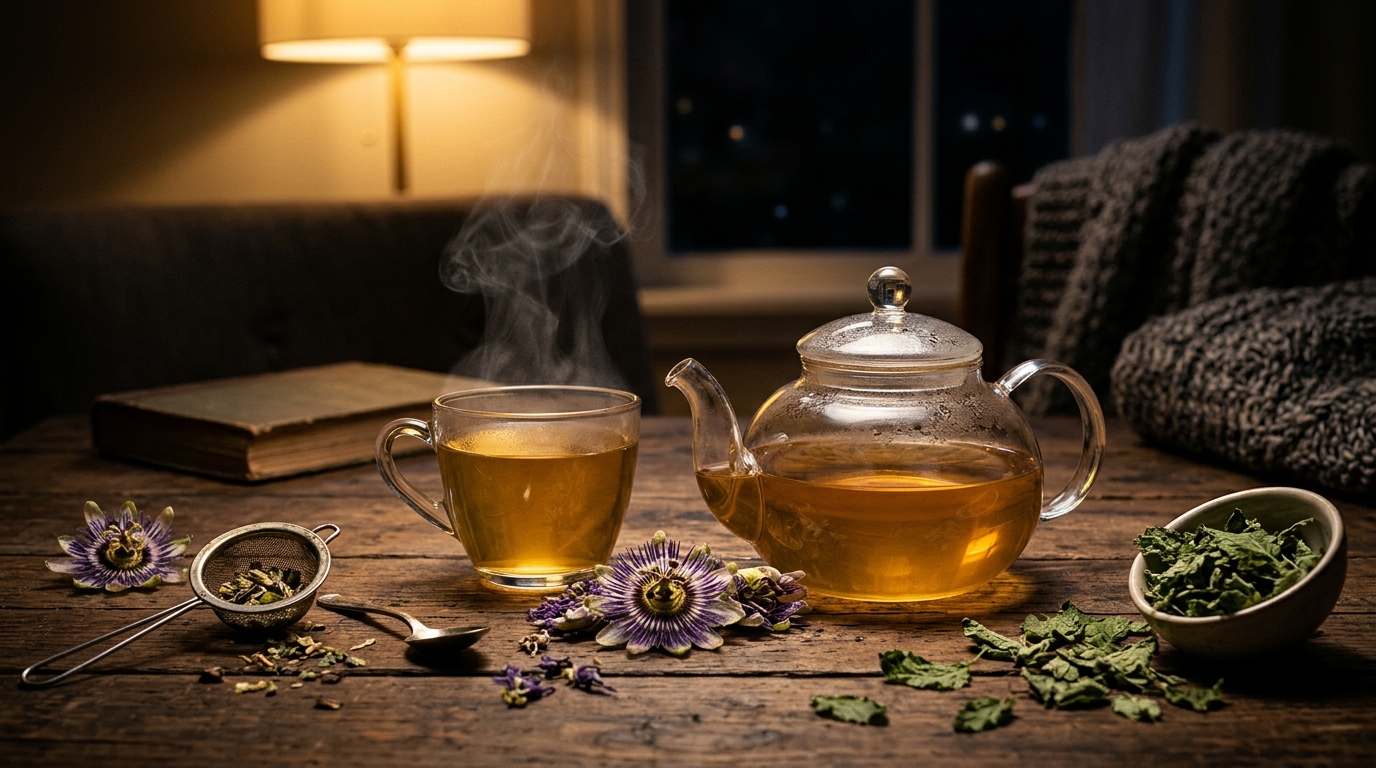
Passionflower (Passiflora incarnata) is a climbing vine native to the southeastern United States, and its extraordinary, otherworldly blooms caught the imagination of everyone who saw them. Spanish missionaries in the 16th century saw symbols of the Passion of Christ in its fringed corona and ten petals, which is how the plant earned its name. Long before that, Indigenous peoples of the Americas, including the Cherokee, used the plant as a poultice for wounds and a calming infusion for restless nerves. By the 19th century, American Eclectic physicians were prescribing passionflower for insomnia, hysteria, and nervous exhaustion, and it has remained a pillar of the herbal sleep tradition ever since.
Lemon balm (Melissa officinalis) belongs to the mint family and has been cultivated for more than two thousand years. Greek and Roman physicians prized it, medieval monasteries grew it in physic gardens, and the Carmelite nuns of Paris distilled it into the famous Carmelite water, a cordial taken for nervous headaches and melancholy. The 17th-century herbalist John Evelyn wrote that balm is good for the melancholy and makes the heart merry. The plant’s name comes from the Greek word for honeybee, because its leaves attract them in droves.
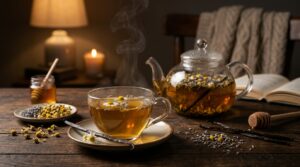
When these two herbs meet in a single cup, something lovely happens. Passionflower brings a deep, almost sedative quality that quiets the mind’s chatter, while lemon balm contributes a bright, uplifting citrus note and a soothing effect on the nervous system and digestion. The result is a tea that tastes like a summer evening: grassy, lightly floral, and softly lemony. It is a blend made for the hour when the day’s worries refuse to leave you alone.
2
cups
Ingredients
- 2 tspdried passionflower (aerial parts: leaf, stem, and flower)
- 2 tspdried lemon balm leaf
- 480 mlwater (95°C / 203°F)
- —raw honey to taste (optional)
- —a thin slice of lemon (optional)
How to Brew
Click on an item below to shop for the recommended items for this recipe on Amazon.
As an Amazon Associate, we earn from qualifying purchases.
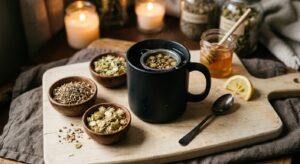
- Measure the dried passionflower and lemon balm into a teapot or a large mug fitted with a mesh infuser. Gently crush the lemon balm leaves between your fingers first to help release their oils.
- Heat fresh water until it just comes off the boil, around 95°C (203°F). Pour it over the herbs, using about 240 ml per 1 teaspoon each of herb for a single cup.
- Cover immediately with a saucer or lid to trap the volatile oils, and steep for 10 minutes. Passionflower is a tough, fibrous herb and benefits from a longer steep than delicate flowers.
- Strain out the herbs, pressing lightly on the infuser to extract the last of the liquid.
- Stir in a little raw honey if you like, and add a thin slice of lemon to emphasize the citrus. Sip slowly about 30 to 45 minutes before bed.
- Combine 4 teaspoons of dried passionflower and 4 teaspoons of dried lemon balm in a clean glass jar. This makes a slightly stronger ratio than hot brew because cold water extracts more slowly.
- Pour in 1 liter of cold, filtered water. Stir once to wet all of the herbs, then seal the jar with a lid.
- Place the jar in the refrigerator and let it steep for 8 to 10 hours, or overnight. Do not exceed 12 hours, as the flavor can turn flat and hay-like.
- Strain through a fine mesh sieve or a coffee filter to remove all plant matter, then transfer to a clean bottle.
- Serve over ice with a lemon wheel, or pour a glass in the early evening. Keep refrigerated and drink within 48 hours.
- Place 3 teaspoons of dried passionflower and 3 teaspoons of dried lemon balm in a heatproof measuring jug or teapot.
- Pour 240 ml of water at 95°C (203°F) over the herbs. This is half the usual water, so the tea will be double strength to allow for melting ice.
- Cover and steep for 8 minutes. This is slightly shorter than a standard hot brew since the concentrate is stronger.
- Strain the hot concentrate directly into a tall glass filled to the top with ice. The ice will melt and dilute the tea to the right strength as it chills it instantly.
- Stir gently, sweeten with honey while the tea is still warm if desired, and garnish with a lemon slice and a fresh lemon balm sprig.
Health Benefits
Both herbs influence the GABA system, the brain’s main calming neurotransmitter. Clinical studies on passionflower have shown anxiety relief comparable to some conventional medications in small trials, and lemon balm has been shown to improve calmness and mood in controlled research.
Passionflower has been shown in human studies to improve subjective sleep quality, and lemon balm combined with other calming herbs has been associated with reduced sleep disturbances. The blend works gently, helping the mind settle rather than forcing sedation.
Lemon balm has a long tradition as a carminative and antispasmodic herb, and its volatile oils help relax smooth muscle in the digestive tract, easing the knotted stomach that often accompanies worry.
Lemon balm has been studied for its ability to increase self-reported calmness and reduce stress-induced agitation, while passionflower’s alkaloids may support a more balanced mood.
Traditionally used for nervous headaches and muscle tension, the combined mild relaxant effects of both herbs can help the body unwind after a stressful day.
🧪 Key Bioactive Compounds
The Science Behind Passionflower
The calming reputation of this pairing rests largely on how both herbs interact with GABA, gamma-aminobutyric acid, the primary inhibitory neurotransmitter in the central nervous system. When GABA activity is low, the brain tends toward overactivity: racing thoughts, tension, and difficulty switching off. Passionflower flavonoids such as chrysin and vitexin appear to modulate GABA-A receptors, while its alkaloids may contribute through other pathways. In a well-known double-blind trial, passionflower performed comparably to oxazepam for generalized anxiety over four weeks, with less impairment of job performance, though the sample was small and more research is needed.
Lemon balm works through a complementary route. Its rosmarinic acid and essential oil constituents have been shown in laboratory studies to inhibit GABA transaminase, the enzyme that breaks down GABA, effectively allowing more of this calming messenger to remain active. Human studies using lemon balm extract have reported improved mood and cognitive calmness, and small trials combining lemon balm with valerian have shown improvements in sleep quality. The citral and citronellal in its volatile oil also contribute through aroma, since inhaling these compounds as you sip may itself promote relaxation.
Together, the two herbs offer layered support: passionflower for deeper quieting of mental chatter, lemon balm for mood, gentle sedation, and digestive comfort. It is worth being honest that much of the human evidence comes from concentrated extracts rather than tea, and results from a cup of infusion will be milder. Even so, the combination of a warming ritual, a pleasant aroma, and genuinely active plant compounds makes this a time-honored and reasonable choice for easing evening unrest.
Brewing Tips
- Use whole, fragrant lemon balm leaves that are still green and smell strongly of lemon. If the leaves are brown or smell like hay, they have lost their volatile oils and the tea will taste flat.
- Drink this tea about 30 to 45 minutes before bed rather than right as you lie down, so the calming effects build as you wind down and you avoid a late-night bathroom trip.
- If you grow your own lemon balm, use a small handful of fresh leaves in place of the dried herb, roughly 1 tablespoon of fresh leaves per teaspoon of dried, and bruise them lightly before steeping.
- Start with the lower end of the herb quantities and adjust. Passionflower can be quite sedating for some people, so find the amount that relaxes you without leaving you groggy the next morning.