Restless legs syndrome (RLS) is more than an inconvenience. For millions of people, the creeping, crawling, tingling sensations that surge through the legs at night make restful sleep feel impossibly distant. Long before modern neurology had a name for this condition, herbalists across Europe, Asia, and the Americas were reaching for specific plants known to quiet overexcited nerves and ease the kind of deep muscular tension that refuses to settle at bedtime. Valerian root was prescribed in ancient Greece and medieval Europe for trembling limbs and nervous agitation, while passionflower was a Cherokee remedy for anxiety-driven physical restlessness, and skullcap was a staple of 19th-century American Eclectic medicine specifically for twitching and nervous exhaustion.
This blend is designed with both tradition and modern phytochemistry in mind. Valerian root anchors the formula with its powerful valerenic acid, which modulates GABA receptors much as pharmaceutical sedatives do but without the same dependency profile. Passionflower adds chrysin, a flavonoid that further softens nervous system overactivity, while skullcap contributes baicalin to reduce the kind of anxious, wired restlessness that so often triggers RLS episodes in the evening. A small addition of magnesium-rich nettle leaf rounds out the blend, supporting the mineral balance that plays a documented role in healthy muscle function and nerve conduction.
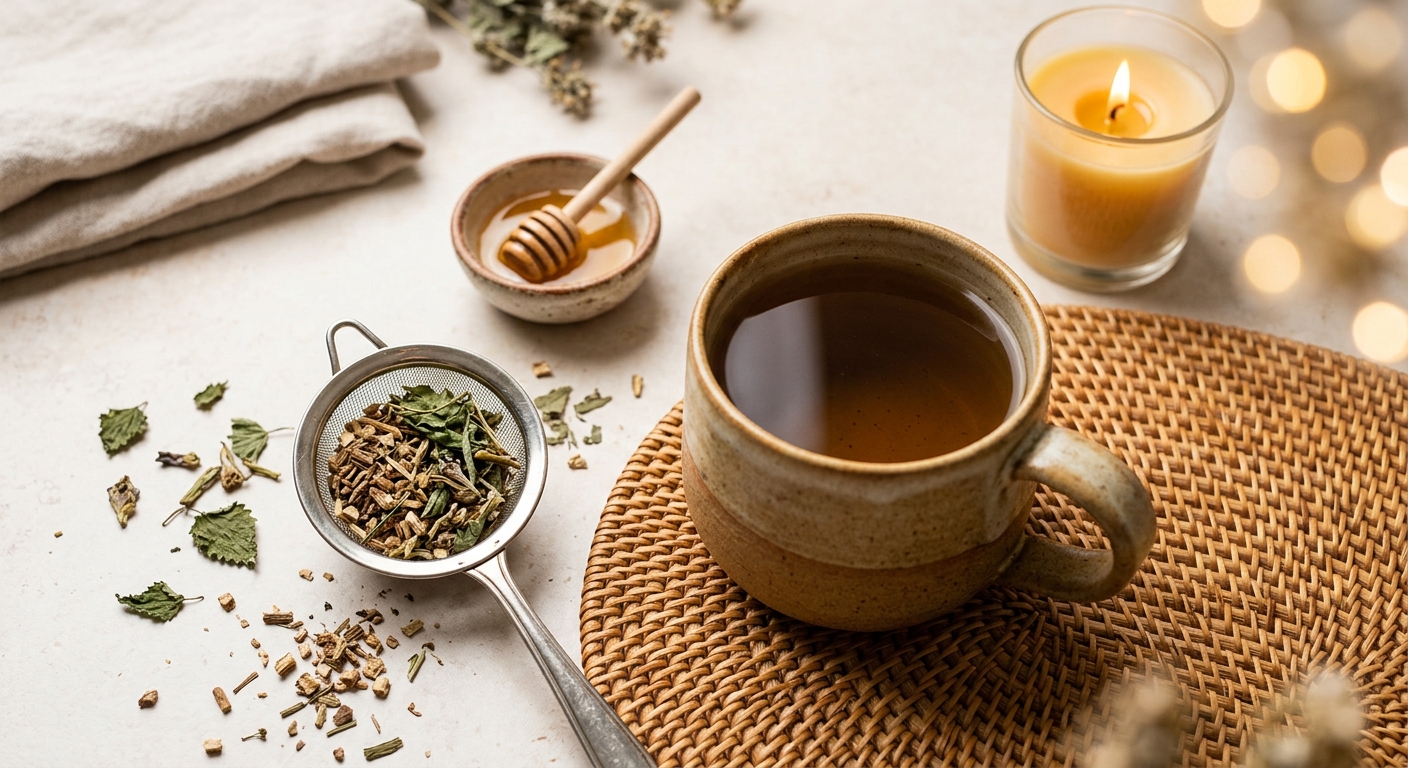
The flavor of this tea is earthy and complex, with the woody depth of valerian softened by passionflower’s faintly floral, grassy character and a subtle bitterness that signals the alkaloids at work. It is not a delicate tea but an honest, purposeful one, best sipped slowly in dim light about an hour before bed, as part of a conscious wind-down ritual. A touch of honey and a squeeze of lemon can brighten the earthiness considerably without diminishing its calming power.
2
cups
Ingredients
- 2 tspdried valerian root (chopped or broken pieces)
- 1 tspdried passionflower (leaf and vine)
- 1 tspdried skullcap (Scutellaria lateriflora)
- 1 tspdried nettle leaf
- 480 mlwater (90 to 95°C / 194 to 203°F)
- —Raw honey to taste (optional)
- —Fresh lemon juice to taste (optional)
How to Brew
Click on an item below to shop for the recommended items for this recipe on Amazon.
As an Amazon Associate, we earn from qualifying purchases.
- Combine the valerian root, passionflower, skullcap, and nettle leaf in a mesh tea infuser or small teapot with an internal strainer. For best results, use loose herbs rather than pre-filled bags to allow full expansion and extraction.
- Heat filtered water to 90 to 95°C (194 to 203°F). Do not use a rolling boil, as temperatures above 95°C can degrade some of the delicate flavonoids in passionflower and skullcap. Use an electric kettle with temperature control if available.
- Pour the hot water over the herbs, covering them completely. Place a small saucer or lid over the top of your mug or teapot to trap volatile aromatic compounds and prevent heat loss during the long steep.
- Steep for 10 to 15 minutes. Taste at 10 minutes and continue steeping if you prefer a stronger, more intensely medicinal cup. The liquid should deepen to a rich amber-brown color.
- Remove the infuser or strain the herbs thoroughly. Stir in raw honey to taste and a small squeeze of fresh lemon if desired. The lemon brightens the earthy flavor noticeably.
- Sip slowly about 45 to 60 minutes before bed, ideally in a dim, quiet space to allow the herbs to begin their work as part of your wind-down routine.
- Place the valerian root, passionflower, skullcap, and nettle leaf into a clean glass jar. Use 1.5 times the standard herb quantity compared to the hot brew method, since cold water extracts compounds more slowly and less completely. For two servings, use 3 teaspoons of valerian root and 1.5 teaspoons each of the other herbs.
- Pour 480 ml of room-temperature filtered water over the herbs. The water should be completely still and cold, not warm. Stir gently with a long spoon to ensure all the herbs are submerged.
- Seal the jar with a lid and leave it at room temperature for 2 hours to begin extraction, then transfer it to the refrigerator. Allow it to cold-steep for a minimum of 8 hours and up to 12 hours for a stronger result. Overnight steeping works perfectly.
- When ready to serve, strain the liquid through a fine mesh strainer or cheesecloth, pressing gently on the spent herbs to extract as much liquid as possible. Discard the spent herbs.
- The cold brew will have a noticeably smoother, less bitter character than the hot version. Stir in a small amount of honey and serve over a few ice cubes, or warm gently on the stovetop if you prefer a soothing warm cup before bed without the bitterness of a full hot brew.
- Place 2.5 teaspoons of dried valerian root into a small stainless steel or ceramic saucepan. Add 600 ml of cold filtered water. Starting in cold water allows the root’s cellular structure to begin releasing compounds slowly as temperature rises, improving extraction efficiency.
- Bring the water to a gentle simmer over medium-low heat. Do not allow it to reach a rolling boil. Once you see small, steady bubbles forming, reduce the heat to maintain a gentle simmer at approximately 85 to 90°C (185 to 194°F).
- After the valerian has simmered gently for 10 minutes, add the passionflower, skullcap, and nettle leaf directly to the pan. These more delicate herbs should not be subjected to the full decoction time. Continue simmering the combined blend for another 10 to 15 minutes.
- Remove the saucepan from heat, place a lid on it, and allow the blend to rest and infuse for an additional 10 minutes off the heat. This resting period allows residual heat to finish extracting the more volatile aromatic compounds without damaging them.
- Strain the liquid through a fine mesh strainer into a mug or heatproof pitcher, pressing firmly on the herbs to extract the full yield. The resulting decoction will be noticeably darker and more concentrated than the hot brew.
- Dilute slightly with hot water if the flavor is too intense, then sweeten with raw honey and a squeeze of lemon. Drink one mug approximately one hour before bed. Any remaining decoction can be stored in the refrigerator for up to 24 hours and gently rewarmed before use.
Health Benefits
Valerenic acid in valerian root modulates GABA-A receptors, reducing the neurological hyperexcitability that underlies both anxiety-driven restlessness and RLS-type sensations. A 2002 study in Pharmacology, Biochemistry and Behavior confirmed valerenic acid’s direct action on these receptors.
The antispasmodic compounds in skullcap (baicalin) and passionflower (scopoletin) act on the peripheral nervous system and skeletal muscle to reduce the involuntary tension and urge to move that characterize RLS episodes, particularly during the evening hours.
Clinical trials and systematic reviews of valerian root, including a 2006 meta-analysis in the American Journal of Medicine, suggest that regular use improves both sleep quality and sleep onset latency, helping users stay asleep longer through the periods when RLS symptoms typically peak.
Passionflower has been shown in a randomized controlled trial published in Phytotherapy Research (2011) to be as effective as low-dose oxazepam for generalized anxiety disorder, making it valuable for the anxious, wired evening state that frequently triggers or worsens RLS.
Nettle leaf is a natural source of magnesium, a mineral shown in multiple studies to play a critical role in neuromuscular function. Magnesium deficiency is associated with increased muscle cramps and restless leg symptoms, and supplementing through food or tea sources may provide modest but meaningful support.
🧪 Key Bioactive Compounds
The Science Behind Valerian Root
The scientific rationale for this blend centers on GABAergic modulation, the same neurological mechanism targeted by many pharmaceutical sleep and anxiety medications. Valerian root’s primary active constituent, valerenic acid, inhibits the enzyme GABA transaminase, which is responsible for breaking down gamma-aminobutyric acid (GABA) in the synaptic cleft. This results in higher available GABA, the brain’s primary inhibitory neurotransmitter, producing a calming, anticonvulsant, and muscle-relaxing effect throughout the central and peripheral nervous systems. Crucially, unlike benzodiazepines, valerenic acid achieves this through an indirect mechanism that does not appear to carry the same tolerance and dependency risk with short-term use.
Passionflower and skullcap extend this GABAergic effect through their own distinct compounds. Chrysin from passionflower binds directly to benzodiazepine receptor sites on the GABA-A receptor complex, functioning as a partial agonist and producing anxiolytic and mild sedative effects. Baicalin from skullcap has a broader mechanism, reducing excitatory glutamate signaling in addition to supporting inhibitory GABA activity, which makes it particularly useful for the wired, overstimulated nervous state that precedes RLS episodes in many sufferers. Scopoletin, a coumarin compound in passionflower, has demonstrated antispasmodic activity in animal studies, directly relevant to the involuntary muscular tension component of restless legs.
The inclusion of nettle leaf addresses a different dimension of the condition: mineral support. Magnesium is required as a cofactor in over 300 enzymatic reactions, including those governing nerve signal transmission and muscle contraction and relaxation. Population studies consistently link low dietary magnesium intake to increased incidence of muscle cramps, sleep disturbance, and restless leg symptoms. While a single cup of nettle tea cannot replace a dedicated magnesium supplement, it contributes a bioavailable source of this mineral alongside iron, calcium, and potassium, nutrients that collectively support the vascular and neuromuscular health underlying restful, uninterrupted sleep.
Brewing Tips
- Brew this tea at least 45 to 60 minutes before you actually want to fall asleep, not right at bedtime. Valerian root can take 30 to 45 minutes to reach peak serum concentration, so timing your cup correctly makes a measurable difference in its effectiveness.
- If the earthy, musky smell of valerian root is off-putting, try storing your dried valerian in an airtight container away from your other herbs, and add a small pinch of dried lavender or lemon balm to your cup. These herbs are compatible, mildly enhance the sedative effect, and significantly improve the aroma without diminishing the therapeutic compounds.
- For chronic or frequent restless legs symptoms, consider pairing this tea with a magnesium glycinate supplement taken at the same time each evening. The tea provides phytochemical support for the nervous system while magnesium glycinate addresses the mineral component of neuromuscular function, and the two approaches are complementary and well-tolerated together for most healthy adults.