Few herbs carry as much mythological weight as He Shou Wu, known in Western botanical circles as Polygonum multiflorum or Fallopia multiflora. The name itself translates roughly to ‘Mr. He’s Black Hair,’ a nod to a beloved Tang dynasty legend in which an elderly man named He Tianer discovered the root growing wild, consumed it regularly, and reportedly regained his dark hair, youthful vitality, and long life. Whether folklore or fact, this story has made He Shou Wu one of the most revered tonic herbs in Traditional Chinese Medicine (TCM) for well over a thousand years, appearing in imperial pharmacopoeias alongside ginseng and reishi as a foundational Jing-nourishing herb.
In TCM, He Shou Wu is classified as a tonic for the Liver and Kidney meridians, the two organ systems most closely associated with deep rest, blood quality, and the body’s capacity to restore itself overnight. Practitioners prescribe it to address patterns of deficiency that manifest as poor sleep, night sweats, premature greying, and a restless, unsettled spirit. The prepared root, known as Zhi He Shou Wu, is steamed with black bean juice to transform its chemistry and reduce the presence of certain compounds found in the raw root. This preparation step is not merely ceremonial; it genuinely alters the herb’s active constituents and is considered essential in classical practice.
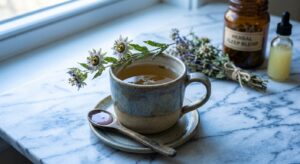
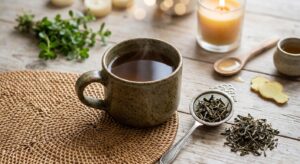
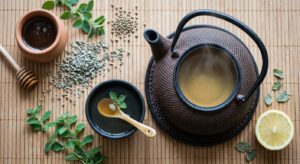
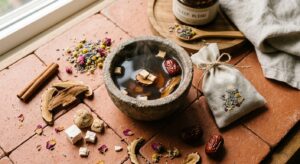
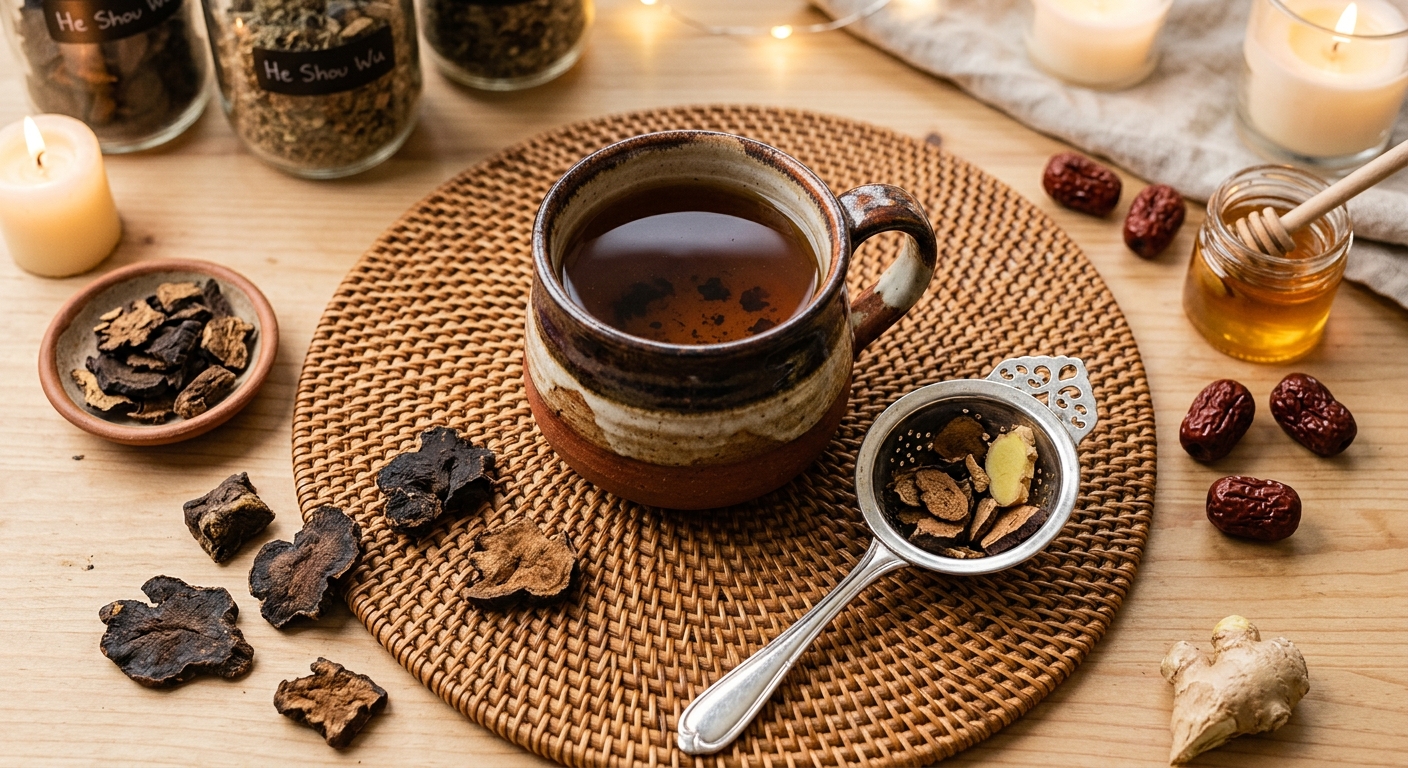
As a tea, He Shou Wu presents a deeply earthy, subtly sweet, and faintly bitter experience that feels grounding from the very first sip. Its rich amber brew has a weight and body that sets it apart from lighter floral teas, making it feel closer to a medicinal tonic than a casual cup. Brewed as a decoction in the traditional style or simmered gently as a concentrate, it is best enjoyed in the evening as part of a deliberate wind-down ritual, inviting the kind of stillness that prepares both body and mind for deep, restorative sleep.
2
cups
Ingredients
- 10 gprepared He Shou Wu root (Zhi He Shou Wu), sliced or broken into pieces
- 500 mlfiltered water
- —raw honey or jujube dates to taste (optional)
- —a small piece of fresh ginger (optional, for warming)
How to Brew
Click on an item below to shop for the recommended items for this recipe on Amazon.
As an Amazon Associate, we earn from qualifying purchases.
- Place 10 g of prepared He Shou Wu root pieces into a small ceramic or clay pot, or a stainless steel saucepan. Avoid aluminum cookware, as it may react with the herb’s tannins.
- Add 500 ml of cold filtered water to the pot. Starting with cold water and a slow rise to temperature helps draw out the deeper compounds from the dense root material.
- Bring the water to a full rolling boil over medium-high heat, then immediately reduce the heat to a gentle, steady simmer. You want small consistent bubbles, not a vigorous boil.
- Allow the root to simmer uncovered for 20 to 30 minutes. The liquid will reduce by roughly one-fifth and deepen to a rich amber or chestnut brown color. If you are adding fresh ginger, add it at this stage.
- Remove from heat and allow to rest for 3 to 5 minutes. Strain the decoction through a fine mesh strainer into two warmed mugs, discarding the spent root pieces.
- Sweeten lightly with raw honey or add two to three dried jujube dates during simmering for a naturally sweet, blood-nourishing addition. Sip slowly in the evening, ideally 60 to 90 minutes before bed.
- Grind or finely break 10 g of prepared He Shou Wu root into smaller fragments to increase surface area. A mortar and pestle works well here. The smaller pieces will allow adequate extraction without heat.
- Place the root fragments into a clean glass jar. Pour 600 ml of cold, filtered water over the root material. Cold brew uses slightly more water than hot decoction to compensate for the lower extraction efficiency.
- Stir gently to ensure all root pieces are submerged. Cover the jar loosely with a lid or cloth and allow it to sit at room temperature for approximately 2 hours to begin the initial extraction.
- Transfer the jar to the refrigerator and allow the brew to continue extracting for a further 10 to 12 hours, ideally overnight. The slow, cold extraction draws out a clean, nuanced flavor profile without the bitterness amplified by heat.
- The next morning, strain the cold brew through a fine mesh strainer lined with a small piece of cheesecloth into a clean pitcher or directly into glasses over ice.
- Taste before sweetening. Cold brew He Shou Wu often needs little to no sweetener. Consume within 48 hours and store covered in the refrigerator. Gently warm a portion if preferred for an evening serving.
- Combine 30 g of prepared He Shou Wu root pieces with 1 litre of cold filtered water in a ceramic or clay pot. This triple-strength ratio is designed for concentrated reduction over a longer cook time.
- Bring to a full boil over medium heat, then reduce immediately to the lowest simmer your stovetop allows. The liquid should show only small, occasional bubbles breaking the surface. Place a lid ajar on the pot to slow evaporation slightly.
- Simmer for 45 to 60 minutes, checking periodically. You are aiming for the liquid to reduce down to approximately 300 to 350 ml of dark, syrupy concentrate. Add small splashes of hot water if it reduces too quickly in the first 20 minutes.
- Remove from heat and strain immediately through a fine mesh strainer, pressing the root material gently with the back of a spoon to extract all remaining liquid. Discard the spent root.
- Allow the concentrate to cool to room temperature, then transfer to a clean glass jar with a tight-fitting lid. Store in the refrigerator for up to 5 days.
- To serve, dilute approximately 50 to 60 ml of concentrate with 150 to 180 ml of hot water, adjusting to your preferred strength. Add honey, a few drops of vanilla, or a pinch of cinnamon for a warming evening tonic.
Health Benefits
TSG, the principal stilbene glycoside in prepared He Shou Wu, has been shown in preclinical research to influence serotonergic and GABAergic pathways, both central to sleep regulation. In TCM, the herb is specifically indicated for sleep disturbances arising from Liver Blood deficiency, a pattern associated with light, fragmented sleep and an overactive mind at night.
Traditional Chinese pharmacology classifies He Shou Wu as a Shen-stabilising herb, meaning it is used to settle emotional turbulence, quiet mental chatter, and ease the kind of diffuse anxiety that makes winding down before sleep difficult. Modern research on TSG suggests interactions with oxidative stress pathways in the brain that may underpin this calming action.
He Shou Wu has a long history as a blood tonic in TCM, used to address pallor, fatigue, and dizziness associated with blood deficiency. Preliminary studies suggest it may support healthy red blood cell production and improve iron metabolism, which are relevant to energy recovery during sleep.
The combination of TSG, resveratrol precursors, and catechins gives He Shou Wu a notably high antioxidant capacity. Chronic oxidative stress is linked to impaired sleep quality and accelerated cellular ageing, making this herb’s antioxidant activity directly relevant to its restorative reputation.
Prepared He Shou Wu has traditionally been used as a liver tonic in TCM, and some modern studies have explored its hepatoprotective potential at appropriate doses. However, this benefit is highly dose-dependent and preparation-dependent, making quality sourcing and correct use critical (see cautions below).
🧪 Key Bioactive Compounds
The Science Behind He Shou Wu
The most extensively studied compound in prepared He Shou Wu is 2,3,5,4′-tetrahydroxystilbene-2-O-β-D-glucoside, commonly abbreviated as TSG. This stilbene glycoside is formed during the traditional black bean steaming process and is considered the primary marker of a correctly prepared root. Research published in journals including the Journal of Ethnopharmacology and Phytomedicine has demonstrated that TSG exhibits significant antioxidant activity, inhibits monoamine oxidase (MAO) to a modest degree, and appears to modulate serotonin and GABA receptor activity in animal models. These properties align with the herb’s traditional indications for sleeplessness and emotional instability, providing a biochemical basis for what Chinese physicians observed empirically over centuries of clinical use.
The anthraquinone compounds in He Shou Wu, principally emodin and physcion, tell a more complex story. In the raw root, these compounds are present in concentrations associated with both laxative and potentially hepatotoxic effects. The traditional black bean steaming preparation significantly reduces free anthraquinone content through chemical transformation, converting them into less bioavailable glycoside-bound forms. This is precisely why classical texts and modern TCM practitioners alike insist on using only the prepared (Zhi) form of the root. Research into the mechanism of He Shou Wu’s rare but documented hepatotoxicity suggests an immune-mediated idiosyncratic reaction rather than a purely dose-dependent toxicity, meaning that while most people tolerate the herb well at standard doses, a small subset may be genetically susceptible to adverse reactions regardless of preparation quality.
From a sleep science perspective, the connection between He Shou Wu’s antioxidant profile and sleep quality is particularly compelling. Oxidative stress is increasingly recognised as a bidirectional disruptor of sleep, both caused by poor sleep and causative of it. TSG’s ability to scavenge reactive oxygen species and upregulate endogenous antioxidant enzymes such as superoxide dismutase (SOD) may help address one of the root causes of chronically poor sleep quality. Additionally, TSG has demonstrated neuroprotective effects in models of neurodegenerative disease by protecting dopaminergic and cholinergic neurons, a mechanism that could plausibly support the clearer, more vivid dream states and deeper sleep architecture that traditional users of He Shou Wu have described for generations.
Brewing Tips
- Always verify that your He Shou Wu has been properly prepared (labelled as Zhi He Shou Wu or processed with black bean). Raw, unprocessed root (Sheng He Shou Wu) should never be used for regular tea consumption due to its higher anthraquinone content and associated hepatotoxicity risk.
- Use a kitchen scale rather than volume measurements when preparing He Shou Wu. Root density varies significantly depending on how it has been sliced or dried, and accurate gram measurements are important for staying within safe dosage ranges.
- He Shou Wu tea benefits from being drunk as part of a consistent evening ritual rather than as an occasional cup. Traditional use emphasises regularity and patience, with its deeper tonic effects building gradually over weeks of consistent, appropriately dosed use.