
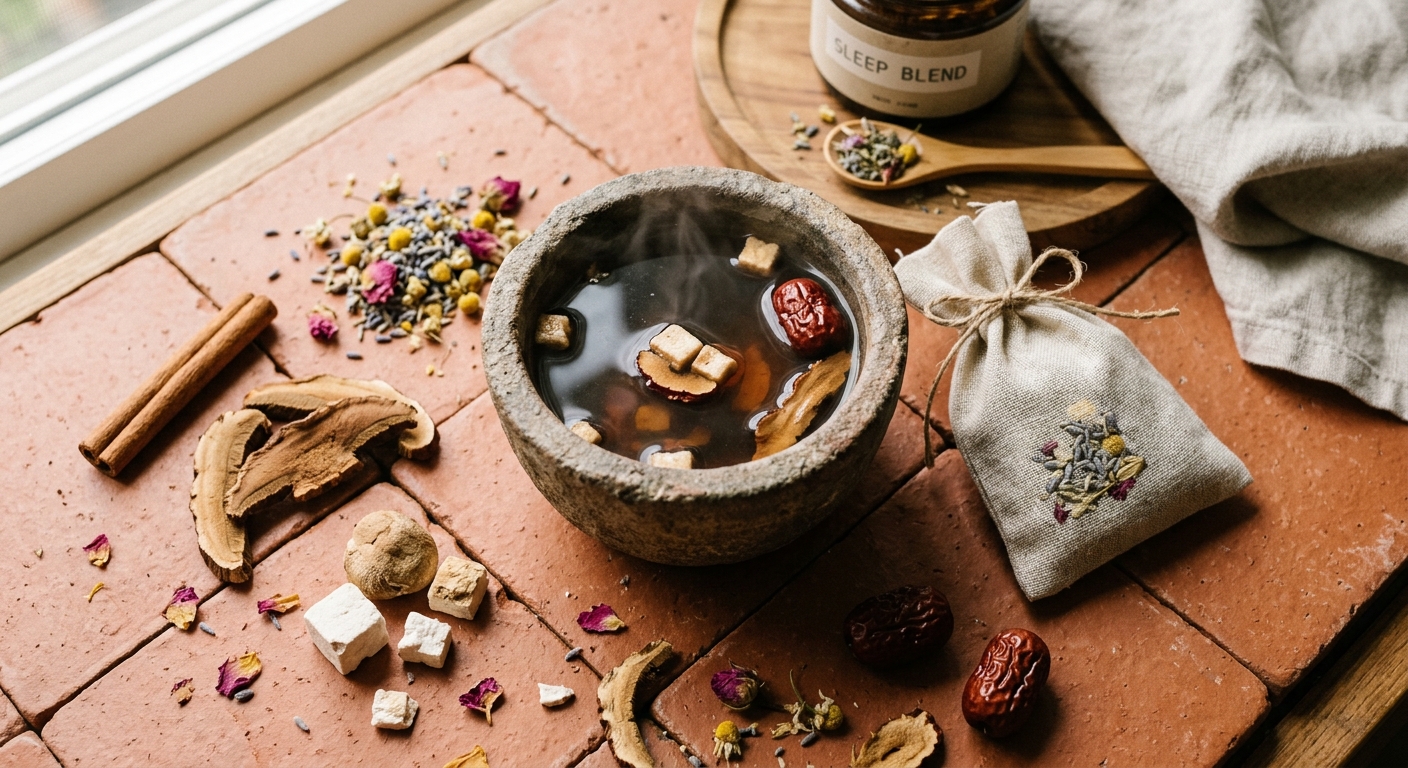
Long before modern sleep aids crowded pharmacy shelves, healers in China, Japan, and Korea were reaching for two remarkable fungi to help the restless mind find peace: Ganoderma lucidum (reishi) and Poria cocos (poria). Together, these mushrooms have formed the cornerstone of sleep and tonification formulas in Traditional Chinese Medicine (TCM) for over two thousand years. Reishi, known as Lingzhi in Chinese, translates poetically to “herb of spiritual potency” or “mushroom of immortality,” a name that reflects the reverence healers held for its wide-ranging calming and restorative properties. Poria, a dense underground fungal mass that grows on the roots of pine trees, was prescribed to quiet the Shen, the spirit or mind, and fortify the spleen and heart meridians, making it an ideal pairing with reishi’s adaptogenic depth.
What makes this blend so enduring is the synergy between its two principal ingredients. Reishi brings its suite of triterpenes and polysaccharides, which research now suggests can shorten sleep latency (the time it takes to fall asleep) and extend non-REM slow-wave sleep. Poria contributes its own triterpenoid compounds and poriatin, acting as a gentle nervine that settles mental chatter and eases anxiety without producing the heavy, groggy feeling associated with pharmaceutical sedatives. Together they create a tea that does not knock you out so much as gently escort your nervous system into a state of relaxed readiness for sleep. It is the difference between falling asleep and truly winding down.
Brewed properly, this tea has a complex, woody, and faintly bitter character with an underlying earthiness that feels almost meditative to drink. The ritual of preparing it, with its slow decoction and rich amber color, is itself a form of evening wind-down. Whether you are new to mushroom teas or a seasoned adaptogen enthusiast, this blend offers something rare: a cup that works with your body’s own chemistry to restore the natural rhythms of rest that modern life so often disrupts.
2
cups
Ingredients
- 10 gdried reishi mushroom slices
- 8 gdried poria mushroom pieces (fu ling)
- 700 mlfiltered water
- —1 cinnamon stick (optional, to soften bitterness)
- —raw honey or jujube dates to taste (optional)
How to Brew
Click on an item below to shop for the recommended items for this recipe on Amazon.
As an Amazon Associate, we earn from qualifying purchases.
- Combine the dried reishi slices and poria pieces in a small saucepan. Add the cinnamon stick if using. Pour in 700 ml of filtered water and bring to a full rolling boil over medium-high heat.
- Once boiling, reduce the heat to a gentle simmer (around 90 to 95°C / 194 to 203°F). Place a loose-fitting lid on the saucepan to reduce evaporation while still allowing some steam to escape.
- Simmer steadily for 45 to 60 minutes. The liquid will reduce and deepen in color, shifting from pale tan to a rich mahogany amber. Check occasionally and add a small splash of water if the level drops too low.
- Remove from heat and allow to rest for 5 minutes. Pour the decoction through a fine mesh strainer into your mugs, pressing the mushroom pieces gently with the back of a spoon to release any remaining liquid.
- Sweeten with raw honey, a few soft jujube dates, or a small pinch of monk fruit sweetener to balance the bitterness. Drink warm, ideally 60 to 90 minutes before bedtime.
- Start with pre-decocted and dried mushroom pieces, or use a fine-ground reishi and poria powder blend (approximately 4 g reishi powder and 3 g poria powder per 500 ml water) for more efficient cold extraction. Place the mushrooms or powder into a clean glass jar.
- Pour 500 ml of cold, filtered water over the mushroom material. If using whole slices, give the jar a firm stir to ensure full contact between water and fungal material. Seal the jar with a lid.
- Let the jar sit at room temperature for 2 hours to begin extraction, then transfer to the refrigerator and cold steep for an additional 16 to 22 hours, for a total brew time of 18 to 24 hours.
- When the brew is complete, strain the liquid through a fine mesh strainer lined with cheesecloth into a clean pitcher, pressing or squeezing the solids thoroughly to extract maximum liquid.
- Serve over ice in a tall glass, or gently warm a portion in a small saucepan without boiling. Sweeten with a cold-dissolved honey syrup or a splash of coconut milk for a creamy, forest-inspired evening drink.
- Use a 1:10 mushroom-to-water ratio for concentrate preparation. Combine 20 g of dried reishi slices and 15 g of poria pieces in a medium saucepan with 1.5 liters of filtered water. Add one cinnamon stick and two pitted jujube dates if desired for natural sweetness.
- Bring the mixture to a full boil over medium-high heat, then reduce to a low, steady simmer. Leave the lid slightly ajar. Simmer for 90 minutes, allowing the liquid to reduce by roughly half to approximately 700 to 750 ml of finished concentrate.
- Check the liquid level every 30 minutes. The concentrate should coat the back of a spoon lightly and have a deep mahogany color. Remove from heat and let cool for 10 minutes before straining.
- Strain through a fine mesh strainer lined with cheesecloth into a clean glass jar or bottle, pressing the mushroom solids firmly. Discard the spent material. Allow the concentrate to cool to room temperature before sealing.
- Store in the refrigerator for up to 5 days. To serve, measure 60 to 80 ml of concentrate into a mug and top with 160 ml of hot water (not boiling). Stir well, adjust sweetness, and enjoy as a potent, convenient nightly sleep tea.
Health Benefits
Multiple preclinical and a growing number of human studies suggest that reishi triterpenes, particularly ganoderic acids, reduce the time to fall asleep and increase the proportion of restorative slow-wave (non-REM) sleep. A 2012 study published in the Journal of Ethnopharmacology found that water extracts of reishi significantly increased total sleep time and non-REM sleep in animal models, an effect attributed largely to its interaction with GABAergic neurotransmission.
Poria cocos has been used for centuries in TCM specifically for its Shen-calming properties, meaning its capacity to settle an overactive, anxious mind. Pachymic acid and related lanostane triterpenes in poria have demonstrated dose-dependent anxiolytic effects in pharmacological studies, without the dependency risks associated with benzodiazepine-class medications.
Reishi is one of the most well-documented adaptogenic mushrooms, meaning it helps the body modulate its stress response by supporting healthy cortisol regulation and adrenal function. Chronically elevated evening cortisol is one of the most common physiological reasons for insomnia, and reishi’s adaptogenic action addresses this root cause rather than simply masking wakefulness.
The beta-D-glucans found in both reishi and poria are potent immunomodulators that activate natural killer cells and macrophage activity while reducing excessive inflammatory cytokine production. Chronic low-grade inflammation is strongly associated with disrupted sleep architecture, and the anti-inflammatory activity of this blend helps create a bodily environment more conducive to deep, uninterrupted rest.
In TCM, the liver is associated with the hours between 1 and 3 am, and a burdened liver is often implicated when people wake consistently during this window. Reishi’s triterpenes have demonstrated hepatoprotective (liver-protecting) activity in multiple studies, supporting the liver’s natural overnight detoxification processes and potentially helping those who experience fragmented late-night waking.
🧪 Key Bioactive Compounds
The Science Behind Reishi Mushroom
The sleep-supporting science behind this blend centers on two distinct but complementary mechanisms. Reishi mushroom contains a family of oxygenated triterpenes called ganoderic acids, of which over 150 individual compounds have been isolated and characterized. Several of these, including ganoderic acids A and F, have been shown to interact with the GABAergic system, the same neurotransmitter pathway targeted by benzodiazepines and many sleep medications. Unlike pharmaceutical GABA modulators, however, ganoderic acids appear to act as partial modulators rather than full agonists, producing calming effects without the deep sedation, memory impairment, or dependency potential of pharmaceutical alternatives. A landmark 2012 study in the Journal of Ethnopharmacology confirmed that water-soluble reishi polysaccharide fractions significantly increased non-REM sleep duration and total sleep time in rodent models, with effects partially reversed by GABA receptor blockers, confirming the GABAergic mechanism.
Poria cocos adds a complementary neurological dimension through its lanostane-type triterpenes, most notably pachymic acid and its derivatives. These compounds have demonstrated dose-dependent inhibition of neuronal excitability in in vitro studies and have produced anxiolytic effects in multiple animal model paradigms equivalent to low doses of diazepam. Poria’s unique beta-glucan polysaccharide, pachyman, also influences the gut microbiome, supporting the populations of bacteria that produce short-chain fatty acids and neurotransmitter precursors such as tryptophan, the amino acid precursor to serotonin and melatonin. This gut-brain axis support represents a slower-acting but deeply systemic pathway through which consistent poria consumption may gradually improve sleep quality over days and weeks of use.
The adaptogenic dimension of this blend addresses a root cause that neither chamomile nor valerian, the more familiar Western sleep herbs, directly target: cortisol dysregulation. Chronic stress elevates evening cortisol, which actively suppresses melatonin production and maintains hyperarousal in the nervous system. Reishi’s triterpenes and polysaccharides have been shown to modulate the hypothalamic-pituitary-adrenal (HPA) axis, blunting excessive cortisol output without suppressing the normal morning cortisol awakening response that gives energy and alertness at the start of the day. This bidirectional, normalizing action is the hallmark of a true adaptogen and explains why regular consumption of this mushroom tea over several weeks is often reported to produce more consistent improvements in sleep quality than a single cup taken acutely.
Brewing Tips
- Never use boiling-only water for a quick steep with these mushrooms. The bioactive triterpenes in reishi and poria are locked within chitin-rich cell walls that require extended heat exposure to break down. Always use the decoction method (a prolonged simmer) for therapeutic benefit.
- Save the spent mushroom pieces after decoction and freeze them. You can re-simmer them a second time with fresh water for a lighter but still beneficial second-draw tea, a practice known in TCM as the second decoction or bian jian.
- For the most pronounced sleep effect, drink this tea consistently each evening for at least two to four weeks. Adaptogenic mushrooms build their effects gradually through repeated use rather than producing strong single-dose sedation. Think of it as retraining your nervous system rather than forcing sleep.