For well over two thousand years, ginseng root has held a place of honor in East Asian medicine. The name of the Asian species, Panax ginseng, comes from the Greek panacea, meaning “all healing,” and its Chinese name, renshen, translates roughly to “man root” for the human-like shape of well-grown roots. Ancient texts such as the Shennong Bencao Jing classed it among the superior tonics, herbs taken over time to support vitality rather than to treat a single complaint. American ginseng (Panax quinquefolius) later became a major trade good between colonial North America and China, and it is traditionally considered gentler and more cooling than its Asian cousin.
Ginseng belongs to a group of plants known as adaptogens, a modern term for herbs traditionally used to help the body cope with physical and mental strain. Unlike a cup of strong coffee, which pushes alertness hard and then drops away, ginseng is valued for a quieter lift. Traditional practitioners often described the feeling as “steady qi” rather than stimulation. This makes it an appealing choice for people who work evenings, overnight, or rotating shifts and want to stay clear-headed without wrecking their wind-down time afterward.
This guide focuses on a deliberately low-dose evening preparation. Ginseng can feel too activating for some people when brewed strong or taken late, so we use a small amount of root, a moderate steep, and a few softening ingredients. The result is a warm, woody, faintly sweet cup that supports a long shift while staying gentle enough for a late-night routine.
2
cups
Ingredients
- 2 tspdried ginseng root slices or coarse pieces (Panax ginseng or American ginseng)
- 480 mlwater (95°C / 203°F)
- 2 slicesfresh ginger (optional, for warmth)
- —raw honey or a few goji berries to taste (optional)
- —a thin strip of lemon peel (optional, for brightness)
How to Brew
Click on an item below to shop for the recommended items for this recipe on Amazon.
As an Amazon Associate, we earn from qualifying purchases.
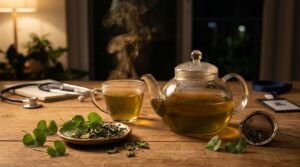
- Measure the dried ginseng root into a teapot or a mug with a lidded infuser. Use thin slices or small coarse pieces rather than powder, so the tea stays clear and the extraction stays gentle.
- Bring fresh water to a boil, then let it rest for about 30 seconds to reach roughly 95°C (203°F). Fully rolling water can make ginseng taste harsher and more bitter.
- Pour the hot water over the root and add the ginger slices and lemon peel if using. Cover the vessel right away to hold in the aromatic compounds.
- Steep for 8 to 10 minutes. Because the pieces are dense, this longer steep is needed to draw out the saponins and flavor, but avoid going past 12 minutes or the cup turns bitter.
- Strain, then stir in honey if you like. Sip slowly over the first hour of your shift.
- Save the used root. Dense ginseng pieces can often be steeped a second time for a weaker, softer cup later in the night.
- Place the ginseng root slices in a clean glass jar. Use slightly more root than the hot method, about 3 teaspoons for 480 ml, since cold water extracts more slowly.
- Add the ginger slices and lemon peel if using. Pour in 480 ml of cool, filtered water and stir gently to wet all the pieces.
- Seal the jar and refrigerate for 8 to 12 hours, or overnight. Gently shake or swirl the jar once or twice if you happen to pass by it.
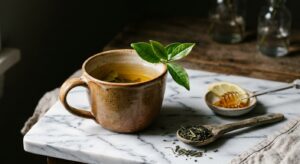
- Strain through a fine mesh sieve into a clean bottle or thermos. The tea should be a very pale gold with a soft, rounded, almost sweet flavor.
- Serve over ice or straight from the cold bottle, adding a drizzle of honey if wanted. Drink within 48 hours and keep refrigerated between uses.
- Add the ginseng root pieces and 600 ml of cold water to a small saucepan. Starting with cold water lets the root release its compounds gradually as the temperature rises.
- Bring the pot to a gentle simmer over medium-low heat. You want tiny bubbles around the edges, not a rolling boil.
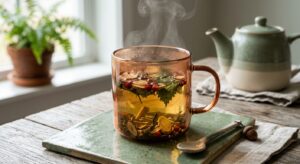
- Add the fresh ginger slices if using, partially cover the pot, and simmer for 15 to 20 minutes. The liquid will reduce slightly and deepen in color to a richer amber.
- Remove from the heat and let the tea rest for 2 minutes so the sediment settles.
- Strain into mugs through a fine sieve, dividing it between 2 servings. Stir in honey or a few goji berries to round out the earthy flavor.
- Drink warm. This version has the fullest body and the strongest root character of the three methods.
Health Benefits
Several small human trials suggest that standardized ginseng extracts can modestly improve attention, working memory, and reaction time, likely through ginsenoside effects on neurotransmitter activity. The effect is subtle and builds with consistent use rather than hitting like caffeine.
Ginseng is among the best-studied herbal options for fatigue, and some clinical trials in people with persistent tiredness report reduced mental and physical weariness. Results vary by species, dose, and individual.
Ginsenosides appear to influence the hypothalamic-pituitary-adrenal axis, the body’s stress-response system, which may help explain the traditional use for coping with demanding schedules. Human evidence is promising but still developing.
Research, especially on American ginseng, suggests it may help moderate post-meal blood glucose in some adults. This is a modest effect and not a substitute for medical care.
Ginsenosides and polysaccharides show antioxidant and immune-modulating activity in lab and animal studies, supporting the traditional use of ginseng as a general tonic, though human data remains limited.
🧪 Key Bioactive Compounds
The Science Behind Ginseng
The activity of ginseng centers on a family of triterpene saponins called ginsenosides. More than 100 have been identified, and they are broadly grouped into protopanaxadiols (such as Rb1, Rc, and Rd) and protopanaxatriols (such as Rg1 and Re). These two groups appear to act somewhat differently. Early research suggests that Rb-type ginsenosides tend toward calming, central nervous system effects, while Rg-type ginsenosides tend toward mildly stimulating and cognition-supportive effects. This balance may explain why ginseng is described as an adaptogen rather than a simple stimulant.
The way the root is prepared changes its chemistry. Heat converts some ginsenosides into forms such as Rg3 and Rh2, which is why traditionally steamed red ginseng differs from dried white ginseng. In a simple tea, only some of these compounds dissolve, and the extraction depends on temperature and time. Hot water and gentle simmering draw out more saponins than a cold soak, which is why the effects of the three methods in this guide differ in strength.
Most clinical research on ginseng uses standardized extracts rather than homemade tea, so results do not translate exactly to a cup you brew yourself. The evidence for reduced fatigue and improved attention is encouraging but mixed, and study quality varies. That is why this recipe takes a low-dose, consistent, and cautious approach, treating ginseng as a gentle daily support rather than a quick fix for a short night.
Brewing Tips
- Choose whole or sliced dried root from a reputable supplier and look for the species (Panax ginseng or Panax quinquefolius) on the label, since other plants sold as ginseng, such as Siberian ginseng, are different herbs.
- Drink this tea at the start of your shift rather than near the end, and finish it at least 3 to 4 hours before you plan to sleep.
- Start with one cup a day and a small dose. If you feel jittery or notice trouble sleeping, reduce the amount of root or switch to the cold brew.
- Store dried ginseng in an airtight container away from light, heat, and moisture to keep its flavor and potency.