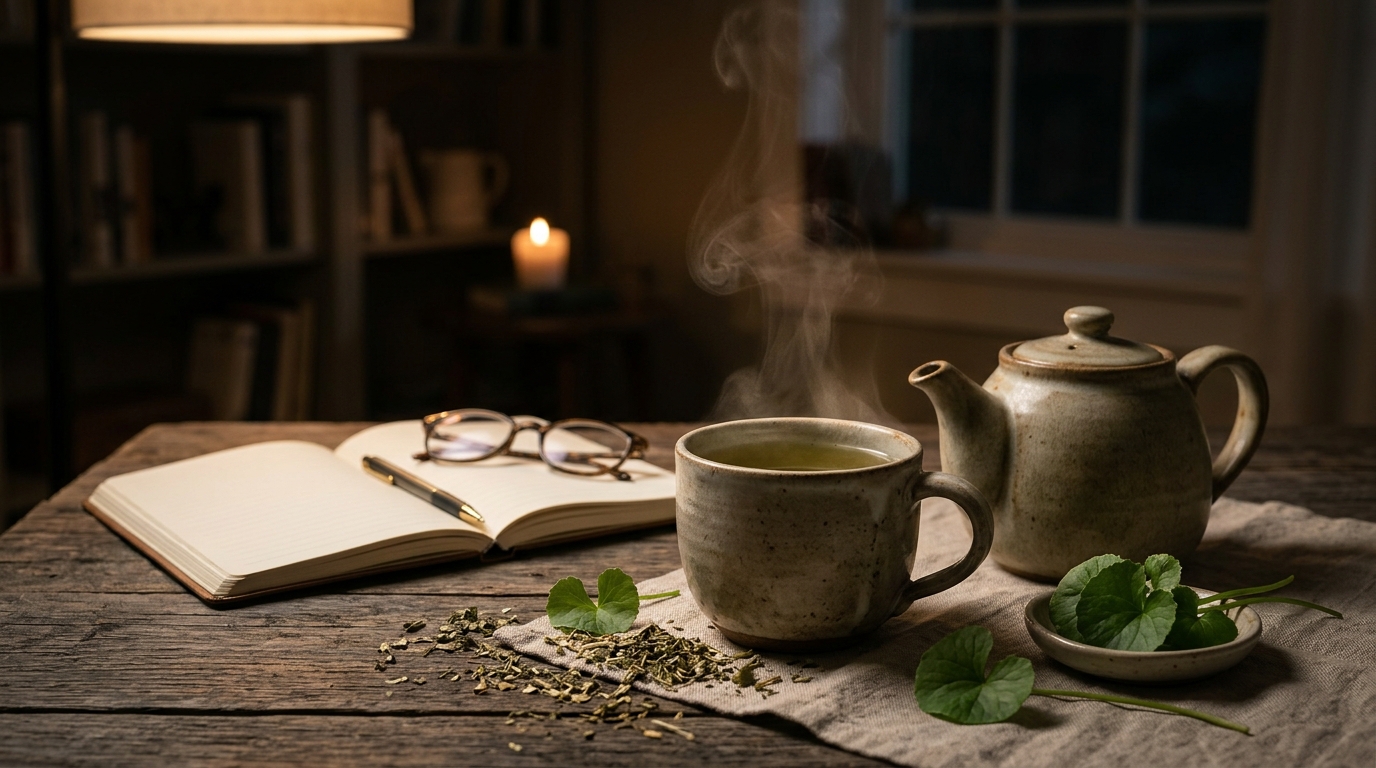
Gotu kola, known botanically as Centella asiatica, has been woven into healing traditions across Asia for thousands of years. In Ayurveda it is called mandukaparni and is classed as a medhya rasayana, a rejuvenating herb for the mind. Practitioners in India and Sri Lanka have long steeped the leaves for students, scholars, and meditators. In Sri Lanka the fresh leaves are eaten daily in a salad called gotu kola sambol, and a popular folk saying credits the plant with the long lives of elephants, which are said to graze on it.
In Traditional Chinese Medicine the herb goes by the name ji xue cao, and in Indonesia and Malaysia it appears in cooling beverages and tonics. Across these cultures a common thread appears: gotu kola is valued for calming nervous agitation while supporting mental clarity. Unlike coffee or black tea, it carries no caffeine, so it suits the late hours when you want to keep thinking clearly but still want to sleep well afterward.
The tea itself is a quiet pleasure. The flavor is green, mildly bitter, and herbaceous, somewhere between fresh parsley, steamed spinach, and cucumber skin. It rewards a slow cup, a warm lamp, and an unhurried evening of reading or writing. Think of it less as a jolt and more as a steady, grounding companion for the mind.
2
cups
Ingredients
- 2 tspdried gotu kola leaf (Centella asiatica)
- 480 mlwater (95°C / 203°F)
- 1 tspdried peppermint or lemon balm (optional, for flavor)
- —raw honey or a slice of lemon to taste (optional)
How to Brew
Click on an item below to shop for the recommended items for this recipe on Amazon.
As an Amazon Associate, we earn from qualifying purchases.
- Measure 2 teaspoons of dried gotu kola leaf into a teapot or large mug with an infuser. The leaves are light and papery, so lightly crush them between your fingers first to help release their compounds.
- Bring fresh water to a near boil, then let it rest for about 30 seconds so it settles at roughly 95°C (203°F). A full rolling boil can push the flavor toward harsh bitterness.
- Pour the hot water over the leaves and cover the vessel immediately. Covering traps the volatile aromatic compounds that would otherwise escape with the steam.
- Steep for 8 to 10 minutes. Gotu kola is a gentle, slow-releasing leaf, and a shorter steep will taste thin and watery. Go closer to 10 minutes for a stronger, more medicinal cup.
- Strain the leaves, stir in honey or a squeeze of lemon if you like, and sip slowly while you work or read. Enjoy it 30 to 60 minutes before you plan to start deep focus.
- Add 3 tablespoons of dried gotu kola leaf to a clean glass jar. Cold extraction is slower and gentler, so a slightly higher ratio of leaf to water is needed.
- Pour in 1 liter of cool, filtered water and stir once to wet all the leaves. Add a few mint leaves or a thin slice of cucumber now if you want extra freshness.
- Seal the jar and refrigerate for 6 to 8 hours, or overnight. Avoid steeping beyond 10 hours, as the tea can develop a grassy, slightly stale flavor.
- Strain through a fine mesh sieve or cheesecloth into a clean pitcher, pressing the leaves lightly to release the last of the liquid.
- Serve over ice or straight from the fridge. Keep refrigerated and drink within 48 hours for best flavor and freshness.
- Add 1 tablespoon of dried gotu kola leaf to a small stainless steel or enamel saucepan with 500 ml of cold water.
- Bring the water slowly to a gentle simmer over medium-low heat. Do not let it reach a hard boil, which would drive off the delicate aromatics and intensify bitterness.
- Reduce the heat to low and simmer uncovered for 10 minutes, until the liquid has reduced slightly and turned a deeper olive-gold.
- Remove from the heat, cover the pot, and let it rest for 5 minutes so the flavors settle and marry.
- Strain into a mug, discarding the leaves. For a traditional touch, stir in a small pinch of ground cardamom or a thin slice of fresh ginger while it rests. Drink warm.
Health Benefits
Gotu kola is traditionally used as a nervine, and small human trials suggest it may reduce feelings of acute stress and support attention without sedation. Its effects are subtle and cumulative rather than immediate.
A small clinical study found that Centella asiatica reduced the startle response in healthy volunteers, suggesting an anxiety-dampening effect. Researchers believe triterpenoids may modulate neurotransmitter activity.
Animal studies and early human research suggest gotu kola may promote healthy neuron growth and protect against oxidative damage in the brain. Larger human trials are still needed to confirm these effects.
Gotu kola extracts have been studied for improving microcirculation and vein health, particularly in chronic venous insufficiency. This may support healthy blood flow to the brain and extremities.
The triterpenoid saponins in gotu kola are well documented for encouraging collagen formation and wound healing, which is why the herb is widely used in topical preparations.
🧪 Key Bioactive Compounds
The Science Behind Gotu Kola
The activity of gotu kola is largely attributed to a family of triterpenoid compounds called centelloids, which include asiaticoside, madecassoside, asiatic acid, and madecassic acid. These molecules have been studied extensively in cell and animal models, where they show antioxidant, anti-inflammatory, and neuroprotective properties. In the brain, they appear to reduce oxidative stress and may support the growth and branching of neurons, which is the biological basis for gotu kola’s reputation as a memory and learning herb.
Human evidence is more modest but promising. A few small randomized trials have found that Centella asiatica extracts may improve mood, working memory, and alertness in healthy adults and older adults with mild cognitive complaints. One often-cited study found a reduction in the acoustic startle response, a marker associated with anxiety, within an hour of dosing. These findings fit the traditional picture of the herb as a calming yet clarifying nervine rather than a stimulant.
It is worth noting that most clinical research uses standardized extracts rather than a simple tea, so the concentration of active compounds in a cup is likely lower and more variable. Tea still offers a gentle way to enjoy the herb, and the ritual of preparing and sipping a warm drink is itself a well-recognized aid to settling the mind before focused evening work.
Brewing Tips
- Use leaf that is still green and fragrant. Dull brown, dusty gotu kola has lost much of its potency and flavor.
- Steep covered and give it the full 8 to 10 minutes. This is a slow-releasing leaf that tastes thin if rushed.
- Brew it earlier in the evening, around dinner or just before you start studying, rather than right before bed, so the clarifying effect works with your focus window.
- Store dried gotu kola in an airtight, opaque container away from light and heat, and use within a year for best quality.
- Cycle your use, drinking it for a few weeks and then taking a short break, as many traditional practitioners recommend.