Ginger (Zingiber officinale) and turmeric (Curcuma longa) are close botanical cousins, both members of the Zingiberaceae family, and both have been prized for well over 4,000 years. In Ayurveda, turmeric is known as haridra, a golden purifier of the blood and a staple of everyday healing, while ginger is called vishwabheshaj, the universal medicine. Traditional Chinese Medicine uses dried ginger (gan jiang) to warm the middle of the body and ease a cold, sluggish stomach. Across Southeast Asia, both roots are simmered into tonics for postpartum recovery, seasonal colds, and heavy feasts.
It is the evening that makes this pairing so appealing. After a large dinner, the digestive system benefits from gentle stimulation, and ginger delivers just that. Its pungent compounds encourage the stomach to empty at a healthy pace, easing the heavy, bloated feeling that follows rich food. Turmeric adds a deeper, earthier note and brings its famous curcuminoids to the cup. The two together create a digestif without alcohol, one that settles the body rather than stimulating it with caffeine.
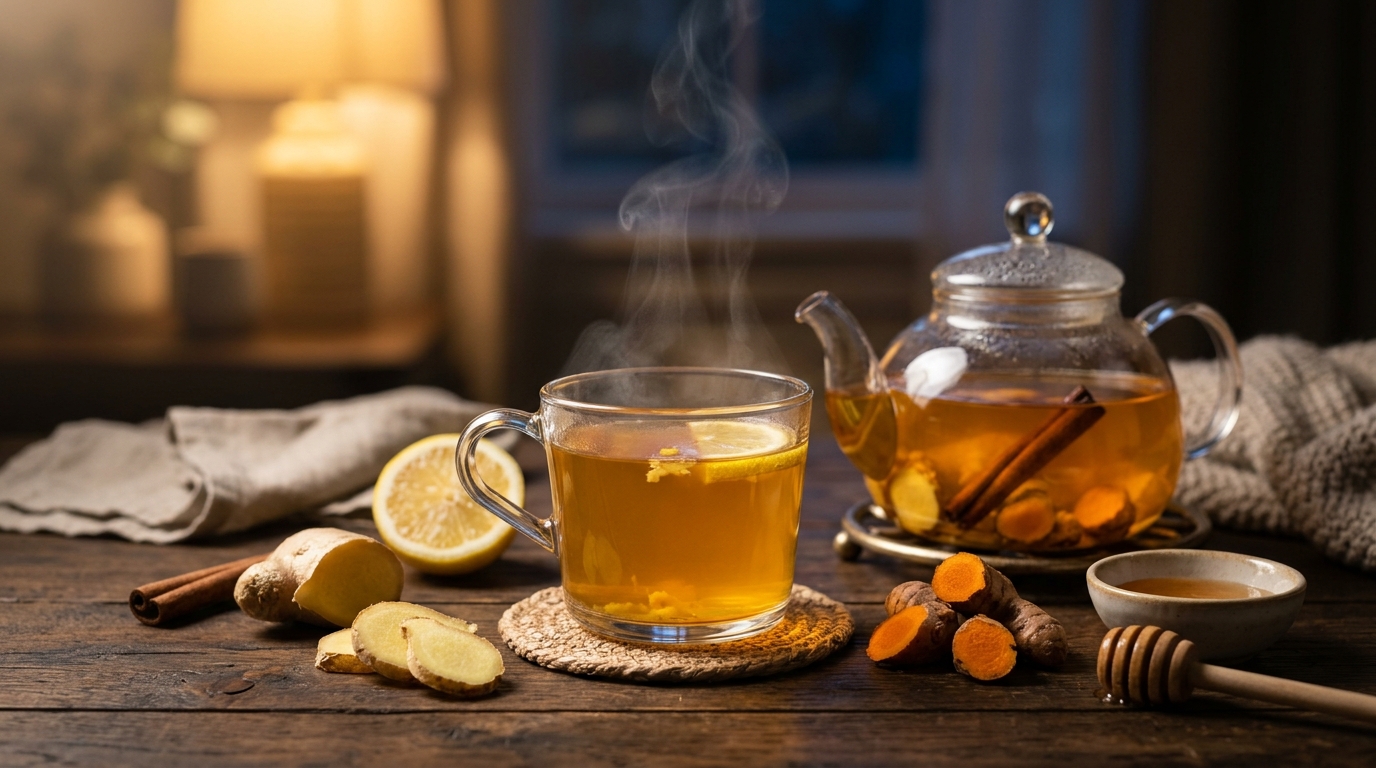
The flavor is bold but comforting: peppery heat from ginger, a warm, slightly bitter, almost mustard-like earthiness from turmeric, and a rounded finish when you add a squeeze of lemon and a pinch of black pepper. The tea glows a vivid saffron gold, and the ritual of grating fresh roots into a pot fills the kitchen with a fragrance that signals the day is winding down.
2
cups
Ingredients
- 2 tspfresh ginger root, thinly sliced or grated
- 1 tspfresh turmeric root, grated (or 1/2 tsp ground turmeric)
- 480 mlwater
- 1 pinchfreshly ground black pepper
- —fresh lemon juice to taste
- —raw honey or maple syrup to taste (optional)
How to Brew
Click on an item below to shop for the recommended items for this recipe on Amazon.
As an Amazon Associate, we earn from qualifying purchases.
- Wash the ginger and turmeric roots well. There is no need to peel them if they are organic, but scrub away any dirt. Thinly slice or coarsely grate 2 teaspoons of ginger and 1 teaspoon of turmeric.
- Bring 480 ml of fresh water to a full boil in a small saucepan or kettle, then remove it from the heat for 30 seconds so it settles just off the boil.
- Place the grated ginger, turmeric, and a small pinch of freshly ground black pepper into a teapot or heatproof jug. Pour the hot water over them.
- Cover and steep for 10 to 12 minutes. The lid traps the volatile aromatic oils, so the tea stays fragrant rather than losing its spice into the air.
- Strain through a fine mesh strainer into two mugs, pressing the roots gently to release the last of the liquid.
- Stir in a squeeze of lemon juice and a teaspoon of honey if you like. Add honey only once the tea has cooled slightly so its delicate enzymes are preserved.
- Finely grate 2 teaspoons of fresh ginger and 1 teaspoon of fresh turmeric. Grating rather than slicing exposes more surface area, which compensates for the lack of heat.
- Add the grated roots and a small pinch of black pepper to a clean glass jar. Pour in 480 ml of cool, filtered water and stir well.
- Seal the jar and refrigerate for 8 to 10 hours or overnight. Give the jar a gentle shake once or twice if you remember.
- Strain through a fine mesh strainer or a double layer of cheesecloth. Cold-brewed turmeric releases fine particles, so a tight strain gives a cleaner cup.
- Stir in lemon juice and a little honey or maple syrup, which dissolves more easily if stirred into a small splash of warm water first.
- Serve over ice or chilled in a glass. The cold brew keeps in the refrigerator for up to 2 days.
- Slice 3 teaspoons of fresh ginger into thin coins and slice or roughly chop 1 teaspoon of fresh turmeric. Bruise the slices lightly with the flat of a knife to break open the cell walls.
- Place the roots in a small saucepan with 600 ml of cold water. Starting with cold water draws the compounds out gradually as the temperature rises.
- Bring to a boil, then immediately reduce the heat to the lowest setting that keeps a gentle, steady simmer. Add a pinch of black pepper and partially cover the pan.
- Simmer for 15 to 20 minutes, until the liquid has reduced slightly to about 480 ml and turned a deep golden color with a strong spicy aroma.
- Remove from the heat and strain into mugs, discarding the spent roots. Let the tea rest for a minute so any fine sediment settles.
- Finish with lemon juice and honey to taste. For a creamy, traditional variation, stir in a splash of warm coconut milk or oat milk and a little extra black pepper.
Health Benefits
Ginger promotes gastric emptying and stimulates digestive secretions, which can reduce post-meal fullness and bloating. Several clinical studies support its role in functional dyspepsia.
Curcumin and gingerols both interact with inflammatory signaling molecules. Clinical trials, particularly in joint discomfort, suggest meaningful benefit, though tea contains modest amounts compared with concentrated extracts.
Ginger is among the best-studied natural remedies for nausea, with evidence in pregnancy-related, post-operative, and motion-related queasiness. Its compounds act on both the gut and the brain’s nausea pathways.
Both roots are rich in polyphenols that neutralize free radicals in laboratory studies. This may contribute to long-term cellular protection, although human evidence from tea specifically is still developing.
As a caffeine-free hot drink, it offers a soothing sensory end to the day. The warmth and aroma encourage relaxation, which itself supports healthy digestion.
🧪 Key Bioactive Compounds
The Science Behind Ginger
The two stars of this tea owe their effects to distinct families of compounds. Turmeric’s golden pigment comes from curcuminoids, chiefly curcumin, which has been studied extensively for its ability to influence inflammatory signaling, including the NF-kB pathway and enzymes such as COX-2. In the laboratory, curcumin is a powerful antioxidant. The challenge is bioavailability: on its own, curcumin is poorly absorbed, rapidly metabolized by the liver, and quickly eliminated. This is why traditional preparations nearly always include black pepper and fat.
Ginger’s pungency comes from gingerols in the fresh root, which convert to shogaols when heated or dried, and to zingerone with prolonged cooking. These compounds act on vanilloid receptors, the same family that responds to capsaicin in chili, which helps explain the warming sensation. In the gut, gingerols appear to speed gastric emptying and modulate serotonin receptors involved in nausea, giving ginger its well-documented antiemetic and digestive effects. Gentle simmering, as in the decoction method, converts more gingerol into the potent shogaols, which is why a longer cook yields a spicier, stronger tea.
It is worth being honest about the evidence. Most strong clinical results for curcumin come from standardized, high-dose extracts, often formulated with piperine or lipids to enhance absorption. A cup of tea delivers a much smaller dose, so it should be viewed as a supportive, pleasant part of a healthy routine rather than a treatment. Its most reliable benefits, easing post-meal discomfort and soothing the stomach, are exactly what an after-dinner cup is designed to provide.
Brewing Tips
- Use fresh roots whenever possible. Fresh ginger and turmeric have more vibrant flavor and a higher level of volatile oils than pre-ground powders, which lose potency on the shelf.
- Wear gloves or rinse your hands and grater promptly when handling fresh turmeric, as it stains skin, cutting boards, and countertops a stubborn yellow.
- Make a ginger turmeric concentrate by simmering a larger batch, straining it, and refrigerating it for up to 5 days. Reheat a few tablespoons in hot water for a quick evening cup.
- Freeze fresh, unpeeled ginger and turmeric. Frozen roots grate effortlessly and keep for months, so you always have some on hand.