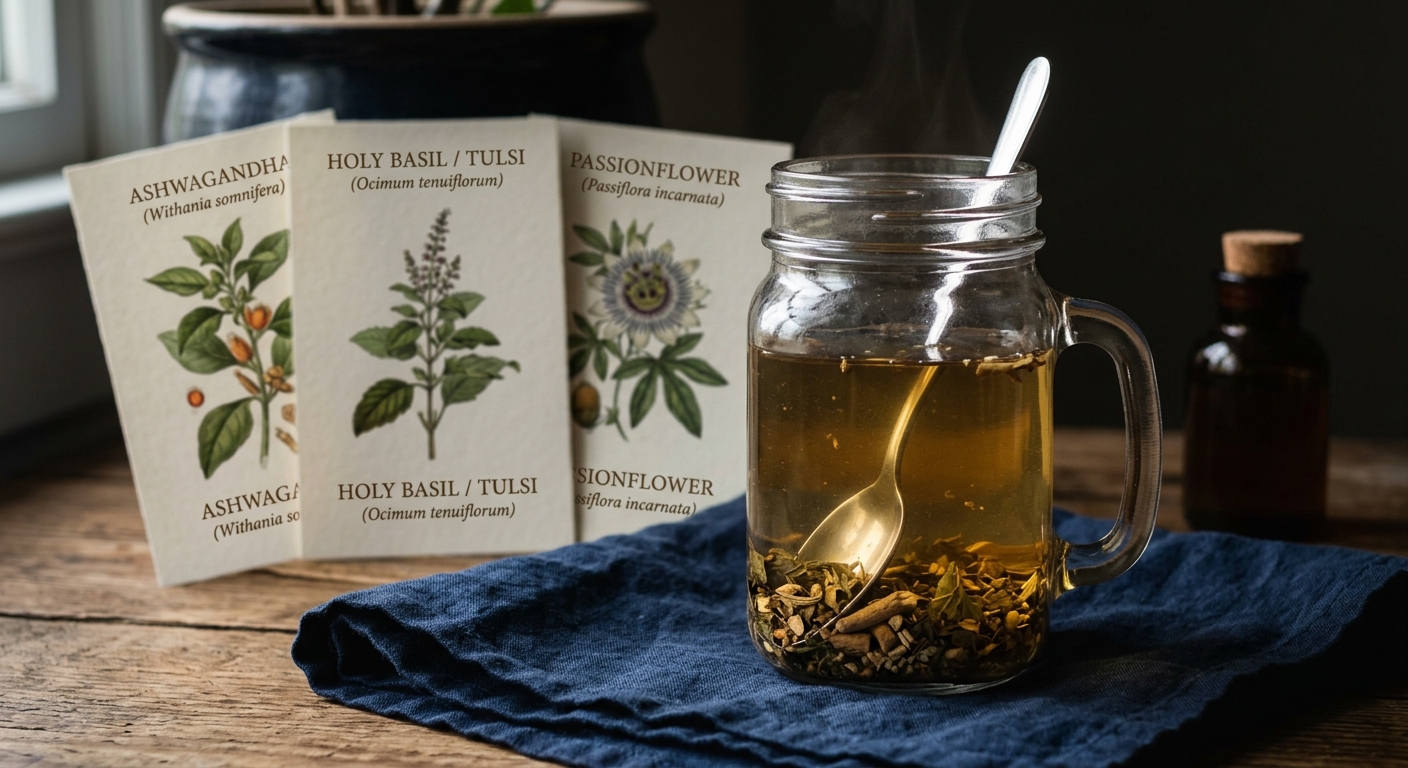
Long before modern life introduced inbox anxiety and round-the-clock notifications, herbalists across cultures were crafting blends designed to steady the mind and strengthen the spirit. The herbs in this Emotional Resilience blend – ashwagandha root, holy basil (tulsi), and passionflower – each carry centuries of use as nervine tonics and adaptogens. In Ayurvedic medicine, ashwagandha has been prescribed for thousands of years as a rasayana, or rejuvenating tonic, believed to build ojas, the vital essence of physical and emotional endurance. Tulsi, often called the “Queen of Herbs” in India, was grown in nearly every household as a sacred plant of clarity and protection. Passionflower arrived later in European herbalism via Indigenous American traditions, where it was used to ease restlessness and promote deep, untroubled sleep.
What makes this blend genuinely special is that it operates on multiple levels simultaneously. Ashwagandha works as a slow-building adaptogen, gradually recalibrating the body’s cortisol response over days and weeks of consistent use. Tulsi brings an immediate, uplifting aromatic quality and mild anxiolytic action that makes each cup feel like a conscious ritual of self-care. Passionflower rounds the formula with gentle sedative compounds that take the sharp edge off acute stress without causing drowsiness in moderate amounts. Together, these three herbs create a tea that is both calming in the moment and nourishing over time.
The flavor of this blend is earthy, faintly sweet, and warmly herbaceous, with tulsi’s clove-like spice lifting what might otherwise be a heavy, root-forward cup. It is the kind of tea that rewards slow drinking – best sipped in a quiet moment, ideally at the same time each day to reinforce the calming ritual and allow the adaptogenic compounds to accumulate their effect.
2
cups
Ingredients
- 1 tspdried ashwagandha root powder or cut-and-sifted root
- 1.5 tspdried holy basil (tulsi) leaves
- 1 tspdried passionflower herb (leaf and vine)
- 480 mlfiltered water (95°C / 203°F)
- —raw honey or coconut sugar to taste (optional)
- —a splash of warm oat milk (optional, softens the root bitterness)
How to Brew
Click on an item below to shop for the recommended items for this recipe on Amazon.
As an Amazon Associate, we earn from qualifying purchases.
- Bring filtered water to 95°C (203°F) using an electric kettle with temperature control. If you do not have temperature control, bring water to a full boil and allow it to sit for 30 seconds before pouring.
- Add the ashwagandha root, tulsi leaves, and passionflower herb into a fine-mesh tea infuser or reusable muslin bag. If using ashwagandha powder rather than cut root, use a tea strainer with very fine holes or a cloth strainer, as the powder passes through standard infusers.
- Place the loaded infuser into a prewarmed ceramic or glass mug (preheat by swirling hot water in the mug and discarding). Pour the hot water over the herbs and set a timer for 10 to 12 minutes.
- During steeping, cover your mug with a small saucer or lid to trap volatile aromatic oils, especially from the tulsi. This prevents the most therapeutic aromatic compounds from evaporating before you drink.
- Remove the infuser and press it gently against the side of the mug with a spoon to extract the remaining liquid from the herbs. Discard the spent plant material.
- Taste the tea before adding any sweetener. If it is more bitter than expected (which varies by ashwagandha source), stir in a small amount of raw honey. A splash of warm oat milk creates a creamier, more latte-like cup that pairs beautifully with the earthy root flavors.
- Measure the ashwagandha root, tulsi, and passionflower into a clean glass jar. Use a slightly higher quantity than for hot brew: 1.5 tsp ashwagandha, 2 tsp tulsi, and 1.5 tsp passionflower per 480 ml of water, to compensate for the reduced extraction of cold water.
- Pour room-temperature filtered water over the herbs. Stir briefly to ensure all plant material is moistened and submerged. If using powdered ashwagandha, stir more vigorously and consider straining through a coffee filter or fine cloth at the end rather than using a standard infuser.
- Cover the jar with a lid or a piece of cheesecloth secured with a rubber band. Allow it to sit at room temperature for 1 hour to begin the initial extraction, then transfer to the refrigerator.
- Refrigerate for a minimum of 10 hours and up to 14 hours. Do not steep longer than 14 hours, as the passionflower can develop an overly grassy, slightly astringent character when over-extracted in cold water.
- Strain the cold brew through a fine-mesh strainer or coffee filter into a pitcher or directly into two glasses filled with ice. Stir in honey while the liquid is still cold (liquid honey dissolves more easily than granulated sweeteners). Serve immediately or keep refrigerated for up to 48 hours.
- Place the ashwagandha root (1.5 tsp cut root or 1 tsp powder per 480 ml water) into a small saucepan with filtered water. Do not add the tulsi or passionflower yet. These herbs are heat-sensitive and will lose their aromatic and anxiolytic compounds if boiled.
- Bring the ashwagandha and water to a full boil over medium-high heat, then immediately reduce the heat to a gentle simmer (around 85 to 90°C). Simmer uncovered for 15 to 20 minutes. The liquid will reduce slightly and deepen in color to a warm amber-brown. Stir occasionally.
- Remove the saucepan from the heat entirely. Add the tulsi leaves and passionflower herb directly to the hot decoction liquid.
- Immediately cover the saucepan with a lid and allow the tulsi and passionflower to steep off the heat for 5 minutes. This infusion step preserves the volatile aromatic oils and alkaloids in these herbs that would be destroyed by continued boiling.
- Strain the decoction through a fine-mesh strainer into two prewarmed mugs, pressing the herbs firmly to extract all liquid. Adjust the volume with a small amount of hot water if the decoction has reduced by more than 20 percent during simmering.
- Taste and sweeten with raw honey if desired. For a traditional Ayurvedic-style preparation, substitute a portion of the water with warm whole milk or oat milk during the simmering stage for a deeply nourishing adaptogenic tonic.
Health Benefits
Multiple randomized controlled trials have found that ashwagandha root extract significantly reduces morning serum cortisol in adults reporting chronic stress, with reductions of 14 to 32 percent observed over 8 to 12 weeks of daily use. The withanolides in ashwagandha appear to normalize hyperactive HPA axis signaling without suppressing the cortisol response entirely.
Both passionflower and tulsi have demonstrated clinically meaningful reductions in generalized anxiety symptoms in small but well-designed trials. Passionflower performed comparably to low-dose oxazepam in one randomized trial for generalized anxiety disorder, with fewer reports of impaired job performance, suggesting a functional anxiolytic effect without significant sedation.
Tulsi’s rosmarinic acid and ursolic acid modulate monoamine pathways, supporting balanced serotonin and dopamine availability. Animal and preliminary human studies suggest tulsi has adaptogenic and antidepressant properties, with subjects reporting improved mood, reduced fatigue, and greater emotional steadiness after 4 to 6 weeks of regular consumption.
Passionflower’s GABA-A agonist activity, combined with ashwagandha’s cortisol-lowering effects, creates conditions that are physiologically conducive to restful sleep. A double-blind, placebo-controlled study found that ashwagandha root extract significantly improved sleep quality, time to fall asleep, and morning alertness in adults with insomnia associated with stress.
Unlike pharmaceutical anxiolytics that work acutely, the adaptogens in this blend accumulate their effects with consistent use. Ashwagandha and tulsi both enhance the body’s nonspecific resistance to biological, chemical, and psychological stressors by supporting mitochondrial integrity, reducing oxidative stress markers, and recalibrating the nervous system’s baseline reactivity.
🧪 Key Bioactive Compounds
The Science Behind Ashwagandha, Holy Basil (Tulsi), And Passionflower
The Emotional Resilience blend works through three complementary but distinct mechanisms of action, each rooted in solid ethnobotanical history and increasingly supported by modern pharmacology. Ashwagandha’s primary bioactives, the withanolides, are steroidal lactones that interact with the hypothalamic-pituitary-adrenal (HPA) axis, the central control system for the body’s stress response. When we experience chronic stress, the HPA axis becomes dysregulated, producing excess cortisol that disrupts sleep, mood, cognition, and immune function. Withanolides, particularly Withaferin A, appear to bind to glucocorticoid receptors and modulate signaling at the level of the hypothalamus, reducing the magnitude and duration of the cortisol stress response. Multiple peer-reviewed randomized controlled trials have confirmed measurable reductions in serum cortisol in stressed adults taking standardized ashwagandha extract, with effect sizes that are clinically meaningful rather than merely statistical.
Holy basil (tulsi) operates on overlapping but distinct pathways. Its rosmarinic acid content is particularly notable for its ability to inhibit GABA-T (gamma-aminobutyric acid transaminase), the enzyme responsible for breaking down GABA in the brain. By slowing GABA degradation, rosmarinic acid effectively raises the available concentration of this inhibitory neurotransmitter, producing a calming effect that is mechanistically similar to, though far milder than, benzodiazepine drugs. Tulsi also contains ursolic acid, which inhibits monoamine oxidase (MAO), the enzyme that breaks down serotonin, dopamine, and norepinephrine. This mild MAO-inhibiting activity helps explain the mood-stabilizing and energizing effects that long-term tulsi users consistently report, supporting emotional regulation without the emotional blunting associated with pharmaceutical interventions.
Passionflower contributes the blend’s most immediately perceptible calming action via its flavone C-glycosides, vitexin and isovitexin. These compounds have been demonstrated in both in vitro and in vivo studies to bind to GABA-A receptors, the same receptor class targeted by anxiolytic medications such as diazepam. The binding affinity is much lower than pharmaceutical drugs, which is precisely why passionflower produces noticeable relaxation at tea doses without causing meaningful sedation or cognitive impairment in most people. The three herbs in this blend demonstrate genuine synergy: ashwagandha addresses the hormonal root of chronic stress, tulsi supports the neurotransmitter environment for mood stability, and passionflower provides immediate nervous system calming, creating a formula that works at multiple timescales simultaneously.
Brewing Tips
- Consistency is the key with adaptogenic herbs. Ashwagandha and tulsi produce their strongest benefits after 4 to 6 weeks of daily use, so commit to a regular tea ritual rather than drinking this blend only during acute stressful moments.
- If you find the ashwagandha flavor too pronounced in the hot brew, switch to the cold brew method. The slower, cooler extraction pulls a noticeably smoother and less bitter version of the root, making the blend far more palatable for those new to ashwagandha’s earthy intensity.
- Store your dried herbs in separate airtight glass jars away from direct light and heat, then blend them together at brew time rather than pre-mixing a large batch. This preserves the volatile aromatic compounds in the tulsi, which degrade quickly once the leaves are blended with the root material.