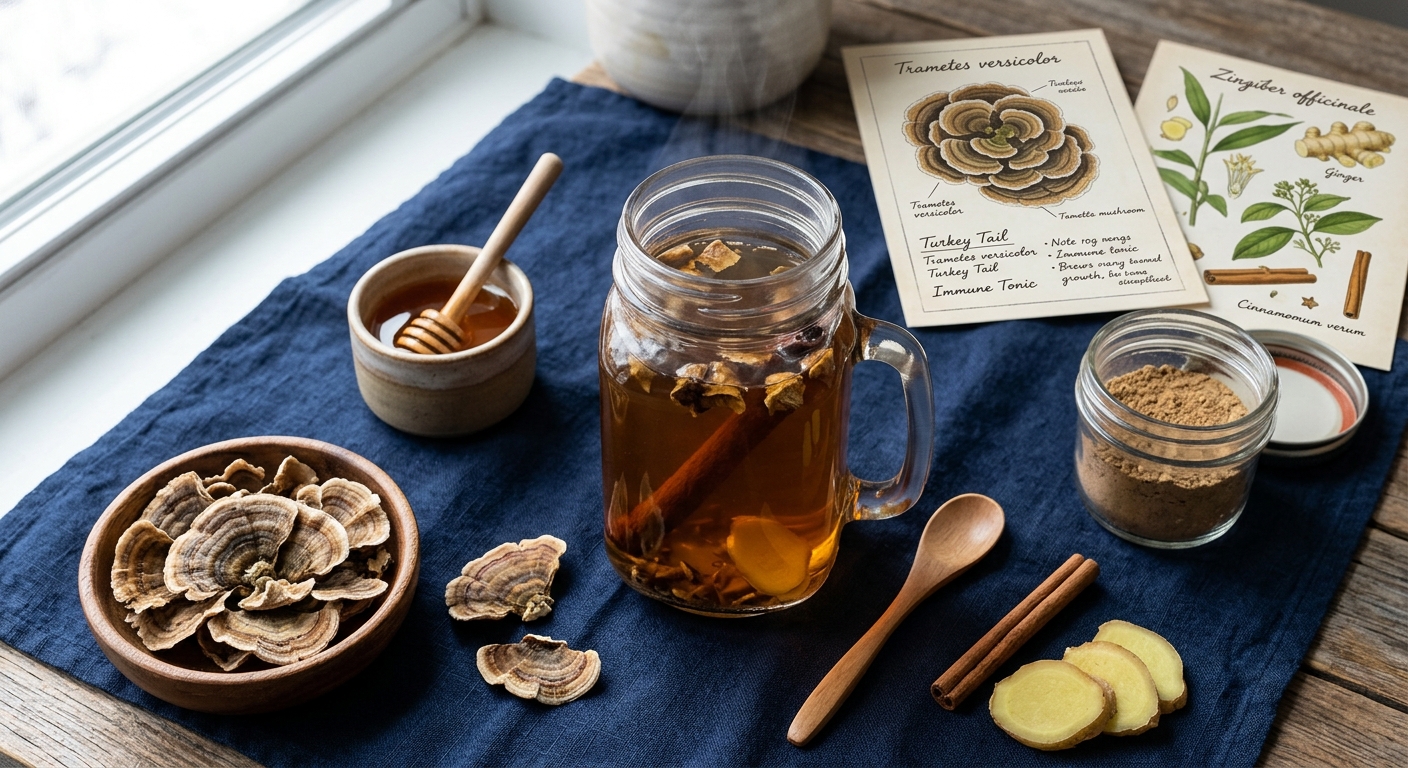
Deep in temperate forests around the world, a striking bracket fungus fans out across fallen logs and decaying stumps in layered rosettes of brown, tan, rust, and cream. Trametes versicolor, known as turkey tail for its resemblance to the fanned plumage of a wild turkey, has been brewed as a medicinal tea in China, Japan, and Korea for well over a thousand years. In Traditional Chinese Medicine, it is known as Yun Zhi, or Cloud Mushroom, and is considered a tonic for the lungs, liver, and spleen, prized for its ability to restore zheng qi, the vital upright energy that keeps illness at bay.
What makes turkey tail exceptional among herbal teas is the sheer volume of modern research validating its traditional use. Unlike many medicinal plants that remain understudied, turkey tail has been the subject of hundreds of peer-reviewed trials, particularly in Japan and the United States, where its polysaccharide extracts have been investigated as complementary cancer therapies. This is not a plant operating on folklore alone. Its bioactive compounds are well characterized, their mechanisms understood, and their effects measurable. Yet it retains a quality that laboratory science rarely captures: a deep, woody, forest-floor warmth that feels genuinely restorative in the cup.
As a tea for stress and anxiety, turkey tail works differently from nervine herbs like lemon balm or passionflower. Rather than acting directly on GABA receptors or calming the nervous system acutely, turkey tail exerts its calming influence through the gut-brain axis. Its prebiotic polysaccharides nourish beneficial gut bacteria, and emerging research consistently links a healthy gut microbiome to reduced cortisol output, better mood regulation, and greater resilience to chronic stress. This is slow, foundational medicine, and it rewards consistent daily brewing.
2
cups
Ingredients
- 10 gdried turkey tail mushroom pieces or powder
- 500 mlwater (for hot brew)
- 1 tspraw honey (optional)
- —a small cinnamon stick or slice of fresh ginger (optional, to round out the flavor)
How to Brew
Click on an item below to shop for the recommended items for this recipe on Amazon.
As an Amazon Associate, we earn from qualifying purchases.
- Add 10 g of dried turkey tail mushroom pieces or powder to a small saucepan. If using whole dried pieces, break or crumble them into smaller fragments to increase surface area and improve extraction.
- Pour 600 ml of cold filtered water into the saucepan. Starting with cold water and bringing it up to temperature together with the mushroom draws out compounds more gradually and evenly.
- Bring the water to a full rolling boil over medium-high heat, then reduce to a steady simmer. Simmer uncovered for 20 to 45 minutes. At 20 minutes you will have a lighter, milder brew. At 45 minutes the tea will be noticeably darker, more concentrated, and higher in polysaccharide content.
- Remove from heat and allow to rest for 3 minutes. Strain the liquid through a fine mesh strainer or cheesecloth into two mugs. Press the mushroom solids firmly with a spoon to extract every last drop.
- Taste the tea plain first. If the earthiness is too pronounced, add a thin slice of fresh ginger or a small cinnamon stick to the saucepan in the last 10 minutes of simmering. Sweeten lightly with raw honey if desired, adding it only after the tea has cooled slightly below boiling to preserve the honey’s enzymes.
- Use turkey tail powder rather than whole dried pieces for cold brewing, as cold water cannot efficiently penetrate the tough fibrous cell walls of larger fragments. Measure 12 g of turkey tail powder per 500 ml of cold filtered water to account for the reduced extraction efficiency.
- Combine the turkey tail powder and cold filtered water in a glass jar with a tight-fitting lid. Stir vigorously for 30 seconds to fully disperse the powder and prevent clumping on the bottom.
- Leave the jar at room temperature for 2 hours, stirring once more after the first hour. Then transfer to the refrigerator and allow to steep for a further 10 to 22 hours, for a total steep time of 12 to 24 hours. Longer steeping within this range produces a more potent result.
- When ready to serve, strain the liquid through a fine mesh strainer lined with cheesecloth or a coffee filter into a jug or directly into glasses filled with ice. The cold brew will be noticeably lighter in color than the decoction, a pale amber to warm gold.
- Serve immediately over ice. A squeeze of fresh lemon juice and a small amount of maple syrup complement the earthy, gentle flavor of the cold-brewed mushroom beautifully. Refrigerate any leftover tea and consume within 48 hours.
- Weigh out 30 g of dried turkey tail mushroom pieces and add them to a medium saucepan. Pour in 1 litre of cold filtered water. The high water-to-mushroom ratio at the start accounts for significant evaporation during the long simmer.
- Bring the water to a full rolling boil over medium-high heat, then reduce to a lively simmer. Simmer uncovered for 60 to 90 minutes, stirring occasionally. The liquid will reduce by roughly 50 to 60 percent, concentrating the polysaccharides and other bioactive compounds significantly. Watch the pot during the final 20 minutes to ensure the liquid does not reduce too far and begin to scorch.
- Remove from heat when the liquid has reduced to approximately 350 to 400 ml and has turned a deep mahogany brown. Allow to cool for 10 minutes.
- Strain through a fine mesh strainer lined with cheesecloth into a clean glass jar, pressing the mushroom solids firmly. Discard the solids. Allow the concentrate to cool to room temperature, then seal the jar and refrigerate.
- To use the concentrate, measure 2 to 3 tablespoons (30 to 45 ml) and stir into 200 ml of warm water to create a single serving of tea. Alternatively, blend it into a morning smoothie or stir it into a vegetable broth for a savory umami boost. The concentrate keeps refrigerated for up to 7 days. Label the jar with the date of preparation.
Health Benefits
The beta-glucan polysaccharides PSK and PSP activate immune cells including macrophages, dendritic cells, and natural killer cells, helping the immune system respond more precisely to threats without tipping into excessive inflammation. PSK is so well validated that it is used clinically in Japan alongside conventional cancer treatment.
PSP acts as a prebiotic, selectively feeding beneficial microbes in the gut microbiome. Because the gut microbiome directly influences cortisol production and the synthesis of serotonin and other mood-regulating neurotransmitters, a healthier gut translates to measurably lower baseline stress and improved emotional resilience over time.
Chronic psychological stress generates excessive free radicals that damage neurons, blood vessels, and immune cells. The polyphenols in turkey tail, including quercetin and hispolon, neutralize these free radicals and reduce markers of oxidative stress, helping protect tissues that would otherwise accumulate damage during prolonged periods of anxiety or burnout.
A 2014 pilot study published in the Journal of the Academy of Nutrition and Dietetics found that daily consumption of turkey tail powder significantly increased populations of Bifidobacterium longum and Lactobacillus while reducing Clostridium perfringens, pointing to a meaningful prebiotic effect with consistent use.
In the framework of Traditional Chinese Medicine, turkey tail is classified as an adaptogen-adjacent tonic, used to restore and preserve vital energy rather than stimulate it. Preliminary research suggests that its polysaccharides may support mitochondrial efficiency and reduce fatigue biomarkers in people experiencing chronic stress or immune depletion.
🧪 Key Bioactive Compounds
The Science Behind Turkey Tail Mushroom
The most studied compounds in turkey tail are its high-molecular-weight beta-glucan polysaccharides, particularly polysaccharide-K (PSK) and polysaccharide peptide (PSP). These compounds work primarily by binding to pattern recognition receptors on the surface of innate immune cells, including Toll-like receptor 2 (TLR-2) and Dectin-1. This binding triggers a cascade of immune activation events: macrophages become more phagocytic, natural killer cells increase their cytotoxic output, and dendritic cells improve their ability to present antigens to T-lymphocytes. The result is a more coordinated, responsive immune system, rather than a bluntly stimulated one. This modulatory quality, rather than simple stimulation, is what distinguishes medicinal mushroom polysaccharides from cruder immune stimulants.
The gut-brain connection is where turkey tail’s relevance to stress and anxiety becomes most scientifically compelling. PSP has been demonstrated to act as a selective prebiotic, measurably shifting the gut microbiome toward greater populations of butyrate-producing and lactate-producing bacteria. These microbial communities influence the enteric nervous system and the vagus nerve, the primary communication highway between the gut and the brain. Higher butyrate production in the gut has been linked in multiple studies to lower neuroinflammation, improved stress resilience, and better regulation of the hypothalamic-pituitary-adrenal (HPA) axis, the system responsible for cortisol release during stress. In this way, drinking turkey tail tea regularly may help recalibrate how strongly the body responds to psychological stressors, though this mechanism takes weeks to months of consistent use to manifest.
Turkey tail also contains a range of phenolic compounds including quercetin, baicalein, and hispolon, which contribute meaningful antioxidant and anti-inflammatory activity. Chronic stress is now well understood to produce a state of low-grade systemic inflammation, driven partly by excess cortisol and partly by the free radicals generated during sustained sympathetic nervous system activation. The polyphenols in turkey tail scavenge these reactive oxygen species and suppress pro-inflammatory cytokines such as interleukin-6 (IL-6) and tumor necrosis factor-alpha (TNF-a). Baicalein, in particular, has demonstrated GABA-A receptor modulating activity in animal studies, hinting at a possible direct calming effect that adds to the indirect gut-mediated pathway. While human clinical trials specifically targeting turkey tail for anxiety are still limited, the mechanistic picture is increasingly coherent and well-grounded in basic science.
Brewing Tips
- Buy turkey tail from reputable suppliers who test for heavy metals and verify species identity. The supplement market contains many mislabeled products, and genuine Trametes versicolor should be confirmed by laboratory analysis or third-party certification.
- Save your spent mushroom pieces after straining the decoction and add them to a pot of vegetable or bone broth. The fibrous solids still contain bound polysaccharides and minerals that release beautifully into a long-simmered stock.
- Consistency matters more than quantity with turkey tail. A modest cup brewed daily for four to six weeks produces significantly greater immune and gut-microbiome benefits than occasional large doses. Think of it as a daily tonic rather than an acute remedy.