Whether it is the night before a big presentation, the hours leading up to a performance, or the restless spiral of anticipatory worry, performance anxiety has a way of hijacking the very mental clarity we need most. Herbalists have long turned to a small group of plants known as nervines and adaptogens to address exactly this kind of acute, situational stress. Unlike herbs that sedate or cloud the mind, the trio at the heart of this blend works with the nervous system rather than against it, calming without dulling, steadying without sedating.
Ashwagandha root (Withania somnifera) has been a cornerstone of Ayurvedic medicine for over 3,000 years, prized as a rasayana, or rejuvenating tonic, prescribed to warriors and scholars alike to build resilience under pressure. Lemon balm (Melissa officinalis) carries an equally rich legacy in European herbalism, referenced by Paracelsus in the sixteenth century as a herb that could “fully revive a man” and calm the heart, while passionflower (Passiflora incarnata) was adopted into Western botanical medicine in the nineteenth century after indigenous communities in the Americas had long used it to ease nervous tension and insomnia.
What makes this blend particularly well suited to performance anxiety, as opposed to generalised daily stress, is the way each plant targets a different physiological thread of the anxious response. Ashwagandha moderates the cortisol surge that accompanies anticipatory stress. Lemon balm quiets the cognitive rumination and mental chatter that can spiral before high-stakes moments. Passionflower addresses the physical symptoms, the tight chest, shallow breath, and restless body, by gently amplifying the brain’s own calming chemistry. Brewed together, they create a tea that is as purposeful as it is comforting.
2
cups
Ingredients
- 1 tspashwagandha root powder or fine-cut dried root
- 1.5 tspdried lemon balm leaf
- 1 tspdried passionflower herb
- 480 mlfiltered water
- —raw honey or maple syrup to taste (optional)
- —a pinch of cardamom (optional, helps mask ashwagandha’s earthiness)
How to Brew
Click on an item below to shop for the recommended items for this recipe on Amazon.
As an Amazon Associate, we earn from qualifying purchases.
- If using cut-and-sifted ashwagandha root (not powder), place it in a small saucepan with 500 ml of cold filtered water and bring to a gentle simmer over medium-low heat. Simmer uncovered for 10 minutes, then remove from heat. If using ashwagandha powder, simply heat your filtered water to 95°C (203°F) in a kettle.
- Place your dried lemon balm and dried passionflower into a tea infuser or directly into a teapot. If you simmered the ashwagandha root, strain the decoction through a fine-mesh strainer directly over the lemon balm and passionflower. If using powder, add the powder to the infuser along with the leaf herbs, then pour the 95°C water over everything.
- Cover your teapot or mug with a small plate or lid to trap the volatile aromatic compounds, particularly the calming terpenes in lemon balm, which evaporate quickly in open air. Steep for 10 to 15 minutes.
- Strain thoroughly. If you used ashwagandha powder, use a fine-mesh strainer or a piece of muslin to catch any sediment.
- Sweeten lightly with raw honey if desired and add a small pinch of cardamom to round out the earthy ashwagandha notes. Sip slowly 30 to 60 minutes before the stressful event for best effect.
- Combine the dried lemon balm, dried passionflower, and ashwagandha root powder or finely ground root in a clean glass jar. Use slightly higher quantities than the hot brew, approximately 20 percent more of each herb, as cold water extracts compounds more slowly and less completely than hot water.
- Pour 500 ml of cold filtered water over the herbs. Stir well to ensure the ashwagandha powder is fully dispersed and not clumped at the bottom.
- Leave the jar at room temperature for 1 hour, then seal and transfer to the refrigerator. Allow to steep for a minimum of 8 hours and up to 12 hours. Overnight preparation is ideal.
- In the morning, strain the blend through a fine-mesh strainer lined with muslin or a coffee filter to remove all fine herb particles and ashwagandha sediment. Press the herbs gently to extract maximum liquid.
- Serve over ice if desired. The cold brew will taste noticeably smoother and less bitter than the hot version, with the lemon balm’s citrus notes more prominent. Sweeten with a small amount of agave or honey syrup (pre-dissolved in warm water) if preferred. Consume within 24 hours.
- Place the ashwagandha root (cut-and-sifted or coarsely broken pieces) into a small stainless steel or ceramic saucepan. Add 600 ml of cold filtered water to account for evaporation during simmering. Do not add the lemon balm or passionflower yet, as prolonged heat will destroy their delicate volatile compounds.
- Bring the water to a gentle boil over medium heat, then reduce heat immediately to a low simmer. Simmer the ashwagandha root uncovered for 20 minutes, stirring occasionally. You will notice the water darkening to a warm amber and taking on a distinctly earthy, slightly milky aroma.
- After 20 minutes, remove the saucepan from heat entirely. Add the dried lemon balm leaf and dried passionflower to the hot decoction liquid. Cover the saucepan with a tight-fitting lid.
- Allow the leaf herbs to infuse in the residual heat, covered, for 5 minutes. This two-stage approach extracts the robust root compounds through simmering while preserving the fragile aromatic and flavonoid compounds in the leaf herbs through gentle covered infusion.
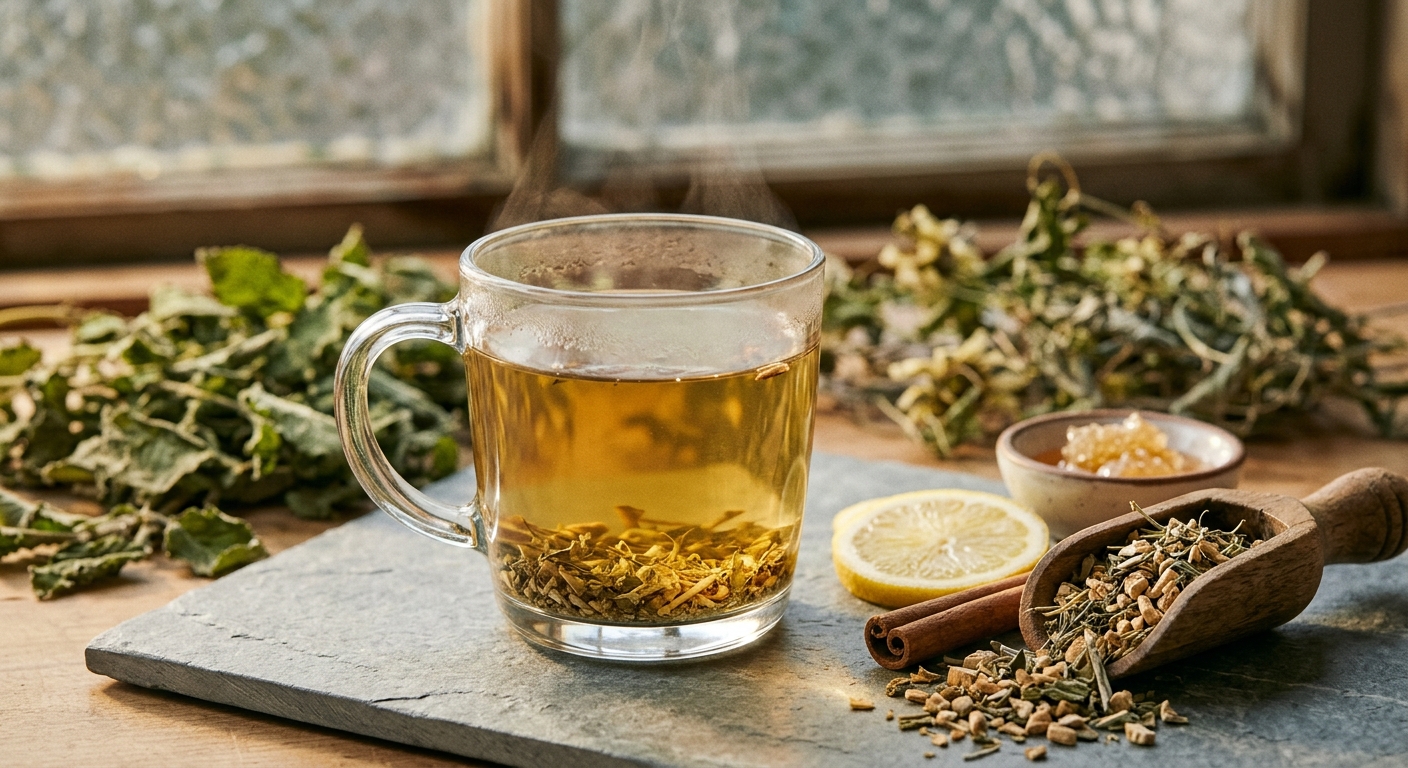
- Strain the finished decoction through a fine-mesh strainer into a warmed mug or teapot, pressing the herbs to release all liquid. You should yield approximately 400 ml after evaporation. Add a pinch of cardamom and sweeten with honey if desired. Drink in two servings: one 60 minutes before the event and one immediately beforehand.
Health Benefits
A randomised, double-blind trial published in Medicine (2019) found that ashwagandha supplementation significantly reduced anxiety scores and serum cortisol compared to placebo. Lemon balm has shown similar anxiolytic effects in human trials at doses achievable through tea, particularly in combination with other nervines.
Ashwagandha’s withanolides act on the hypothalamic-pituitary-adrenal axis to normalise cortisol secretion patterns, blunting the acute cortisol spike that triggers the physical symptoms of performance anxiety such as trembling, rapid heart rate, and mental blanking.
Unlike pharmaceutical anxiolytics, lemon balm has been shown in human studies to improve calmness and memory performance simultaneously, suggesting it reduces anxious interference on cognition rather than broadly suppressing mental function. This makes it particularly valuable before performances requiring sharp concentration.
Passionflower has demonstrated clinical efficacy in reducing the somatic symptoms of anxiety, including palpitations, muscle tension, and gastrointestinal distress, via its action at GABA-A receptors. A 2011 randomised trial found it as effective as low-dose pharmaceutical anxiolytic for generalised anxiety disorder with fewer cognitive side effects.
Used consistently as a daily tonic rather than only in acute moments, ashwagandha acts as an adaptogen, gradually raising the body’s baseline stress threshold. Regular consumption over 8 weeks has been associated with reduced perceived stress, improved sleep quality, and lower morning cortisol levels in multiple controlled trials.
🧪 Key Bioactive Compounds
The Science Behind Ashwagandha
The anxiolytic action of this blend operates across three distinct but complementary neurochemical pathways, which is what makes the combination more effective than any single herb used alone. Ashwagandha’s withanolides work primarily at the level of the hypothalamic-pituitary-adrenal axis, suppressing the upstream hormonal cascade that triggers cortisol release. By moderating this axis, ashwagandha prevents the cortisol surge that creates many of the most disruptive physical symptoms of performance anxiety, including cognitive impairment, muscle tension, and cardiovascular arousal. Withaferin A, one of the most bioactive withanolides, has also been shown in preclinical research to promote neurogenesis in the hippocampus and to reduce neuroinflammatory signalling in the amygdala, the brain’s primary fear-processing centre.
Lemon balm’s key mechanism centres on the enzyme GABA-transaminase, which is responsible for breaking down gamma-aminobutyric acid, the brain’s principal inhibitory neurotransmitter. Rosmarinic acid inhibits this enzyme, effectively increasing the amount of available GABA in the synaptic cleft and prolonging its calming effect. Separately, lemon balm’s citral constituents inhibit acetylcholinesterase, preserving the availability of acetylcholine and supporting the kind of grounded, attentive calm that is essential during a performance, rather than the foggy detachment associated with pharmacological sedation. A 2014 human crossover study published in Nutrients found that a single dose of lemon balm extract significantly reduced self-reported anxiety and improved mood and calmness within hours of ingestion.
Passionflower contributes flavonoid glycosides, most notably vitexin and chrysin, that bind to the benzodiazepine receptor site on the GABA-A receptor complex. This is the same receptor site targeted by prescription anxiolytics such as diazepam, but passionflower’s flavonoids act as partial agonists with a much lower affinity, producing a measurable anxiolytic effect without the sedation, tolerance, or withdrawal risk associated with pharmaceutical benzodiazepines. A landmark randomised controlled trial by Akhondzadeh et al. (2001) found passionflower extract as effective as oxazepam for generalised anxiety disorder over a four-week period, with participants in the passionflower group reporting significantly less impairment of job performance, a finding of particular relevance to anyone using this tea to manage performance anxiety.
Brewing Tips
- Brew this tea covered at all times during steeping. Lemon balm’s most valuable volatile compounds, including the monoterpenes responsible for its calming aroma and GABAergic activity, evaporate readily in steam, and a covered steep preserves significantly more of these compounds in the cup.
- If you find the earthiness of ashwagandha off-putting, blend the finished tea with 60 ml of warm oat milk and a small pinch of cinnamon. The beta-glucans in oats are mildly calming themselves, and the fat in oat milk improves the absorption of ashwagandha’s fat-soluble withanolides.
- For best results with acute performance anxiety, begin drinking this tea 60 minutes before the event rather than immediately beforehand. Lemon balm and passionflower both show peak serum activity approximately 45 to 90 minutes after ingestion, so timing matters as much as the blend itself.