The years following menopause bring profound shifts in cardiovascular risk. With the decline of estrogen, which once offered natural protection to artery walls and cholesterol balance, post-menopausal women face a significantly elevated risk of heart disease. For centuries, traditional herbalists across Europe, Asia, and the Americas have turned to the same small group of botanicals to support the aging heart: hawthorn berries for their toning and vasodilatory properties, hibiscus flowers for their ability to gently lower blood pressure, and rose hips as a dense source of vitamin C and bioflavonoids that strengthen capillary walls. Together, these three herbs form a synergistic blend with a remarkable depth of both flavor and function.
Hawthorn (Crataegus monogyna and related species) holds a special place in European folk medicine as the heart herb. Its berries, leaves, and flowers were prescribed by herbalists and later by physicians for everything from mild angina to palpitations and early-stage heart failure. The German Commission E formally approved hawthorn preparations for declining cardiac performance, a distinction few herbs achieve. Hibiscus (Hibiscus sabdariffa), known as sorrel in the Caribbean, karkade in Egypt, and agua de jamaica in Mexico, has been drunk for heart and kidney support across multiple continents. Rose hip (Rosa canina) became famous during World War II in Britain as a vitamin C source, but traditional use long recognized its role in reducing inflammation and supporting vascular integrity.
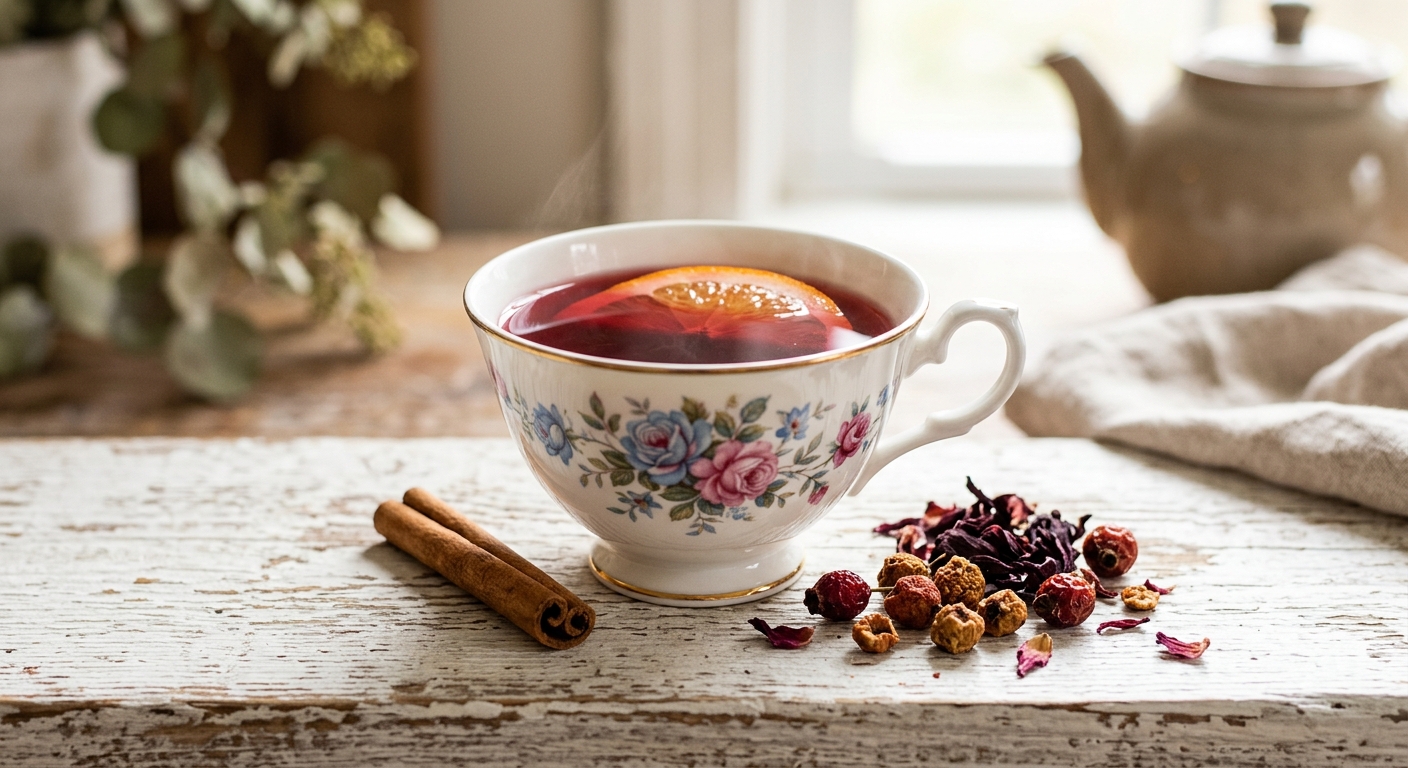
This tea is more than a remedy. It is a daily ritual of self-care, offering a vivid, jewel-toned brew with a tangy, berry-forward flavor that genuinely pleases the palate. Whether you steep it hot on a cool morning or cold-brew a pitcher for the week ahead, this blend invites you to make cardiovascular nourishment a pleasure rather than a chore. It pairs beautifully with a quiet moment, a good book, and the knowledge that you are actively tending to your most vital organ.
2
cups
Ingredients
- 2 tspdried hawthorn berries (lightly crushed)
- 1.5 tspdried hibiscus flowers
- 1.5 tspdried rose hips (lightly crushed)
- 480 mlwater (93°C / 200°F)
- —raw honey or maple syrup to taste (optional)
- —a slice of fresh orange (optional, for serving)
How to Brew
Click on an item below to shop for the recommended items for this recipe on Amazon.
As an Amazon Associate, we earn from qualifying purchases.
- Lightly crush the hawthorn berries and rose hips using the back of a spoon or a mortar and pestle. This breaks the skin and dramatically increases extraction of oligomeric proanthocyanidins and vitamin C.
- Combine the crushed hawthorn berries, rose hips, and hibiscus flowers in a tea infuser, muslin bag, or small teapot designed for loose leaf infusions.
- Heat filtered water to 93 to 96°C (200 to 205°F). Avoid a full rolling boil as excessive heat can degrade some of the heat-sensitive anthocyanins in hibiscus.
- Pour the hot water over the herbs and cover immediately with a lid or small saucer. Covering traps volatile aromatic compounds and keeps the brew hotter for longer.
- Steep for 12 to 15 minutes, checking color at 12 minutes. The tea should be a deep, vibrant ruby red. If it appears pale, steep for a further 2 to 3 minutes.
- Remove the infuser, sweeten lightly with raw honey if desired, and serve immediately. Add a slice of orange to the mug for a bright citrus note that complements the hibiscus beautifully.
- Lightly crush the hawthorn berries and rose hips as you would for hot brew. For cold brew, double the herb quantity per batch: use 4 tsp hawthorn berries, 3 tsp hibiscus, and 3 tsp rose hips for 480 ml of water, as cold water extracts more slowly and requires a higher starting ratio.
- Combine the crushed herbs and hibiscus flowers in a clean glass jar with a lid. Pour 480 ml of cold, filtered water directly over the herbs at room temperature.
- Stir gently to ensure all herbs are submerged and saturated. Place the lid on the jar and leave on the counter for 30 minutes to allow an initial ambient-temperature extraction to begin.
- Transfer the jar to the refrigerator and allow to steep for 10 to 14 hours, ideally overnight. The slow, cold extraction preserves the bright anthocyanin color and produces a mellower tartness than hot brewing.
- Strain through a fine mesh strainer or cheesecloth into a serving glass filled with ice. The cold brew can be stored unstrained in the refrigerator for up to 48 hours before straining, or strained and kept for up to 3 days.
- Serve over ice with a slice of orange or a few fresh mint leaves. Sweeten with a small amount of simple syrup or liquid honey if desired, as granulated sweeteners do not dissolve well in cold liquid.
- Place the dried hawthorn berries and rose hips (no need to crush them first, as extended simmering will break them down) into a small stainless steel or ceramic saucepan. Use 1 tbsp of hawthorn berries and 1 tbsp of rose hips per 480 ml of cold filtered water for a concentrated therapeutic brew.
- Add 600 ml of cold filtered water to account for evaporation during simmering. Place the saucepan over medium heat and bring slowly to a gentle simmer, not a rolling boil.
- Once simmering, reduce heat to maintain a steady 85 to 90°C (185 to 194°F). Add the hibiscus flowers to the pan now rather than at the start, as they are delicate and over-boiling destroys their anthocyanins. Stir gently.
- Simmer uncovered for 20 to 25 minutes. You will notice the liquid deepening from pale pink to a dark, wine-like ruby red as the hawthorn and rose hip compounds extract fully into the water. The liquid will reduce by roughly 20 percent.
- Remove from heat and allow to rest for 5 minutes before straining through a fine mesh strainer into mugs or a heatproof pitcher. Press the spent herbs gently with a spoon to recover every last drop of the concentrated liquid.
- The resulting decoction is more concentrated than a standard hot brew. You may wish to dilute it slightly with hot water if the tartness is intense, or enjoy it as-is. Sweeten with raw honey and serve with a cinnamon stick for a warming, apothecary-style tonic.
Health Benefits
Multiple randomized controlled trials have demonstrated that hibiscus tea consumption significantly reduces systolic and diastolic blood pressure in adults with prehypertension and mild hypertension. The ACE-inhibiting anthocyanins in hibiscus, combined with the vasodilatory OPCs from hawthorn, create a dual mechanism for gentle blood pressure modulation that is particularly relevant post-menopause when estrogen’s protective vasodilatory influence declines.
Post-menopausal women experience accelerated oxidative stress that contributes to arterial plaque formation and atherosclerosis. The combined antioxidant load of hawthorn OPCs, rose hip vitamin C, and hibiscus anthocyanins neutralizes free radicals that oxidize LDL cholesterol, one of the key early steps in plaque development. Animal and in vitro studies consistently show hawthorn extracts slow atherosclerotic progression.
Vitexin and hyperoside in hawthorn have been shown in clinical studies, including the SPICE trial involving patients with chronic heart failure, to improve cardiac output and exercise tolerance. Even in healthy adults, regular hawthorn consumption appears to reduce peripheral vascular resistance, supporting efficient circulation to all tissues.
Both hawthorn and hibiscus have demonstrated lipid-modifying effects in human clinical trials. Hibiscus acid appears to inhibit fatty acid synthesis, while hawthorn polyphenols reduce LDL oxidation and support HDL function. A 2011 study in the Journal of Alternative and Complementary Medicine found hibiscus tea consumption reduced LDL and raised HDL in metabolic syndrome patients over four weeks.
Chronic low-grade inflammation is a recognized driver of cardiovascular disease in post-menopausal women, and all three herbs in this blend carry meaningful anti-inflammatory compounds. Rose hip preparations have been validated in clinical trials for reducing C-reactive protein (CRP), a key marker of systemic inflammation, while hawthorn and hibiscus polyphenols downregulate pro-inflammatory cytokines including interleukin-6 and tumor necrosis factor-alpha.
🧪 Key Bioactive Compounds
The Science Behind Hawthorn Berry
The cardiovascular benefits of this three-herb blend are rooted in well-characterized phytochemistry. Hawthorn berry’s most clinically significant compounds are its oligomeric proanthocyanidins (OPCs) and flavone glycosides, particularly vitexin and hyperoside. OPCs act on multiple cardiovascular pathways simultaneously: they inhibit phosphodiesterase, increasing cyclic AMP in cardiac muscle cells to improve contractile force, while also relaxing smooth muscle in artery walls through nitric oxide potentiation. The result is improved coronary perfusion and reduced cardiac workload. The landmark SPICE trial, a multicenter European study published in 2008, found that hawthorn extract added to standard treatment for chronic heart failure patients significantly improved exercise tolerance and reduced symptoms over 24 months.
Hibiscus sabdariffa’s anthocyanins, led by delphinidin-3-sambubioside and cyanidin-3-sambubioside, are responsible for its clinically validated antihypertensive effect. A 2010 meta-analysis published in the Journal of Nutrition reviewed five randomized controlled trials and concluded that hibiscus tea consumption significantly lowered both systolic and diastolic blood pressure compared to placebo. The proposed mechanisms include ACE inhibition, diuretic activity from organic acids, and direct vascular smooth muscle relaxation via anthocyanin-mediated endothelial nitric oxide synthase activation. These mechanisms are relevant specifically in post-menopausal women, whose declining estrogen levels reduce endogenous nitric oxide production and stiffen arterial walls.
Rose hip’s contribution to this blend is primarily antioxidant and anti-inflammatory. The fruit is exceptional among plant foods for its vitamin C density, with values between 400 and 2000 mg per 100 g of fresh weight depending on species and ripeness. Vitamin C is not only a direct antioxidant but also regenerates vitamin E within cell membranes and is essential for collagen cross-linking in arterial walls, directly countering the increased vascular fragility seen post-menopause. Additionally, a galactolipid compound unique to rose hip known as GOPO has been validated in multiple human trials to reduce CRP levels, positioning rose hip as a meaningful anti-inflammatory botanical alongside its nutritive role.
Brewing Tips
- Buy whole, dried hawthorn berries and rose hips rather than pre-ground versions. Grinding increases surface area and accelerates oxidation, degrading the very OPCs and vitamin C you are brewing for. Crush them fresh each time just before brewing.
- Store your herb blend in a dark, airtight glass jar away from heat and light. Anthocyanins in hibiscus are particularly sensitive to light degradation, and proper storage extends the potency and color of your blend for up to 12 months.
- Brew this tea in ceramic or glass vessels rather than metal. Highly acidic infusions like hibiscus can react subtly with certain metals, and the tannins in hawthorn may bind to iron ions in low-quality metal pots, slightly altering flavor and reducing polyphenol bioavailability.