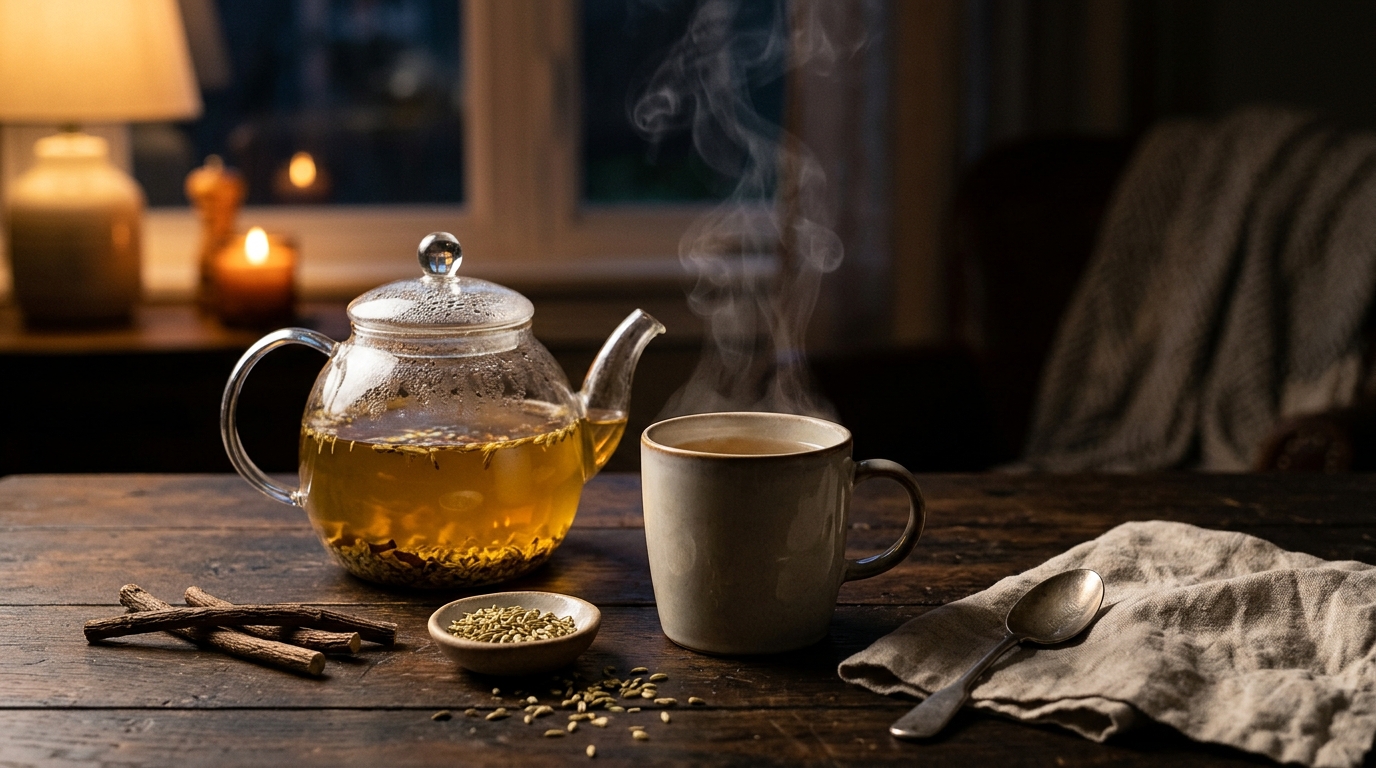
Walk into an Indian restaurant at the end of a meal and you may be offered a small dish of roasted fennel seeds to chew on the way out. Travel to the Mediterranean and you will find fennel steeped in tea or tucked into digestive liqueurs. The habit is ancient. Greek and Roman physicians prescribed fennel for stomach discomfort, and Pliny the Elder recommended it for a long list of ailments. Medieval monks grew it in their physic gardens, and it was said to be a plant that could keep both hunger and evil spirits at bay.
Licorice root has an equally long pedigree. Sticks of it were found in the tomb of Tutankhamun, and Traditional Chinese Medicine treats it as a harmonizer, a herb added to formulas to soften harsh flavors and bring other ingredients into balance. Its main sweet compound, glycyrrhizin, is roughly 30 to 50 times sweeter than sugar, which is why a small piece of root can sweeten an entire pot of tea.
Paired together, the two herbs form one of the most satisfying after-dinner infusions you can make. Fennel brings a warm, anise-like aroma and carminative action, while licorice adds rounded sweetness and a soothing, slightly demulcent texture. The result tastes like a dessert but behaves like a digestive aid, making it an ideal ritual for winding down after supper.
2
cups
Ingredients
- 2 tspfennel seeds, lightly crushed
- 1 tspdried licorice root, cut and sifted
- 480 mlwater (95°C / 203°F)
- —a thin slice of fresh ginger (optional)
- —a strip of lemon peel (optional)
How to Brew
Click on an item below to shop for the recommended items for this recipe on Amazon.
As an Amazon Associate, we earn from qualifying purchases.
- Measure the fennel seeds into a mortar or onto a cutting board and crush them lightly with a pestle or the flat of a knife. You only want to crack the seeds, not grind them to powder. This ruptures the cell walls and releases the volatile oils, particularly anethole.
- Place the crushed fennel and the licorice root into a teapot or a large mug fitted with a tea infuser. If you are using ginger or lemon peel, add them now.
- Bring fresh water to a near boil, about 95°C (203°F). Pour it over the herbs and immediately cover the vessel with a lid or small plate. Covering is important because it traps the aromatic oils in the cup rather than letting them escape with the steam.
- Steep for 10 to 12 minutes. Fennel seeds and licorice root are dense, so a longer steep is needed to extract their flavor and sweetness. Shorter steeps will taste thin.
- Strain into cups and sip slowly. No sweetener is usually needed, since the licorice provides plenty of natural sweetness.
- Lightly crush 2 tablespoons of fennel seeds and combine them with 2 teaspoons of licorice root in a clean glass jar. Because cold water extracts more slowly, this method uses a higher ratio of herb to water than hot brewing.
- Add 1 liter of cold, filtered water and stir once to wet all of the herbs. Seal the jar with a lid.
- Refrigerate for 8 to 10 hours, or overnight. Give the jar a gentle shake once or twice if you happen to pass by it.
- Strain through a fine mesh sieve or a coffee filter to remove all of the small fennel fragments.
- Serve over ice or chilled, straight from the jar. The tea will keep in the refrigerator for up to 3 days.
- Add the licorice root and 480 ml of cold water to a small saucepan. Starting with cold water lets the root hydrate gradually and release its glycyrrhizin evenly.
- Bring to a boil over medium heat, then reduce to the lowest simmer and cover. Simmer the licorice alone for 10 minutes.
- Add the lightly crushed fennel seeds to the pot, cover again, and simmer for another 5 minutes. Fennel is added late because its volatile oils are delicate and would be lost with prolonged boiling.
- Remove from the heat and leave the lid on for 5 minutes so the aromatic oils settle back into the liquid.
- Strain into a warm mug. The decoction will be deeper in color and sweeter than a standard infusion, so it pairs especially well with a cold evening.
Health Benefits
Fennel is one of the best-documented carminative herbs. Its anethole relaxes intestinal smooth muscle, allowing trapped gas to pass more comfortably, and clinical studies on fennel preparations show reduced colic and bloating.
Licorice root has demulcent properties, meaning it forms a soothing film over irritated tissue. Deglycyrrhizinated licorice (DGL) has been studied for gastric discomfort, and whole root offers a milder version of the same effect.
Fennel has a mild antispasmodic action on the gut, which can ease the cramping sensation that sometimes follows a large meal and help digestion proceed at a comfortable pace.
Both herbs have a traditional place in respiratory teas. Licorice coats the throat and fennel acts as a mild expectorant, making this a pleasant cup when you have an evening cough or scratchy throat.
The warm, sweet ritual itself signals the body to slow down. Replacing a sugary dessert with a naturally sweet tea is also a quiet way to reduce late-night sugar intake.
🧪 Key Bioactive Compounds
The Science Behind Fennel
The digestive reputation of this tea rests largely on one molecule: trans-anethole. This aromatic compound makes up the majority of fennel’s essential oil and is also found in anise and star anise. Research suggests that anethole acts as an antispasmodic on smooth muscle, reducing the intensity of gut contractions that cause cramping and helping the passage of gas. Controlled trials on fennel preparations, particularly in infant colic and in adults with functional bowel complaints, have shown measurable improvements in symptoms, though study sizes are modest and results vary by preparation.
Licorice contributes a very different kind of chemistry. Glycyrrhizin, the sweet saponin that gives the root its flavor, is hydrolyzed in the gut to glycyrrhetinic acid, which has anti-inflammatory effects and influences how the body handles cortisol. This same mechanism explains why heavy, prolonged licorice intake can raise blood pressure. The flavonoids liquiritin and isoliquiritigenin add antioxidant activity and have been investigated for protecting the stomach lining, which supports licorice’s long use in traditional medicine for gastric upset.
Together, the herbs complement each other well. Fennel works mainly on gut motility and gas, while licorice softens and soothes the surface of the digestive and throat tissues. Because fennel’s volatile oils evaporate easily and licorice’s compounds need heat and time to extract, covering the cup during steeping or adding the fennel late during a decoction gives the best balance of both.
Brewing Tips
- Crush the fennel seeds just before brewing. Pre-ground fennel loses its volatile oils quickly and makes a flat, dusty tea.
- Choose licorice root that is cut and sifted rather than powdered, which clouds the cup and can leave a gritty texture.
- Keep the licorice quantity modest. A single teaspoon per two cups gives plenty of sweetness and keeps your intake within a comfortable range.
- Cover the cup or teapot while steeping to trap the aromatic oils, which are the part of fennel that does the most digestive work.
- Make a double batch of the cold brew and keep it in the refrigerator for an easy, sugar-free iced drink the next day.