Few herbs carry as much cultural weight in women’s health as dong quai (Angelica sinensis). For well over a thousand years, practitioners of Traditional Chinese Medicine have called it “female ginseng,” prescribing the sweet, pungent, slightly bitter root to nourish the blood, regulate the menstrual cycle, and ease cramping. The name itself is often translated as “state of return,” a nod to its reputation for restoring balance after loss of blood, whether from menstruation or childbirth. In classical formulas like Si Wu Tang, it sits at the center of a family of recipes designed to build and move blood.
Red raspberry leaf (Rubus idaeus) comes from a very different tradition, but it fills a strikingly similar role. European and North American herbalists have long used the leaf, not the fruit, as a uterine tonic. Midwives passed down the habit of drinking strong raspberry leaf infusions in late pregnancy, and the leaf became a household staple for anyone seeking gentle support through their monthly cycle. It is rich in minerals, particularly iron, magnesium, calcium, and potassium, and carries a mellow, tannic character reminiscent of mild black tea.
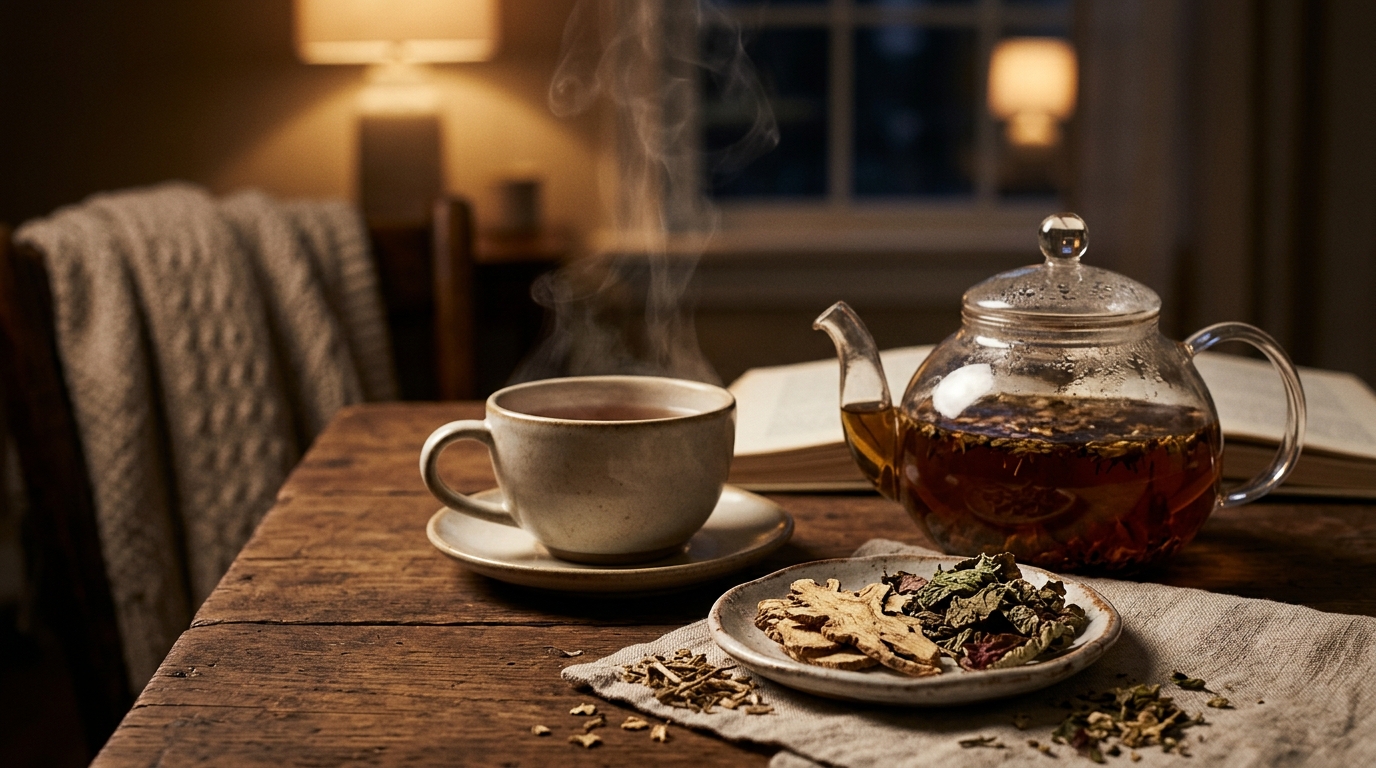
Brewed together, the two herbs create a balanced evening cup. The dong quai brings warmth, a celery-like sweetness, and a deep, slightly medicinal root character, while the raspberry leaf softens it with grassy, gently astringent notes. Neither herb contains caffeine, so the blend suits the wind-down hours. It is best approached as a quiet ritual, ideally in the days leading up to and during menstruation, rather than as something to drink indefinitely without a break.
2
cups
Ingredients
- 2 tspdried dong quai root, sliced or roughly chopped
- 2 tspdried red raspberry leaf
- 500 mlwater (95°C / 203°F)
- —raw honey or a slice of fresh ginger to taste (optional)
How to Brew
Click on an item below to shop for the recommended items for this recipe on Amazon.
As an Amazon Associate, we earn from qualifying purchases.
- Measure 2 teaspoons of dried dong quai root and 2 teaspoons of dried red raspberry leaf into a teapot or large mug with a lid. If your dong quai slices are thick and hard, lightly crush them with the back of a spoon to expose more surface area.
- Bring fresh water to a near boil, then let it rest for about 30 seconds so it settles around 95°C (203°F). The tough root needs hotter water than a delicate flower would, but a violent rolling boil can flatten the leaf’s gentle flavor.
- Pour 500 ml of the hot water over the herbs, cover immediately, and set a timer for 10 to 12 minutes. This longer steep is needed to draw out the root’s compounds and the minerals in the leaf.
- Strain through a fine mesh strainer into two cups, pressing the herbs lightly to release the last of the liquid.
- Sweeten with a small spoonful of raw honey or add a thin slice of fresh ginger for extra warmth. Sip slowly in the evening, ideally an hour or two before bed.
- Combine 2 teaspoons of dong quai root and 2 teaspoons of red raspberry leaf in a clean glass jar. Add 500 ml of cool filtered water and stir once to wet all of the herbs.
- Seal the jar and leave it on the counter for 30 minutes to begin the infusion, then transfer to the refrigerator.
- Let the jar steep in the refrigerator for 8 to 10 hours, or overnight. Give it a gentle shake once or twice if you remember.
- Strain through a fine mesh strainer or a piece of muslin into a clean glass, discarding the herbs.
- Serve over ice or drink straight from the fridge. Because cold water pulls out less tannin, the result is smooth and lightly sweet. Drink within 24 hours and keep refrigerated.
- Place 2 teaspoons of dried dong quai root in a small saucepan with 600 ml of cold water. Starting with cold water lets the root release its compounds gradually as it heats.
- Bring the water to a boil over medium heat, then immediately reduce to a low simmer. Partially cover the pot and simmer gently for 20 minutes, until the liquid has reduced by roughly a fifth and turned a deep amber.
- Remove the pan from the heat and stir in 2 teaspoons of red raspberry leaf. Add the leaf at the end because its delicate flavor and minerals are better preserved with a short steep than a long simmer.
- Cover the pan and let the leaf steep for 5 minutes.
- Strain through a fine mesh strainer into two mugs. The decoction will taste stronger and more medicinal than the hot brew, so a little honey or a strip of orange peel helps round it out.
Health Benefits
Dong quai’s phthalides have shown antispasmodic effects on smooth muscle in laboratory studies, and it is traditionally used for painful periods. Clinical evidence in humans is mixed, so it is best viewed as a supportive traditional remedy rather than a proven treatment.
In Traditional Chinese Medicine, dong quai is a primary herb for regulating irregular menstruation. Raspberry leaf is traditionally paired with it for general uterine tone, though rigorous trials on cycle regularity are limited.
Red raspberry leaf provides iron, magnesium, calcium, and potassium, nutrients that can run low during menstruation. A cup of tea contributes a modest amount alongside a balanced diet.
Warm, caffeine-free herbal teas encourage relaxation and a slower pace before bed. The comforting, earthy character of this blend suits that wind-down role, and the ritual itself carries real value for stress.
Both ferulic acid from dong quai and the ellagitannins in raspberry leaf have measurable antioxidant activity in lab settings, which may contribute to general cellular protection.
🧪 Key Bioactive Compounds
The Science Behind Dong Quai
Dong quai’s pharmacology is dominated by two families of compounds. The volatile phthalides, especially Z-ligustilide and butylidenephthalide, give the root its characteristic aroma and have been shown in laboratory models to relax smooth muscle, including uterine tissue. The phenolic acids, chiefly ferulic acid, act as antioxidants and may influence blood vessel tone and platelet behavior. Dong quai also contains coumarin derivatives, which is the basis for caution around anticoagulant medications. Despite its reputation as a hormonal herb, research suggests it does not appear to act as a strong phytoestrogen the way soy or red clover do, and its traditional effects are more likely mediated through circulation and smooth muscle activity.
Red raspberry leaf’s reputation rests on a combination of its mineral content and its tannins. Ellagitannins give the leaf its astringency, and flavonoids such as kaempferol and quercetin glycosides contribute antioxidant activity. The leaf is also a modest source of iron, magnesium, and calcium. The alkaloid fragarine has been proposed as the basis for its traditional uterine toning effect, and some small studies, mostly in pregnancy, have looked at its influence on labor, but the quality of human evidence is limited and results are inconsistent.
It is worth being honest about the state of the research. Much of what we know about this pairing comes from centuries of traditional use and from laboratory or animal studies rather than large, well-controlled human trials. That does not make the tradition meaningless, but it does mean these teas are best understood as gentle, supportive practices. They complement, rather than replace, medical care for conditions such as severe menstrual pain, very heavy bleeding, or irregular cycles that warrant a proper evaluation.
Brewing Tips
- Source whole or sliced dong quai root from a reputable herb supplier and look for pieces that are pale tan to yellow-brown with a strong, sweet, celery-like scent. Old, scentless root has lost much of its volatile oil.
- Store both herbs in airtight, opaque containers away from heat and light. Dong quai root keeps well for up to two years, while raspberry leaf is best used within a year.
- Start with a weaker brew, such as 1 teaspoon of each herb, to see how your body responds before moving to the full strength, since dong quai is potent.
- Reuse the dong quai root for a second, lighter infusion, since a dense root often has more to give after the first steep.
- Track how you feel across a cycle or two in a simple journal so you can tell whether the tea is genuinely helping you.