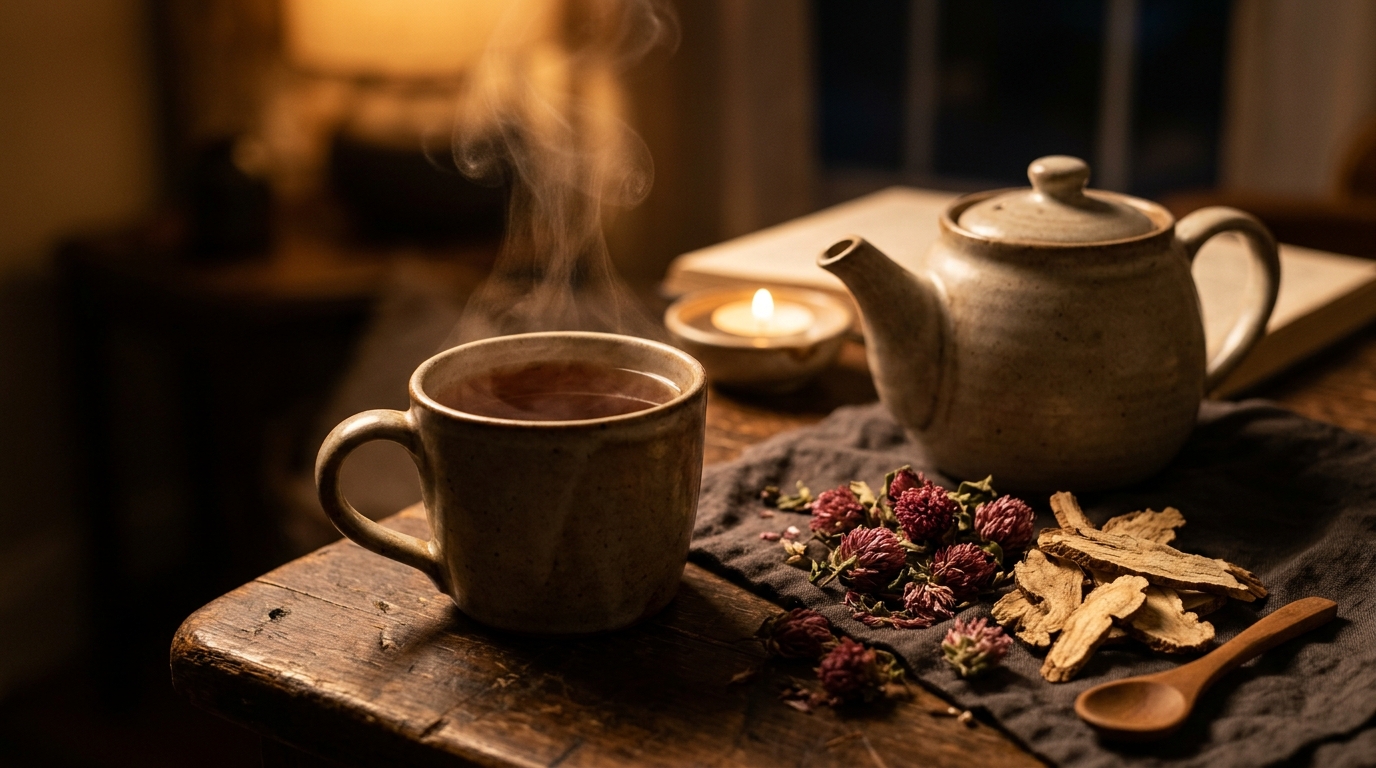
Dong quai (Angelica sinensis) has been called the ‘female ginseng’ for well over two thousand years. In Traditional Chinese Medicine, its name is often translated as ‘state of return,’ reflecting its role in restoring balance to the blood and the menstrual cycle. The aromatic root appears in classic formulas such as Si Wu Tang, and it has long been used to ease cramping, nourish the blood, and warm the body. Its flavor is distinctive: celery-like, earthy, faintly sweet, and slightly bitter, with a lingering medicinal warmth.
Red clover (Trifolium pratense) comes from a very different tradition. Native to Europe and western Asia, its magenta blossoms were used by European folk herbalists and later by Native American healers as a ‘blood purifier’ and respiratory remedy. Today it is best known as one of the richest dietary sources of isoflavones, plant compounds that interact with estrogen receptors in the body. Its taste is mild, honeyed, and hay-like, which makes it a perfect softener for dong quai’s more assertive character.
Brewed together, the two herbs create an evening ritual that bridges East and West. The dong quai brings depth and warmth, while the red clover adds sweetness and a floral lightness. Many women find that a quiet cup taken in the late afternoon or early evening becomes a calming daily pause, one that supports the body through the shifting rhythms of the menstrual cycle, perimenopause, and beyond.
2
cups
Ingredients
- 2 tspdried dong quai root, sliced or cut
- 2 tbspdried red clover blossoms
- 480 mlfiltered water (95°C / 203°F)
- —raw honey or maple syrup to taste (optional)
- —1 thin slice of fresh ginger (optional)
How to Brew
Click on an item below to shop for the recommended items for this recipe on Amazon.
As an Amazon Associate, we earn from qualifying purchases.
- Measure 2 teaspoons of dried dong quai root and 2 tablespoons of red clover blossoms into a teapot or large infuser basket. Break up any large root slices slightly with your fingers to expose more surface area.
- Heat filtered water until just off the boil, about 95°C (203°F). Rinse the dong quai briefly with a splash of hot water for 10 seconds and discard it if your root is dusty or very dry.
- Pour 480 ml of the hot water over the herbs and cover immediately with a lid or saucer to trap the aromatic oils.
- Steep for 10 to 15 minutes. The longer steep draws out the root’s compounds and gives a deeper amber color. Taste at 10 minutes and extend if you prefer a stronger, more medicinal cup.
- Strain into two mugs, pressing the herbs lightly against the strainer to release the last of the liquid.
- Sweeten with a little raw honey if desired and sip slowly in the early evening, ideally without screens or distraction.
- Add 3 teaspoons of dried dong quai root and 3 tablespoons of red clover blossoms to a clean glass jar. This is a higher ratio than hot brewing to compensate for gentler extraction.
- Pour 720 ml of cool filtered water over the herbs, stir once with a long spoon, and seal the jar.
- Leave the jar on the counter for 1 hour so the herbs begin to soften, then transfer it to the refrigerator.
- Steep in the refrigerator for 8 to 10 hours, or overnight, giving the jar a gentle swirl once if you are nearby.
- Strain through a fine mesh sieve or a layer of muslin into a clean pitcher or glass, discarding the spent herbs.
- Serve over ice with a slice of orange or a few drops of vanilla, and drink within 48 hours. Keep refrigerated at all times.
- Place 2 teaspoons of dried dong quai root in a small saucepan with 600 ml of cold filtered water. Starting with cold water helps the root release its compounds gradually.
- Bring to a gentle boil, then reduce the heat to the lowest setting that maintains a soft simmer. Partially cover the pot and simmer for 20 minutes, until the liquid has reduced slightly and turned a rich amber color.
- Remove the pan from the heat and immediately stir in 2 tablespoons of dried red clover blossoms. If using, add a thin slice of fresh ginger now.
- Cover the pan fully and let it steep off the heat for 10 minutes. This gentle infusion extracts the red clover without bitterness.
- Strain through a fine mesh strainer into two warmed mugs, pressing the roots gently to release their liquid.
- Stir in honey or a splash of warm oat milk if desired. This version is the most robust and warming, ideal for cold evenings or during the days leading up to menstruation.
Health Benefits
Dong quai’s ligustilide and related phthalides have antispasmodic effects on smooth muscle, and traditional use for dysmenorrhea is long established. Clinical evidence is mixed but promising, particularly in combination formulas.
Red clover isoflavones act as weak phytoestrogens, and several trials suggest modest reductions in hot flash frequency for some women. Results vary between studies, so effects are best viewed as supportive rather than dramatic.
Isoflavones such as formononetin and biochanin A have been studied for their potential to slow bone loss in perimenopausal and postmenopausal women. The evidence is preliminary but encouraging.
Dong quai is traditionally considered a blood-moving herb, and its coumarins and ferulic acid may improve peripheral circulation and warmth in cold hands and feet.
While neither herb is a strong sedative, the warm, aromatic preparation itself helps signal the body to unwind, and the stabilizing effect on hormonal swings may indirectly support more restful evenings.
🧪 Key Bioactive Compounds
The Science Behind Dong Quai
The two herbs in this blend work through quite different phytochemical pathways. Dong quai’s activity is attributed largely to its phthalides, particularly Z-ligustilide, along with ferulic acid and a suite of coumarins. Laboratory studies show that ligustilide relaxes smooth muscle and has anti-inflammatory effects, which offers a plausible mechanism for its traditional use in menstrual cramping. Ferulic acid contributes strong antioxidant activity, and the coumarins influence blood viscosity. Notably, despite its reputation as a women’s herb, dong quai alone shows only weak estrogenic activity in most studies, and its benefits appear to stem more from circulatory and antispasmodic effects than from direct hormonal action.
Red clover, by contrast, is valued for its isoflavones: formononetin, biochanin A, daidzein, and genistein. These compounds have a structure similar to human estradiol and can bind to estrogen receptors, with a stronger preference for the beta subtype. This selective, gentle interaction is why red clover has been studied for menopausal hot flashes and bone density. Clinical results have been inconsistent, with some trials showing meaningful improvement and others showing little difference from placebo, likely reflecting variation in isoflavone content, individual gut bacteria that convert these compounds, and study design.
It is worth noting that a cup of tea delivers a much lower isoflavone dose than the standardized extracts used in clinical research. A tea should be regarded as a supportive, gentle practice rather than a replacement for medical care. Its greatest strength may lie in combining modest pharmacological effects with the soothing, consistent ritual of a daily warm drink, which itself has measurable benefits for stress and sleep quality.
Brewing Tips
- Buy cut and sifted dong quai root from a reputable supplier and check that it smells sweetly aromatic and celery-like, not musty or flat. Fresh root should be pale tan to yellow-brown, not dark and brittle.
- Drink this tea in the late afternoon or early evening rather than right before bed, since dong quai is warming and some people find it mildly stimulating to circulation.
- If the flavor of dong quai is too strong at first, begin with 1 teaspoon of root and increase gradually, or add a spoonful of honey and a slice of ginger to round out the bitterness.
- Store both herbs in airtight, opaque containers away from light and heat, and use within a year for the best flavor and potency.
- Consider cycle-aware use: many women drink this tea in the two weeks before menstruation and pause during heavy bleeding, but check with a practitioner about the pattern that suits you.