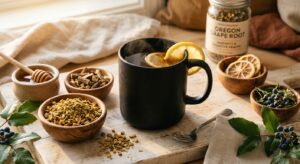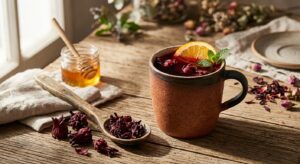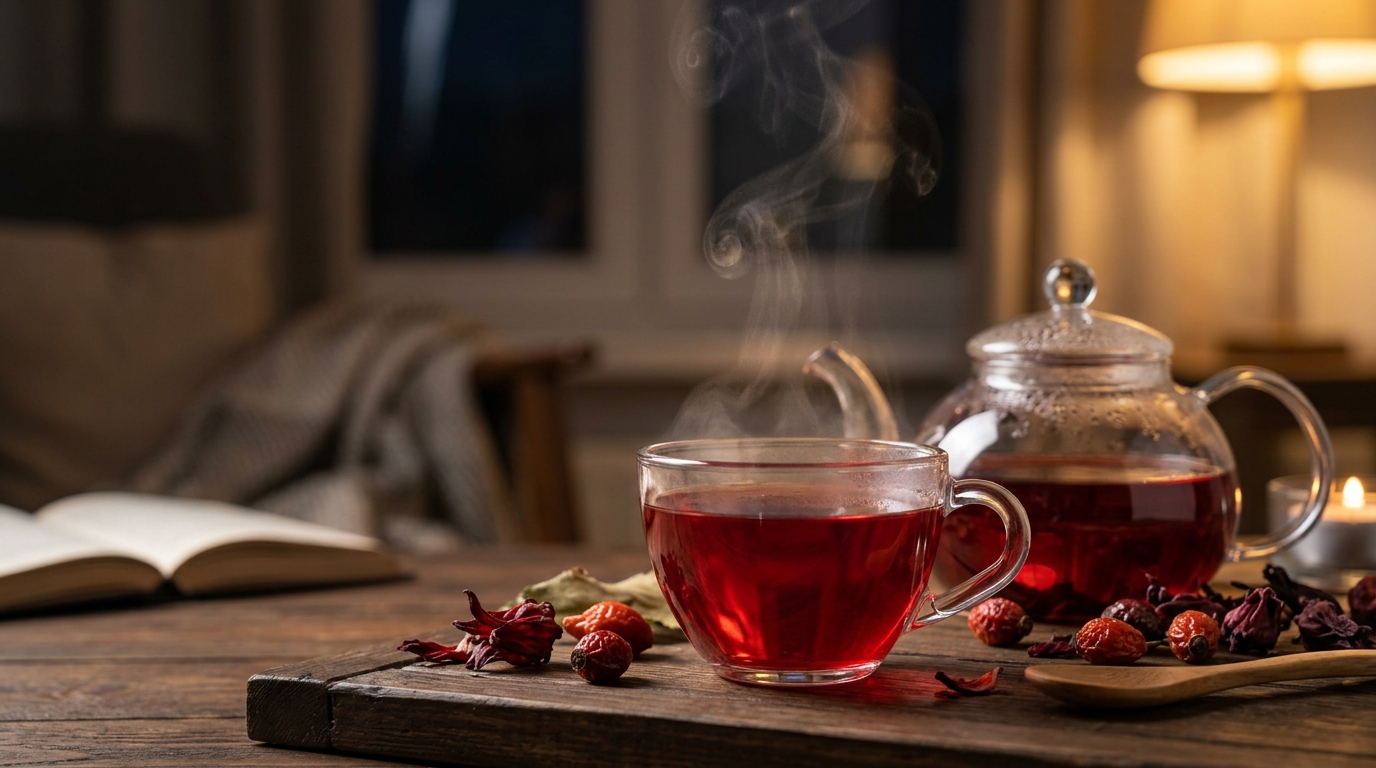
Rose hips, the fruit left behind when a wild rose drops its petals, have a long record as a cold-weather remedy. During the Second World War, when citrus fruit was scarce in Britain, schoolchildren were sent into hedgerows to gather hips, which were boiled down into a vitamin C syrup for the whole country. Scandinavian and Eastern European households have simmered dried hips into winter drinks for generations, and the tradition makes sense: gram for gram, rose hips are among the richest plant sources of vitamin C.
Hibiscus, the dried calyces of Hibiscus sabdariffa, comes from a different tradition altogether. In Egypt it is served as karkadé, in Mexico and Central America as agua de jamaica, and in West Africa as bissap or zobo. Prized for its cranberry-like tartness and vivid crimson color, hibiscus has been used for centuries as a cooling drink and a folk remedy for blood pressure and digestive comfort.
Together, the two make a natural pairing. Rose hip brings a gentle, fruity, slightly apple-like body with a whisper of rose, while hibiscus adds sharp, jewel-bright acidity. The result is a tea that tastes like a berry cordial, glows like stained glass in the cup, and carries no caffeine, which makes it an ideal evening ritual when the days are short and the sniffles are circulating.
2
cups
Ingredients
- 2 tbspdried rose hips, cut and sifted
- 1 tbspdried hibiscus calyces
- 480 mlwater (95°C / 203°F)
- —raw honey or maple syrup to taste (optional)
- —thin slice of orange or a cinnamon stick for garnish (optional)
How to Brew
Click on an item below to shop for the recommended items for this recipe on Amazon.
As an Amazon Associate, we earn from qualifying purchases.
- Measure 2 tablespoons of cut rose hips and 1 tablespoon of dried hibiscus into a teapot or large mug. If your rose hips are whole, crush them lightly with the back of a spoon or a mortar and pestle to crack the skin and expose the flesh.
- Bring fresh water to a boil, then let it rest for about 30 seconds so it settles near 95°C (203°F). Pour 480 ml over the herbs.
- Cover the pot or mug with a saucer to trap the volatile aromatics and heat, and steep for 8 to 10 minutes. Hibiscus turns the water red within the first two minutes, but the longer steep draws out the rose hip.
- Strain through a fine mesh strainer. Rose hips contain tiny hairs and seed fragments, so a fine strainer or a paper tea filter gives the smoothest cup.
- Sweeten with honey or maple syrup while the tea is still warm. Add the sweetener gradually, because hibiscus is quite tart and individual tastes vary widely.
- Sip slowly. For a cozy variation, add a cinnamon stick or a strip of orange peel to the pot before steeping.
- Combine 3 tablespoons of cut rose hips and 1.5 tablespoons of dried hibiscus in a large glass jar. Cold brewing requires a slightly higher herb ratio, because there is no heat to speed up extraction.
- Pour 1 liter of cold, filtered water over the herbs and stir briefly with a long spoon to wet everything evenly.
- Seal the jar and refrigerate for 8 to 12 hours. Rose hips extract slowly in cold water, so the full 12 hours gives the fullest flavor.
- Strain through a fine mesh strainer lined with a piece of muslin or a coffee filter to catch fine hairs and sediment.
- Serve over ice with a squeeze of fresh lemon or a few slices of orange. For an evening nightcap, you can also gently warm a mugful of the cold brew on the stove to just below a simmer, which keeps its smoothness while giving you a warm cup.
- Store the finished tea in a sealed jar in the refrigerator and drink within 3 days.
- Place 3 tablespoons of whole dried rose hips in a small saucepan with 600 ml of cold water. Lightly crush the hips with the back of a wooden spoon so the skins split open.
- Bring to a boil over medium heat, then reduce to the lowest simmer. Cover with a lid and simmer gently for 15 minutes, until the water turns amber and smells of cooked apple.
- Turn off the heat and stir in 1 tablespoon of dried hibiscus. Cover again and let the mixture steep for 5 minutes. The liquid will shift from golden to deep crimson.
- Strain through a fine mesh strainer or a muslin-lined sieve, pressing gently on the softened hips to release their pulp. Pressing yields a thicker, more full-bodied tea.
- Add a cinnamon stick, a few slices of fresh ginger, or a spoonful of honey while the tea is still hot. This version makes a naturally sweet-tart winter tonic that reheats well.
- Refrigerate leftovers and gently rewarm on the stove. Avoid microwaving to a rolling boil, which dulls the flavor.
Health Benefits
Vitamin C contributes to normal immune cell activity, and rose hips supply it alongside flavonoids that may enhance its effect. While vitamin C does not prevent colds, regular intake may modestly shorten their duration in some people.
Hibiscus anthocyanins and rose hip polyphenols neutralize free radicals in laboratory and human studies, which may help limit oxidative stress linked to chronic inflammation.
Several clinical trials and meta-analyses have found that regular hibiscus tea intake produces modest reductions in systolic and diastolic blood pressure in adults with mildly elevated readings. It should complement, not replace, medical care.
Rose hip powder, particularly the GOPO-containing extract, has shown small but consistent benefits for osteoarthritis discomfort in randomized trials. Tea delivers lower doses than concentrated extracts, so effects are likely milder.
Because neither herb contains caffeine, this tea supports hydration and a calming wind-down routine without interfering with sleep, making it a flavorful alternative to evening black tea.
🧪 Key Bioactive Compounds
The Science Behind Rose Hip
The standout compound in rose hips is ascorbic acid, and the amounts are genuinely impressive. Depending on the species, growing conditions, and how the hips are dried, vitamin C content ranges widely, but Rosa canina hips are consistently among the richest plant sources. Vitamin C is a water-soluble antioxidant that supports neutrophil and lymphocyte function and regenerates other antioxidants in the body. It is also heat-sensitive and degrades in oxygen, which is why the cold brew method and fresher, properly stored hips deliver more of it. Rose hips also contain flavonoids, carotenoids, and the galactolipid GOPO, which has been studied for its ability to dampen the migration of inflammatory cells.
Hibiscus brings a different set of chemistry to the cup. Its red color comes from anthocyanins, primarily delphinidin-3-sambubioside and cyanidin-3-sambubioside, which are also responsible for much of its antioxidant capacity. Clinical research on hibiscus has focused on blood pressure: pooled analyses of randomized trials report average reductions of several mmHg in systolic pressure, possibly through mild diuretic activity and inhibition of angiotensin-converting enzyme. The evidence is promising but not definitive, and trial doses typically involve two to three cups of tea per day.
The two herbs also complement each other nutritionally. The organic acids in hibiscus lower the pH of the infusion, which helps stabilize both vitamin C and anthocyanins during brewing and storage. This is part of why the combination tastes bright and why the color holds so well. Keep in mind that tea delivers a smaller dose of these compounds than concentrated supplements, so it is best viewed as a pleasant, hydrating way to add antioxidants to a balanced diet rather than a treatment for illness.
Brewing Tips
- Choose cut and sifted rose hips for hot brewing and whole hips for simmering. Whole hips are very slow to release flavor in a simple steep.
- Always strain with a fine mesh or paper filter. Rose hips have tiny irritating hairs around the seeds that can scratch the throat if they remain in the cup.
- Use a non-reactive teapot, such as glass or ceramic, rather than aluminum. The acidity can react with metal and alter both the color and taste.
- Store dried rose hips and hibiscus in airtight, opaque containers away from heat and light, and use within a year to preserve vitamin C and color.
- A squeeze of lemon turns the tea a vivid pink-red and brightens the flavor, while a spoonful of honey softens the tartness for an easy-drinking evening cup.