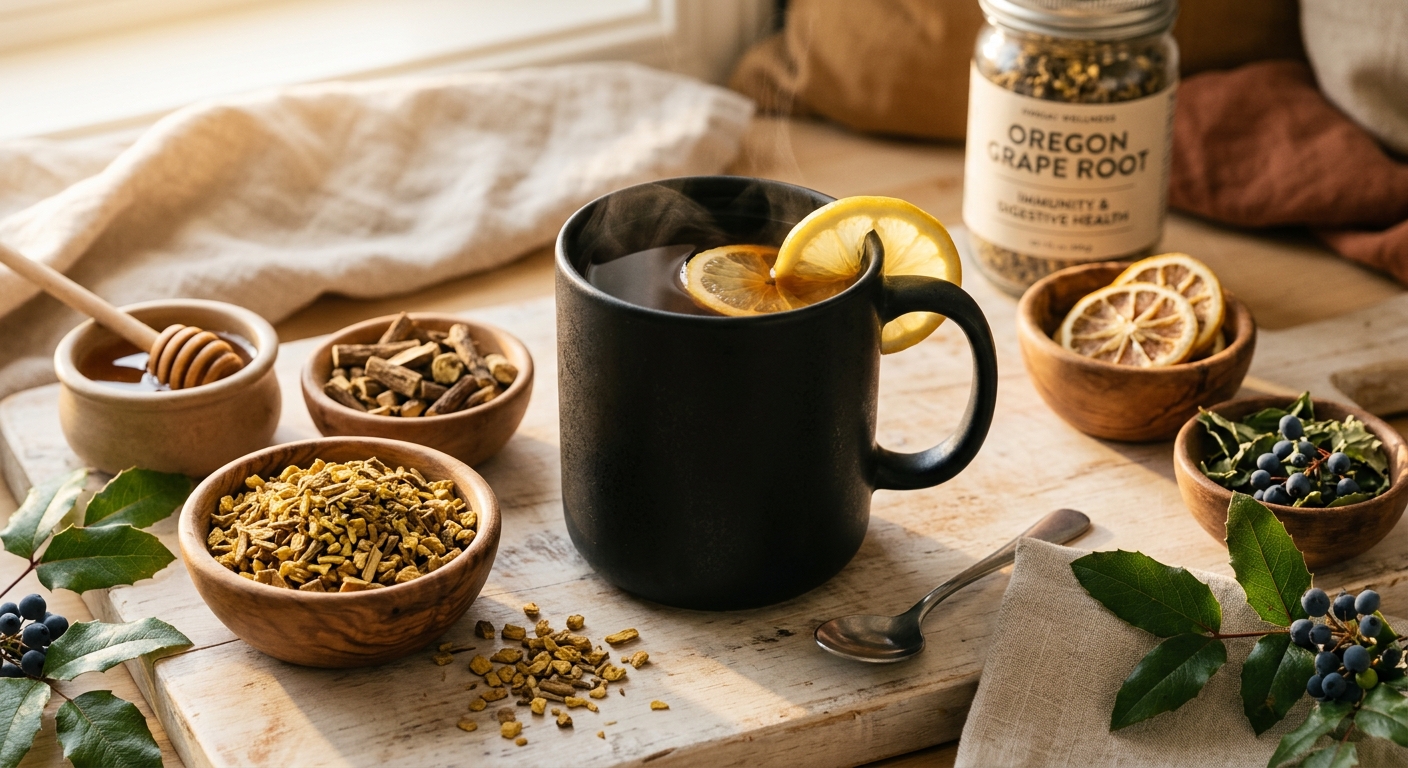
Long before it appeared in modern herbal apothecaries, Oregon Grape Root (Mahonia aquifolium, also classified as Berberis aquifolium) was a cornerstone of Indigenous healing traditions throughout the Pacific Northwest. Tribes including the Nlaka’pamux, Okanagan, and Thompson peoples used the bright yellow root as a treatment for fevers, infections, skin conditions, and digestive complaints. The plant’s striking appearance, with its holly-like leaves, clusters of small yellow flowers, and dusty blue-purple berries, made it an unmistakable feature of the Pacific forest understory, and its vivid golden-yellow root bark hinted at the powerful alkaloids within.
European settlers quickly recognized the plant’s medicinal potential, and by the nineteenth century, Oregon Grape Root had earned a place in the Eclectic physicians’ pharmacopoeia as a bitter tonic and liver stimulant. It was used to treat jaundice, poor digestion, chronic skin eruptions like psoriasis and eczema, and recurrent respiratory infections. The bitter compounds in the root were understood, even then, to stimulate bile production, support liver function, and awaken sluggish digestive systems. This reputation as a broad-acting alterative, a herb that slowly shifts the body toward better function, made it one of the most celebrated plants in early American botanical medicine.
What makes Oregon Grape Root so remarkable is the concentration of berberine, a bright yellow isoquinoline alkaloid that has become one of the most extensively studied plant compounds in modern pharmacology. Berberine demonstrates significant antimicrobial, anti-inflammatory, and immune-modulating activity in laboratory and clinical research, lending scientific credibility to centuries of traditional use. The tea itself is intensely bitter and deeply golden in color, with a dry, almost astringent finish that serious herbal drinkers come to appreciate for its unmistakable medicinal character. This is not a gentle sipping tea. It is a purposeful brew meant to do real work in the body.
2
cups
Ingredients
- 2 tspdried Oregon grape root, coarsely chopped or broken
- 500 mlfiltered water
- —raw honey or licorice root to taste (optional, to balance bitterness)
- —lemon slice (optional)
How to Brew
Click on an item below to shop for the recommended items for this recipe on Amazon.
As an Amazon Associate, we earn from qualifying purchases.
- Measure 2 teaspoons of coarsely chopped or broken dried Oregon grape root per cup of water (approximately 500 ml for two servings) and place it directly into a small saucepan.
- Add cold filtered water to the saucepan. Starting with cold water and bringing it to heat together allows the root to release its compounds gradually and more completely than adding root to already-boiling water.
- Bring the water to a full boil over medium-high heat, then immediately reduce to a gentle simmer. Cover the saucepan with a lid to prevent evaporation of volatile aromatic compounds.
- Simmer covered for 15 to 20 minutes. The liquid will deepen to a rich golden-amber color. For a stronger medicinal brew, extend the simmer to 25 minutes, adding a small splash of water if the volume reduces too much.
- Remove from heat and allow to rest, still covered, for 5 minutes. Then strain through a fine mesh strainer or cheesecloth into your mug, pressing the root material gently to extract the last of the liquid.
- The decoction will be intensely bitter. If desired, stir in raw honey, a small piece of licorice root steeped briefly in the hot liquid, or a squeeze of lemon to soften the bitterness before drinking. Consume while warm.
- Measure 3 teaspoons of coarsely chopped dried Oregon grape root and place it into a clean glass jar with a tight-fitting lid. The slightly higher ratio compensates for the lower extraction efficiency of cold water.
- Pour 500 ml of cold filtered water over the root. Stir briefly to ensure all the root material is fully submerged and in contact with the water.
- Seal the jar and allow it to sit at room temperature for the first 2 hours. This initial room-temperature period allows the root to begin releasing its compounds before the jar is moved to the refrigerator.
- Transfer the sealed jar to the refrigerator and allow it to cold brew for a further 10 to 16 hours, or overnight. The liquid will slowly turn a clear, pale golden-amber, noticeably lighter than a hot decoction.
- When ready, strain the liquid through a fine mesh strainer or cheesecloth into a glass or pitcher. Press the root gently with the back of a spoon to extract remaining liquid.
- Serve the cold brew over ice for a refreshing wellness shot, or warm it gently in a saucepan over low heat without boiling. Add honey or lemon to taste. Cold brew concentrate keeps refrigerated in a sealed jar for up to 48 hours.
- Measure 4 tablespoons of coarsely chopped dried Oregon grape root and place it into a medium saucepan. Add 750 ml of cold filtered water. The goal is to reduce this volume by roughly half during the simmer to create a 2x concentrate.
- Bring to a full boil over medium-high heat, then reduce to a steady, gentle simmer. Cover partially with a lid, leaving a small gap to allow steam to escape and controlled evaporation to occur.
- Simmer for 35 to 45 minutes, checking occasionally. The liquid should reduce to approximately 350 to 400 ml. The color will be a deep, dark amber-gold and the aroma will be powerfully earthy and resinous.
- Remove from heat and allow the concentrate to cool in the pan, still covered, for 10 minutes. This resting period allows any remaining alkaloids to continue diffusing from the root into the liquid.
- Strain through a fine mesh strainer lined with cheesecloth into a sterilized glass jar with a tight-fitting lid. Press the root firmly to extract every drop of concentrate.
- To use, dilute 30 to 60 ml of concentrate into 150 to 200 ml of hot or warm water per serving. Add honey or lemon as desired. Store the sealed concentrate jar in the refrigerator and use within 5 to 7 days. Label the jar with the preparation date.
Health Benefits
Berberine, the dominant alkaloid in Oregon Grape Root, has demonstrated direct antimicrobial activity against a wide range of pathogens including Staphylococcus aureus, Streptococcus spp., Candida albicans, and Giardia lamblia in laboratory studies. It disrupts bacterial cell wall integrity and inhibits pathogen adhesion to host tissues, making it a traditional and evidence-supported remedy for acute infections of the respiratory, digestive, and urinary tracts.
The bitter alkaloids in Oregon Grape Root, particularly berberine and canadine, have a well-documented cholagogue effect, meaning they stimulate the liver to produce and release bile. Increased bile flow supports fat digestion, improves absorption of fat-soluble vitamins, and helps the liver process and eliminate metabolic waste more efficiently. This is consistent with its long traditional use as a liver tonic in both Indigenous and Eclectic herbal medicine.
As a classic bitter tonic, Oregon Grape Root stimulates secretion of digestive enzymes and gastric acid when consumed before or with meals, improving the breakdown and absorption of nutrients. Traditional herbalists prescribed it specifically for sluggish digestion, bloating, and the feeling of fullness after small meals, all symptoms associated with insufficient digestive secretion.
Both topical and internal use of berberine-containing extracts have been studied for inflammatory skin conditions. A 2013 randomized controlled trial published in Phytomedicine found that topical berberine sulfate significantly reduced symptoms of psoriasis. Internally, the herb’s liver-supporting and anti-inflammatory actions are thought to address underlying systemic factors that contribute to chronic skin eruptions.
Multiple clinical trials have demonstrated that berberine activates AMP-activated protein kinase (AMPK), a key enzyme in glucose metabolism, improving insulin sensitivity and reducing fasting blood glucose levels. A notable 2008 meta-analysis found berberine to be comparably effective to metformin in managing type 2 diabetes markers, though Oregon Grape Root tea delivers berberine in lower concentrations than pharmaceutical extracts.
🧪 Key Bioactive Compounds
The Science Behind Oregon Grape Root
The pharmacological story of Oregon Grape Root begins and ends with berberine, a bright yellow isoquinoline alkaloid that has accumulated an impressive body of modern research support. Berberine works through multiple mechanisms simultaneously. In immune contexts, it inhibits the NF-kB signaling pathway, a master regulator of inflammatory gene expression, reducing the production of pro-inflammatory cytokines like TNF-alpha and IL-6. It also directly disrupts the cell membranes and DNA replication machinery of a broad spectrum of bacteria, fungi, and protozoa, making it effective against pathogens that have developed resistance to conventional antibiotics in some preliminary research settings.
One of berberine’s most clinically validated mechanisms is its activation of AMPK, often described as a cellular energy sensor. When AMPK is activated, it triggers a cascade of metabolic improvements including enhanced insulin sensitivity, reduced hepatic glucose production, and improved lipid profiles. This is the same pathway activated by the diabetes drug metformin, which is why multiple clinical trials have found berberine to produce comparable reductions in HbA1c and fasting glucose. Beyond metabolic effects, berberine’s interaction with the gut microbiome is an active area of research, with evidence suggesting it selectively inhibits harmful bacterial species while supporting the growth of beneficial short-chain fatty acid producers, contributing to its broad digestive benefits.
The other alkaloids present in Oregon Grape Root, including berbamine, oxyacanthine, and canadine, contribute synergistically to its overall pharmacological profile. Berbamine has demonstrated significant immunomodulatory effects in animal and in vitro studies, including the ability to promote white blood cell recovery after chemotherapy-induced bone marrow suppression, though human clinical data remain limited. Canadine (L-tetrahydroberberine) has shown mild dopaminergic and GABAergic activity, potentially contributing to the subtle calming quality some users report. The tannin content adds a complementary layer of astringency that reinforces the gut-toning and antimicrobial effects of the alkaloids, particularly at mucosal surfaces in the digestive tract where tannins can form a temporary protective barrier against pathogens and irritants.
Brewing Tips
- Always start with cold water and bring the root up to temperature together rather than adding dried root to boiling water. This gradual heating improves alkaloid extraction and reduces the risk of cooking off delicate aromatic compounds.
- Store dried Oregon grape root in an airtight glass container away from direct light and heat. The bright yellow berberine is light-sensitive and can degrade with prolonged UV exposure, reducing the potency of your brew over time.
- If you find the bitterness difficult to tolerate, try drinking it quickly like a shot rather than sipping slowly. Prolonged contact with taste receptors intensifies the perception of bitterness, so a faster consumption reduces the subjective intensity without changing the medicinal dose.