Long before cumin became a staple of spice racks and curry blends, healers in ancient Egypt, India, and the Mediterranean world were steeping its seeds in hot water to treat digestive complaints. Cumin (Cuminum cyminum) appears in Egyptian medical papyri dating back over 3,500 years, and the Ayurvedic tradition has classified it as a tridoshic herb, meaning it is considered balancing for all three constitutional types. The Romans used it as a pepper substitute, the ancient Greeks kept it on the table in its own vessel, and across the Arab world it was steeped into a tea called kamoun and offered to guests as a welcome remedy after a heavy meal.
What makes cumin so effective as a digestive tea is the remarkable concentration of volatile oils held within its small, ribbed seeds. When those seeds are lightly toasted or simply steeped in hot water, they release thymoquinone, cuminaldehyde, and a complex of other aromatic compounds that stimulate the secretion of digestive enzymes, relax intestinal spasms, and reduce the gas-producing fermentation that causes bloating. The result is a cup that works on a physiological level, not just a ceremonial one.
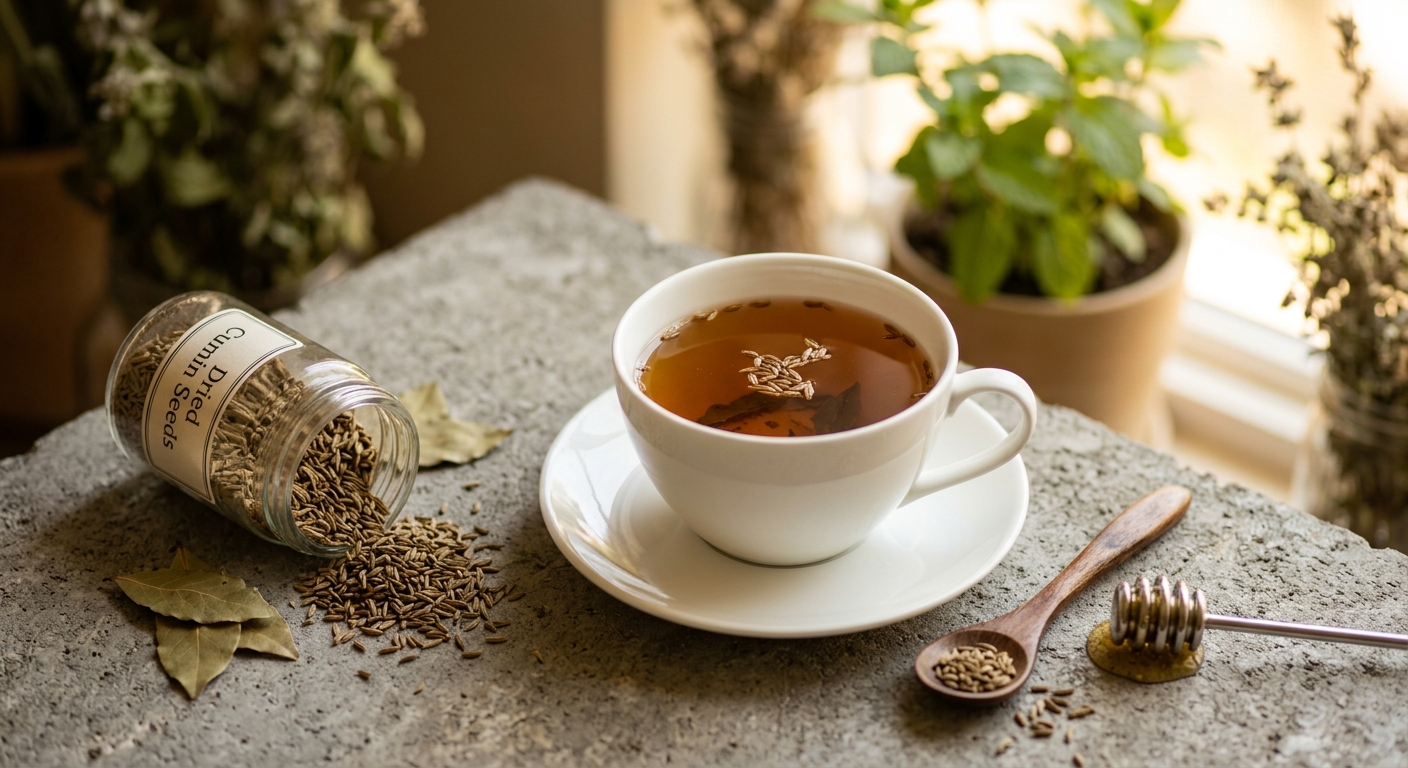
The flavor of cumin seed tea is earthy, slightly smoky, and warmly spiced, with a dry finish reminiscent of toasted bread crust. It is more savory than most herbal teas, which surprises first-time drinkers in the best way. A small squeeze of lemon and a drizzle of honey round out the cup beautifully, while a pinch of ginger or fennel seed makes it even more effective for digestive complaints. This is not the delicate floral world of chamomile. Cumin tea is bold, grounding, and deeply satisfying.
2
cups
Ingredients
- 2 tspwhole cumin seeds
- 480 mlwater (95°C / 203°F)
- —fresh lemon juice to taste (optional)
- —raw honey to taste (optional)
How to Brew
Click on an item below to shop for the recommended items for this recipe on Amazon.
As an Amazon Associate, we earn from qualifying purchases.
- Place 2 teaspoons of whole cumin seeds in a dry skillet over medium-low heat. Toast them for 60 to 90 seconds, stirring constantly, until they become fragrant and deepen slightly in color. Do not allow them to burn, as this turns the flavor bitter.
- Transfer the toasted seeds to a small saucepan or a heatproof mug. Using a mortar and pestle or the flat side of a spoon, very lightly crush the seeds to crack them open. This is optional but releases the oils more efficiently.
- Bring 480 ml of water to 95°C (203°F). Pour the hot water directly over the cumin seeds.
- Cover the mug or saucepan with a lid or small plate to trap the volatile aromatic compounds, and steep for 7 to 10 minutes. Steeping closer to 10 minutes produces a stronger, more medicinal cup.
- Strain the tea through a fine mesh strainer into your serving cups. Add a squeeze of fresh lemon juice and raw honey to taste. Serve immediately.
- Measure 3 teaspoons of whole cumin seeds into a clean glass jar. There is no need to toast the seeds for cold brew, as the long steep time draws out oils gently without heat.
- Lightly crush the seeds using a mortar and pestle or by pressing them under the flat of a spoon. This step is recommended for cold brew since there is no heat to help extraction.
- Pour 600 ml of cold, filtered water over the crushed seeds. Stir briefly to ensure all the seeds are submerged.
- Seal the jar with a lid and place it in the refrigerator. Allow it to steep for 10 to 12 hours, or overnight.
- In the morning, strain the tea through a fine mesh strainer lined with a cheesecloth or a coffee filter to remove all the fine seed particles. Pour over ice and finish with a slice of lemon or a thin round of fresh ginger. Serve chilled.
- Measure 1 tablespoon (approximately 3 teaspoons) of whole cumin seeds into a small saucepan. Toast them dry in the pan for 60 seconds over medium heat until fragrant, then add 500 ml of cold water directly to the pan.
- Bring the water and seeds to a full rolling boil over medium-high heat, then immediately reduce the heat to a gentle simmer.
- Allow the mixture to simmer uncovered for 15 to 20 minutes. The liquid will reduce by roughly one-third and deepen in color to a rich golden-amber. This concentration process extracts the deeper, more complex compounds from within the seed.
- Remove the saucepan from the heat and allow it to rest for 3 to 5 minutes so the seeds settle to the bottom.
- Strain through a fine mesh strainer into two small cups. Because a decoction is more concentrated and more potent, the serving size is smaller than a standard cup. Add a pinch of rock salt or a small squeeze of lime, both of which are traditional Ayurvedic additions that are said to enhance digestion further. Sip slowly after a meal.
Health Benefits
Cumin acts as a carminative, meaning it relaxes the smooth muscle of the gut wall and encourages the expulsion of trapped gas. Several clinical trials have found that cumin supplementation significantly reduces bloating, flatulence, and abdominal discomfort in participants with irritable bowel syndrome.
Cuminaldehyde and other volatile compounds stimulate the pancreas to secrete higher levels of digestive enzymes including lipase, amylase, and protease, improving the breakdown and absorption of fats, carbohydrates, and proteins.
Thymoquinone in cumin has shown hepatoprotective effects in multiple animal studies, helping to protect liver cells from oxidative damage and supporting the production of bile, which is essential for fat digestion.
Cuminaldehyde has demonstrated inhibitory activity against bacteria such as Escherichia coli and Staphylococcus aureus in laboratory studies, suggesting that regular consumption of cumin tea may help maintain a healthier balance of gut microbiota.
A small number of clinical studies, including one published in the International Journal of Molecular Sciences, have found that cumin supplementation reduced fasting blood glucose and improved insulin sensitivity in participants with type 2 diabetes, likely due to the antioxidant and anti-inflammatory activity of its key compounds.
🧪 Key Bioactive Compounds
The Science Behind Cumin Seed
The medicinal power of cumin seed tea lies primarily in its exceptionally high concentration of volatile aromatic oils, which make up roughly 2.5 to 4.5 percent of the seed’s dry weight. The dominant compound, cuminaldehyde, is responsible for cumin’s signature scent and is also the molecule most directly linked to its digestive benefits. Research has shown that cuminaldehyde triggers a reflex stimulation of salivary and pancreatic enzyme secretion, which effectively primes the entire digestive system before a meal has even fully entered the stomach. This is why cumin tea is traditionally consumed before or during meals rather than purely as an after-dinner remedy.
Thymoquinone, another key bioactive compound, has attracted significant research attention in recent decades for its anti-inflammatory and hepatoprotective properties. Studies published in journals including Phytotherapy Research and the Journal of Ethnopharmacology have demonstrated that thymoquinone reduces the activity of pro-inflammatory cytokines in gastrointestinal tissue, which helps explain cumin’s traditional use in managing inflammatory bowel conditions. Additionally, thymoquinone has shown the ability to increase bile production and flow, supporting the emulsification and absorption of dietary fats.
A randomized controlled trial conducted by researchers at the Shahid Sadoughi University of Medical Sciences in Iran and published in the Middle East Journal of Digestive Diseases found that patients with irritable bowel syndrome who took cumin essential oil extract for four weeks reported significant reductions in abdominal pain, bloating, and incomplete defecation compared to placebo. While whole seed tea delivers lower concentrations than an extract, the cumulative effect of daily consumption is meaningful, particularly for those with functional digestive complaints. The combination of carminative, antispasmodic, and enzyme-stimulating actions makes cumin seed tea one of the most mechanistically well-supported herbal remedies in the digestive category.
Brewing Tips
- Always toast the seeds before hot brewing or decoction. Even 60 to 90 seconds in a dry pan dramatically amplifies the aroma and breaks down the seed coat, allowing far more of the volatile oils to infuse into the water.
- Use freshly purchased cumin seeds rather than seeds that have been sitting in your spice cabinet for over a year. Volatile oils degrade with age, and old seeds will produce a flat, lifeless tea with minimal therapeutic benefit.
- For best digestive results, drink cumin tea 15 to 20 minutes before a meal to prime enzyme secretion, or sip it slowly during a meal to reduce bloating in real time. The decoction method is best reserved for after a heavy or troublesome meal when you need the strongest effect.