Long before black pepper became a staple shaker on every kitchen table, it was regarded as liquid gold. Traded along ancient spice routes from the Malabar Coast of India to the markets of Rome and Arabia, Piper nigrum commanded extraordinary value, sometimes used as currency and offered as tribute to rulers. In Ayurvedic medicine, black pepper has been prescribed for thousands of years as a digestive tonic, a warming carminative, and a catalyst herb that amplifies the power of every remedy it accompanies. That last quality is not merely folk wisdom; modern science has confirmed that piperine, the compound responsible for black pepper’s heat, dramatically enhances the bioavailability of many nutrients and botanical compounds.
Black pepper tea is one of the simplest and most grounding brews in the herbal repertoire. Unlike elaborate blends or delicate florals, it asks very little of you: a handful of peppercorns, hot water, and a moment of patience. The result is a tea that is deeply warming from the first sip, with a clean, pungent spice that settles into a pleasant, lingering heat. In many South and Southeast Asian households, a cup of pepper tea is a home remedy for cold mornings, sluggish digestion, respiratory congestion, and low appetite. It is humble in appearance, but formidable in effect.
This guide walks you through everything you need to know about brewing black pepper tea at home, from the traditional hot infusion to a surprising cold brew that softens the spice into something almost sweet. Whether you are drawn to it for its digestive benefits, its warming energy, or simply your curiosity about one of the world’s oldest medicinal spices, black pepper tea is worth a place in your rotation.
2
cups
Ingredients
- 1 tspwhole black peppercorns, lightly cracked
- 480 mlwater (95°C / 203°F)
- 1 small slicefresh ginger (optional, for added warmth)
- —raw honey or jaggery to taste (optional)
- —squeeze of lemon juice (optional)
How to Brew
Click on an item below to shop for the recommended items for this recipe on Amazon.
As an Amazon Associate, we earn from qualifying purchases.
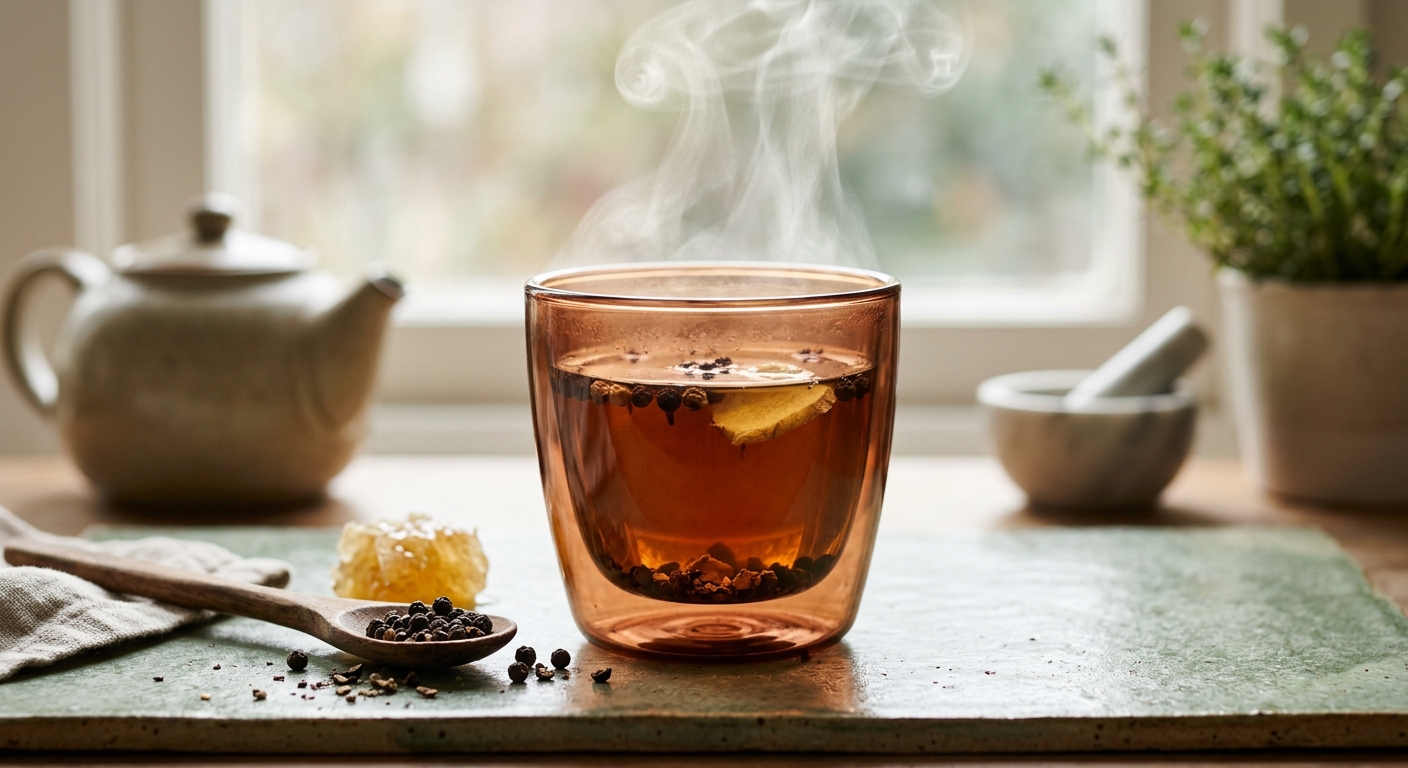
- Measure 1 teaspoon of whole black peppercorns per 240 ml of water. Place the peppercorns on a clean cutting board and press down firmly with the flat of a heavy knife or the bottom of a mug to crack them open. You want them cracked, not ground. Cracking exposes the interior and releases far more piperine and essential oils than steeping whole peppercorns.
- Pour 480 ml of water into a small saucepan and bring it to just below a full boil, around 90 to 95°C. Add the cracked peppercorns directly to the water. If using fresh ginger, add one or two thin slices at this stage.
- Reduce the heat to a low simmer and allow the peppercorns to steep in the hot water for 10 to 15 minutes. The longer you steep, the more intense the heat will be. Taste at 10 minutes and continue if you want a bolder cup.
- Remove from the heat and pour the tea through a fine mesh strainer into your mugs, catching all the peppercorn fragments. Discard the solids.
- Add raw honey, jaggery, or a squeeze of lemon juice if desired. Drink warm and sip slowly, allowing the heat to settle in the stomach. This tea is best consumed 20 to 30 minutes before or after a meal to support digestion.
- Use whole, uncracked peppercorns for cold brewing rather than cracked ones. The slow, cold extraction naturally draws out compounds at a gentler rate, and whole peppercorns will produce a balanced, mellow spice without the aggressive heat that cracked peppercorns bring. Use 1.5 teaspoons of whole peppercorns per 480 ml of cold, filtered water.
- Combine the peppercorns and cold water in a clean glass jar. If you would like added complexity, add a thin strip of lemon peel or a few fresh mint leaves. Stir briefly to settle the peppercorns to the bottom. Do not crush or muddle them.
- Seal the jar with a lid and let it sit at room temperature for 1 hour to begin the extraction, then transfer it to the refrigerator. Allow the tea to cold brew for a total of 10 to 12 hours, or overnight.
- Strain the liquid through a fine mesh strainer or a piece of cheesecloth into a clean pitcher or glass. Taste the brew. You should notice a gentle, building warmth rather than immediate heat, with a clean, slightly fruity pepper flavor.
- Serve over ice in tall glasses. Add a slice of lemon or a few sprigs of mint as garnish. A light drizzle of honey stirred in works beautifully here. Consume within 48 hours and keep refrigerated.
- For a decoction, use a slightly higher ratio: 1.5 teaspoons of cracked black peppercorns per 360 ml of water, noting that the liquid will reduce during cooking to approximately 240 ml of finished tea. Additionally, crack the peppercorns more aggressively than for hot brew, using a mortar and pestle to break them into coarse fragments without fully grinding them to powder.
- Combine the coarsely cracked peppercorns and water in a small saucepan. Bring the mixture to a full, rolling boil over medium-high heat. This initial boil begins the deep extraction of piperine and volatile oils from the hard outer shell of the peppercorn.
- Once boiling, reduce the heat to a low simmer and allow the decoction to cook uncovered for 20 to 25 minutes. You will notice the liquid reducing and darkening slightly. Stir occasionally. The aroma will become intensely spicy and resinous as the essential oils are driven into the liquid.
- After 20 to 25 minutes, remove from the heat and allow the decoction to rest for 5 minutes. This resting period lets the sediment settle and allows the temperature to drop slightly before straining.
- Strain twice through a fine mesh strainer into a small cup or mug. The finished decoction will be deeper in color than the hot brew and noticeably more concentrated and peppery. Sip in small amounts. The traditional Ayurvedic serving is around 120 ml, taken before meals to stimulate digestive enzymes and reduce bloating. Sweeten with a small amount of raw honey if desired, but add it only after the liquid has cooled slightly below 60°C to preserve the honey’s enzymes.
Health Benefits
Piperine has been shown in multiple studies to increase the secretion of digestive enzymes in the pancreas, improving the breakdown of proteins, fats, and carbohydrates. Drinking black pepper tea before or after meals may support more complete digestion and reduce the discomfort of heavy or rich foods.
Black pepper acts as a carminative, meaning it relaxes the smooth muscle of the gastrointestinal tract and encourages the expulsion of gas. Traditional herbalists in Ayurveda and European folk medicine have long used it to treat flatulence, abdominal distension, and feelings of fullness.
Piperine is one of the best-studied bioavailability enhancers in natural medicine. Research published in the journal Planta Medica has shown it increases the absorption of curcumin by up to 2000 percent. It has similar enhancing effects on selenium, beta-carotene, B vitamins, and several pharmaceutical compounds.
The warming, expectorant qualities of black pepper have made it a go-to remedy in traditional medicine for congestion, coughs, and sinusitis. The volatile oils in peppercorns help loosen mucus and encourage productive coughing, making this tea a useful companion during cold and flu season.
Black pepper contains a range of polyphenols and volatile oil compounds that exhibit significant antioxidant activity in laboratory studies. Regular consumption may help reduce oxidative stress in gastrointestinal tissues, contributing to long-term gut health and reduced inflammation.
🧪 Key Bioactive Compounds
The Science Behind Black Pepper
The star compound in black pepper is piperine, the alkaloid responsible for its characteristic heat and most of its documented health effects. Piperine works on digestion through multiple pathways simultaneously. It stimulates the enteric nervous system, triggering increased secretion of digestive enzymes from the pancreas and hydrochloric acid in the stomach. It also activates TRPV1 receptors in the gut lining, the same receptors that respond to capsaicin in chili peppers, producing a warming, motility-enhancing effect that helps move food through the gastrointestinal tract more efficiently. Clinical studies have consistently shown that piperine reduces transit time and decreases the incidence of gas and bloating in subjects with sluggish digestion.
Piperine’s most extraordinary property from a pharmacological standpoint is its ability to inhibit the enzyme CYP3A4 and the drug transporter P-glycoprotein in the intestinal wall. Normally, these enzymes break down a large percentage of many compounds before they can enter the bloodstream, a process called first-pass metabolism. By temporarily inhibiting this breakdown process, piperine allows significantly more of certain nutrients and compounds to survive long enough to be absorbed. This is why the combination of black pepper and turmeric is so celebrated: studies show that piperine increases curcumin’s plasma concentration by as much as 2000 percent. The same mechanism applies to nutrients like selenium, beta-carotene, and coenzyme Q10.
Beyond piperine, black pepper’s essential oil contains beta-caryophyllene, a sesquiterpene that has attracted considerable scientific interest for its ability to act as a selective agonist at cannabinoid CB2 receptors. Unlike piperine, beta-caryophyllene does not produce the sharp heat sensation but works quietly in the background to reduce inflammation in the gut lining, modulate the immune response in gastrointestinal tissue, and potentially support the integrity of the intestinal barrier. Research published in journals including Nature Chemical Biology has described beta-caryophyllene as the first dietary cannabinoid, opening up new avenues for understanding how culinary spices like black pepper contribute to gut health at a molecular level.
Brewing Tips
- Always crack or coarsely break peppercorns before steeping rather than using pre-ground black pepper. Pre-ground pepper loses its volatile oils quickly and produces a flat, overly sharp tea without the complexity of freshly cracked peppercorns.
- Add a small pinch of cardamom seeds to your hot brew or decoction. Cardamom shares many of black pepper’s digestive benefits, adds a lovely floral sweetness that balances the heat, and is a traditional pairing in Ayurvedic pepper preparations.
- Start with fewer peppercorns than you think you need, especially if you are new to this tea. Half a teaspoon per cup is a gentle starting point. You can always increase the amount as your palate and digestive system adjust to the heat.