High in the Himalayas and across the Tibetan Plateau, where thin air and harsh seasons demanded extraordinary resilience, healers developed a sophisticated pharmacopoeia of adaptogenic herbs. Rhodiola rosea grew in rocky alpine crevices, prized by Tibetan monks for sustaining mental clarity during long meditations and arduous mountain journeys. Ashwagandha, a cornerstone of Ayurvedic medicine for over 3,000 years, traveled northward along ancient trade routes to become part of Himalayan wellness traditions. Holy basil, known in Sanskrit as Tulsi, was revered as a sacred plant capable of harmonizing the nervous system and opening the heart. Together, these three herbs form the foundation of what we now call Tibetan Herbal Stress Tea.
What sets this blend apart from ordinary calming teas is its adaptogenic nature. Unlike sedatives or nervines that simply quiet the nervous system, adaptogens work by modulating the body’s stress response at a hormonal and cellular level. They help you become more resilient to stress over time, rather than simply masking symptoms in the moment. The combination of rhodiola’s energizing clarity, ashwagandha’s deep rootedness, and tulsi’s bright, aromatic warmth creates a tea that calms without sedating, and uplifts without overstimulating – a balance that modern herbalists call the adaptogenic paradox.
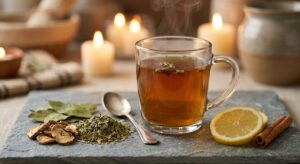
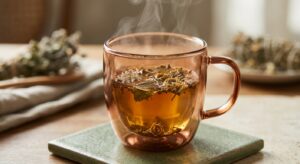
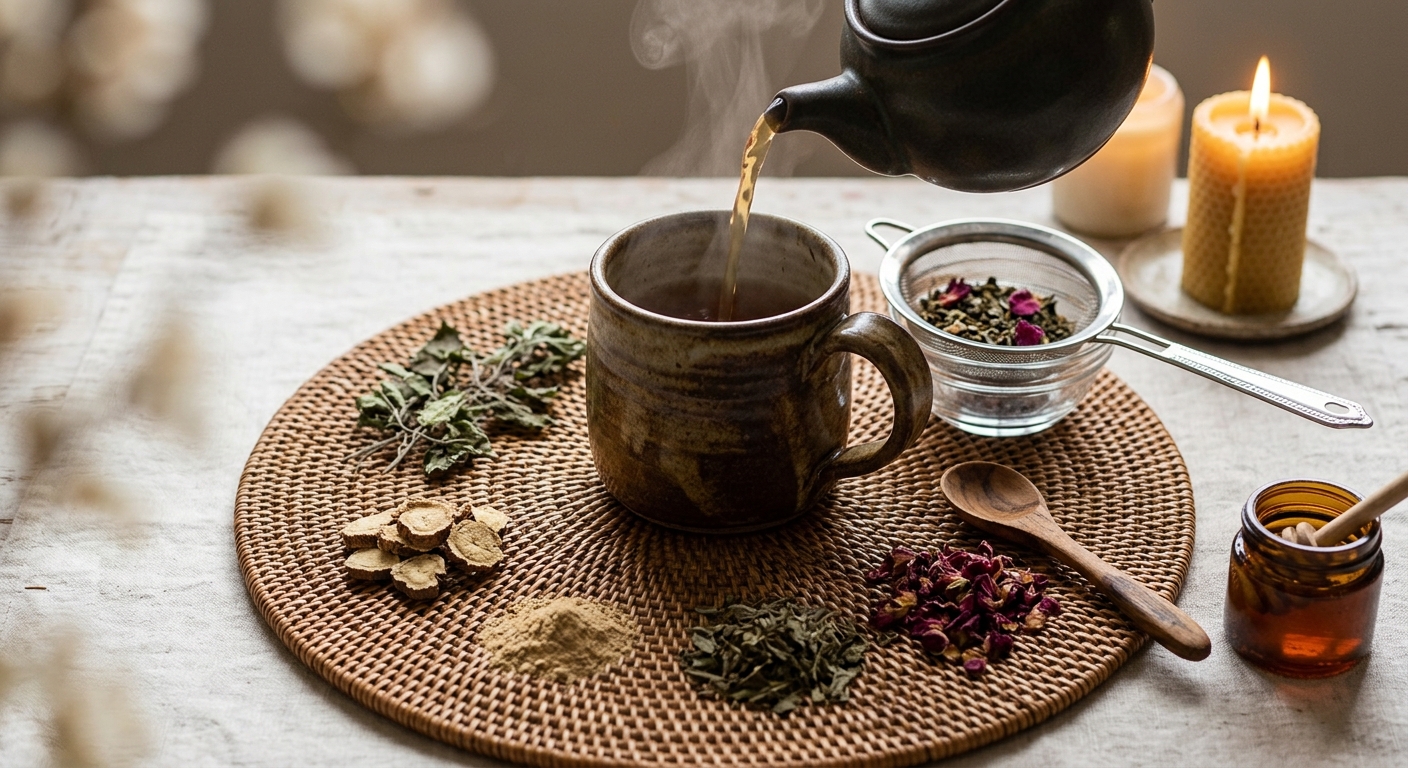
The sensory experience of this tea is deeply comforting. Rhodiola brings an earthy, slightly rose-like quality that grounds you immediately upon the first inhale. Ashwagandha adds a warm, malty depth reminiscent of oat straw, while tulsi lifts everything with notes of clove and pepper. The resulting brew is complex, warming, and deeply nourishing, with a golden-amber hue that glows like late afternoon sun on mountain stone. Whether you are navigating a high-pressure workday or simply seeking a ritual of stillness, this tea meets you exactly where you are.
2
cups
Ingredients
- 1.5 tspdried rhodiola rosea root (sliced or granulated)
- 1 tspashwagandha root powder or sliced root
- 1.5 tspdried holy basil (tulsi) leaves
- 0.5 tspdried rose petals (optional, for floral depth)
- 480 mlwater (92°C / 198°F)
- —raw honey or jaggery to taste (optional)
- —a thin slice of fresh ginger (optional, for added warmth)
How to Brew
Click on an item below to shop for the recommended items for this recipe on Amazon.
As an Amazon Associate, we earn from qualifying purchases.
- Bring filtered water to 90 to 95°C (194 to 203°F). If using a standard kettle, allow boiling water to rest for 2 minutes before pouring. Avoid a full rolling boil, as excessive heat can degrade some of rhodiola’s delicate aromatic compounds.
- Combine 1.5 tsp dried rhodiola root, 1 tsp ashwagandha root, and 1.5 tsp dried tulsi leaves in a mesh tea infuser or teapot strainer. Add rose petals and a slice of fresh ginger if using. For two servings, use a 500 ml teapot or two individual infusers.
- Pour the heated water over the herbs, ensuring all plant material is fully submerged. Cover the teapot or mug with a lid or small saucer to trap the volatile aromatic compounds – this is especially important for tulsi, whose beneficial terpenoids evaporate quickly.
- Steep for 7 to 10 minutes. Begin tasting at 7 minutes: a 7-minute steep yields a brighter, more tulsi-forward flavor, while 10 minutes draws out more of the earthy, rooty depth from rhodiola and ashwagandha.
- Remove the infuser and pour into warmed mugs. Stir in raw honey or jaggery to taste. Drink slowly and allow at least 10 minutes of quiet to fully receive the calming effect of this tea.
- Use a higher herb ratio for cold brewing: increase the blend to 2 tsp rhodiola, 1.5 tsp ashwagandha, and 2 tsp tulsi per 480 ml of water. The cold extraction process is less efficient for woody roots, so the extra volume compensates.
- Add all herbs to a clean glass jar or cold brew pitcher. Pour room-temperature filtered water over the herbs. Do not use ice-cold water at this stage, as the initial ambient-temperature period helps begin the extraction before the herbs are refrigerated.
- Stir gently to ensure all herbs are fully saturated and submerged. Place a small plate or cling film over the jar opening and allow it to sit at room temperature for 1 hour before transferring to the refrigerator.
- Refrigerate for 10 to 14 hours (overnight is ideal). The slow, cold extraction draws out adaptogenic glycosides and flavonoids without the bitterness that can emerge from high-heat brewing of ashwagandha.
- Strain through a fine mesh strainer or cheesecloth into a glass. Serve over ice with a slice of lemon or a few fresh tulsi leaves as garnish. Sweeten with a small amount of liquid honey if desired, as it dissolves more easily in cold liquid than crystallized honey.
- Add 480 ml of cold filtered water to a small saucepan. Add 2 tsp rhodiola root and 1.5 tsp ashwagandha root directly to the cold water. Starting in cold water and slowly heating allows a more gradual and thorough extraction of the dense root material.
- Bring the water slowly to a gentle simmer over medium-low heat. Do not allow the liquid to reach a full rolling boil, as this destroys some of the heat-sensitive rosavins in rhodiola. Maintain a steady, gentle simmer with small bubbles just breaking the surface.
- Simmer uncovered for 15 to 20 minutes, stirring occasionally. You will notice the liquid deepening to a rich amber color and the earthy, malty aroma of ashwagandha becoming more pronounced as the decoction concentrates.
- Remove from heat and immediately add 1.5 tsp dried tulsi leaves directly to the hot liquid. Cover the saucepan with a lid and allow the tulsi to infuse off-heat for 5 minutes. This two-stage approach correctly treats the delicate tulsi as an infusion rather than a decoction, preserving its aromatic oils.
- Strain through a fine mesh strainer into mugs, pressing gently on the spent herbs to extract any remaining liquid. Stir in raw honey, a pinch of cinnamon, or a few drops of ashwagandha-infused ghee if you wish to honor the Ayurvedic tradition of fat-soluble herb delivery. Sip slowly while warm.
Health Benefits
Rhodiola’s rosavins and salidroside, alongside ashwagandha’s withanolides, work synergistically on the hypothalamic-pituitary-adrenal axis to normalize cortisol output. Multiple randomized controlled trials have shown ashwagandha root extract significantly reduces serum cortisol in chronically stressed adults.
A 2019 double-blind study published in Medicine found that 240 mg of ashwagandha extract daily significantly reduced anxiety scores compared to placebo. Rhodiola’s salidroside supports serotonin and dopamine balance, further easing anxious mental states without causing sedation.
Rhodiola rosea has been studied in military cadets, physicians on night shifts, and students during exam periods, consistently showing improvements in mental fatigue, concentration, and cognitive accuracy under high-stress conditions. Its dual action on dopamine and acetylcholine systems underlies this nootropic effect.
Both rhodiola and ashwagandha have demonstrated ergogenic effects in clinical trials, increasing VO2 max, reducing exercise-induced cortisol spikes, and improving recovery time. Holy basil further protects cells from oxidative stress generated during physical exertion, making this blend valuable for active individuals managing high demands.
Rather than acting as a direct sedative, this blend improves sleep quality indirectly by lowering evening cortisol and calming the nervous system. Ashwagandha’s triethylene glycol content has been specifically associated with sleep onset improvements in human clinical trials.
🧪 Key Bioactive Compounds
The Science Behind Rhodiola Rosea
The science behind Tibetan Herbal Stress Tea centers on the concept of HPA axis modulation. The hypothalamic-pituitary-adrenal (HPA) axis is the body’s central stress-response highway, triggering cortisol release in response to physical or psychological threat. In chronic stress, this axis becomes dysregulated, leading to persistently elevated cortisol, impaired immunity, poor sleep, anxiety, and metabolic disruption. Rhodiola rosea’s primary active compounds, the rosavins and salidroside, appear to act as partial antagonists at key points in this pathway, helping to normalize cortisol secretion rather than simply suppressing it. This is the defining property of a true adaptogen: bidirectional regulation that moves the body toward homeostasis regardless of whether stress hormones are too high or too low.
Ashwagandha’s withanolides, particularly withaferin A and withanolide D, have been shown in multiple peer-reviewed studies to significantly reduce serum cortisol, lower C-reactive protein (a marker of inflammation linked to chronic stress), and enhance GABA-ergic signaling in the brain. A landmark 2012 study in the Indian Journal of Psychological Medicine found that participants taking ashwagandha root extract experienced a 27.9 percent reduction in serum cortisol compared to placebo. These steroidal lactones also appear to regenerate axons and dendrites in neuronal cells, suggesting a neuroprotective role during prolonged stress exposure. The fat-soluble nature of withanolides is why traditional Ayurvedic preparations often combined ashwagandha with warm milk or ghee, a practice that modern pharmacokinetic research has validated as enhancing absorption.
Holy basil (Ocimum tenuiflorum) rounds out the blend with its own distinct mechanism of action. Its essential oils, rich in eugenol, linalool, and beta-caryophyllene, exert COX-2 inhibitory anti-inflammatory effects comparable in some studies to low-dose ibuprofen, addressing the inflammatory component of chronic stress. Tulsi’s ursolic acid has been shown to stabilize blood glucose during stress-induced cortisol spikes, breaking the vicious cycle of stress-driven sugar cravings and energy crashes. Together, the three herbs in this blend address stress from complementary angles: neuroendocrine regulation, anti-inflammatory protection, and neurotransmitter balance, creating a genuinely synergistic formula that is greater than the sum of its individual parts.
Brewing Tips
- Source rhodiola root that is standardized to contain at least 3 percent rosavins and 1 percent salidroside – these are the benchmarks used in clinical research and ensure you are getting a therapeutically meaningful dose in each cup.
- For ashwagandha, sliced root generally produces a milder, less bitter cup than powder. If using powder, start with half the suggested amount and increase gradually as you become accustomed to its distinctive earthy taste.
- This blend is most effective when consumed consistently over several weeks. Adaptogens work cumulatively by gradually recalibrating the HPA axis, so a single cup offers comfort but a daily ritual over 4 to 8 weeks yields the most significant stress resilience benefits.