Spearmint (Mentha spicata) has been woven into human life for thousands of years. Ancient Greeks and Romans scented their baths and banquet halls with it, and the species name comes from the pointed, spear-shaped leaves that set it apart from its sharper cousin, peppermint. In Middle Eastern and North African traditions, spearmint tea is a symbol of hospitality, poured in glasses throughout the day and always offered to guests. In traditional herbal medicine across Europe and Asia, it was reached for to settle the stomach, ease bloating, and calm a restless mind.
What makes spearmint especially interesting for women’s health is a thread of modern research that began with an unexpected observation. In Turkey, where spearmint tea is a daily habit, clinicians noticed that women who drank it regularly seemed to have lower androgen levels. This prompted small clinical studies in women with hirsutism and polycystic ovary syndrome (PCOS), a condition in which excess androgens such as testosterone can drive unwanted hair growth, acne, and irregular cycles.
The evidence is still early. The trials are small and short, and spearmint tea is not a treatment for PCOS. But as a gentle, caffeine-free evening ritual with a promising signal behind it, it is one of the most intriguing herbal teas for women looking for a supportive daily habit alongside the care of their healthcare provider. The flavor helps too: cooling, mellow, and lightly sweet, it makes a lovely way to close the day.
2
cups
Ingredients
- 2 tspdried spearmint leaves (Mentha spicata)
- 480 mlwater (95°C / 203°F)
- —fresh spearmint sprig for garnish (optional)
- —raw honey or a slice of lemon to taste (optional)
How to Brew
Click on an item below to shop for the recommended items for this recipe on Amazon.
As an Amazon Associate, we earn from qualifying purchases.
- Bring fresh, filtered water to a near boil, then let it rest for about 30 seconds so it settles at roughly 95°C (203°F). A full rolling boil can dull spearmint’s delicate sweetness.
- Measure 2 teaspoons of dried spearmint leaves into a teapot or infuser basket, using about 1 teaspoon per cup. Gently crush the leaves between your fingers first to release their oils.
- Pour the hot water over the leaves and immediately cover the pot or mug with a small plate or lid to trap the aromatic oils.
- Steep for 5 to 7 minutes. Five minutes gives a light, fresh cup, while seven yields a fuller body and stronger mint character without turning bitter.
- Remove the infuser or strain out the leaves, then pour into your favorite mug.
- Sip slowly about an hour before bed as a calming ritual, adding a little honey or a lemon slice if you like.
- Add 4 tablespoons of dried spearmint leaves to a 1-liter glass jar. Cold extraction is gentler, so you need roughly double the herb per volume compared with a hot brew.
- Pour in 1 liter of cold, filtered water and stir once to submerge all the leaves.
- Seal the jar and place it in the refrigerator. Do not steep at warm room temperature for the full time, as herbs left out can spoil.
- Let it steep for 8 to 12 hours, or overnight, until the water turns a pale golden green and smells distinctly of fresh mint.
- Strain through a fine mesh strainer into a clean pitcher, pressing the leaves lightly to release the last of the liquid.
- Serve over ice with a fresh spearmint sprig. Drink within 48 hours for the best flavor and freshness.
- Place 1 heaping tablespoon of dried spearmint leaves in a heatproof glass jar or French press. This is roughly double the amount used in a standard hot brew.
- Bring 480 ml of water to a boil, then pour it over the leaves.
- Cover the jar tightly with a lid or a saucer. Keeping it sealed is essential, as it prevents the volatile oils (including carvone, spearmint’s signature compound) from escaping.
- Let the infusion steep for 20 to 30 minutes, until the water has darkened to a deeper golden green and cooled to a comfortable drinking temperature.
- Strain thoroughly, pressing the leaves to extract every drop of the liquid.
- Drink warm, or gently reheat on the stove without boiling. Any leftovers can be refrigerated and enjoyed within 24 hours.
Health Benefits
In small clinical trials, women with PCOS or hirsutism who drank spearmint tea twice daily for 5 to 30 days showed reductions in free and total testosterone alongside increases in LH and FSH. The studies are short and small, so the effect is promising but not yet proven long term.
Carvone and related compounds relax the smooth muscle of the digestive tract, which may ease bloating, gas, and mild nausea. This is one of spearmint’s best-established traditional uses.
Rosmarinic acid and flavonoids in spearmint help neutralize free radicals in laboratory studies. Because PCOS is associated with higher oxidative stress, antioxidant-rich foods and drinks are an area of ongoing interest.
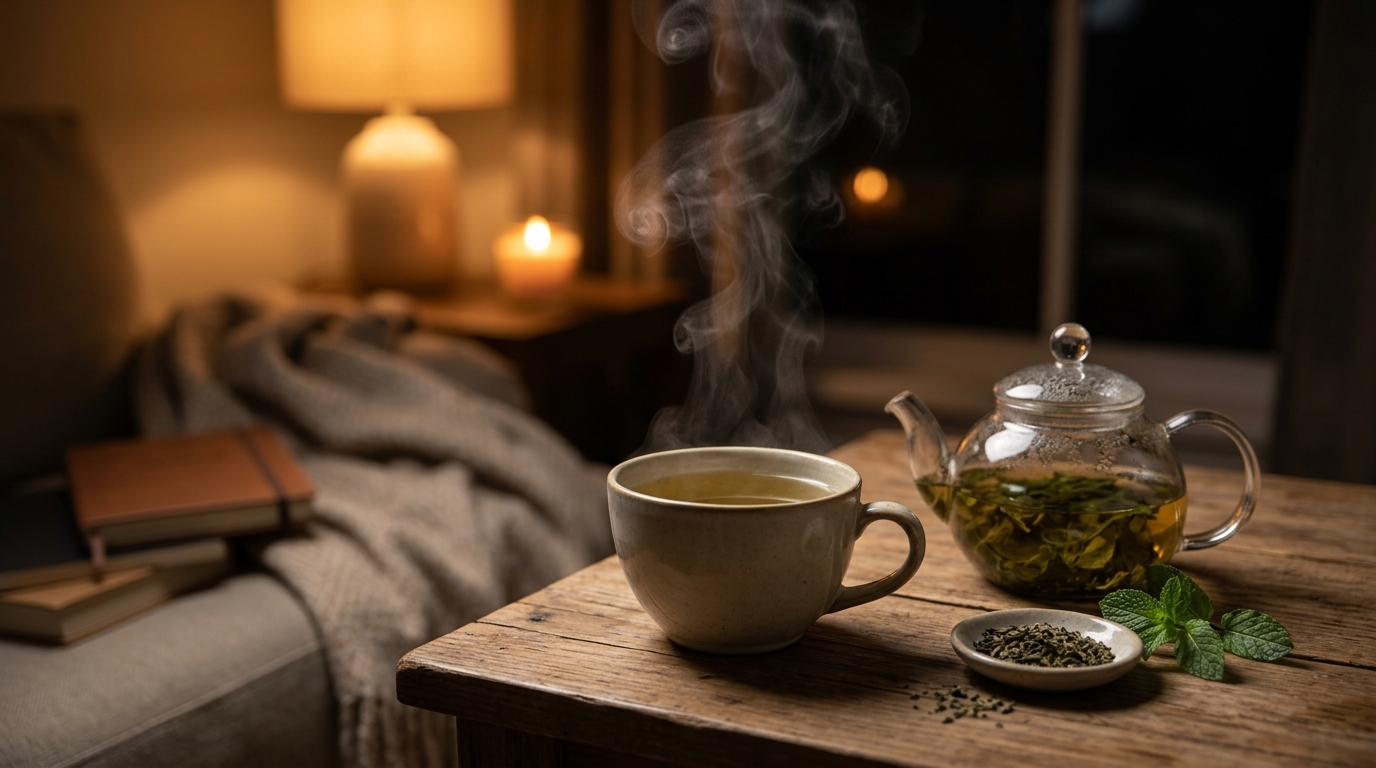
Spearmint is naturally caffeine-free, and its warm, aromatic ritual encourages a slower pace in the evening. While it is not a sedative, the sensory experience and warmth can support a wind-down routine.
Because hirsutism is driven in part by androgen activity, the testosterone-lowering signal seen in early trials has led researchers to explore spearmint as a gentle complementary option. Results on actual hair growth over longer periods remain limited.
🧪 Key Bioactive Compounds
The Science Behind Spearmint
The most-cited research on spearmint and PCOS comes from a handful of small studies. A 2007 Turkish trial in women with hirsutism found that drinking spearmint tea twice daily for five days lowered free and total testosterone while raising luteinizing hormone and follicle-stimulating hormone. A later 2010 randomized trial in women with PCOS reported similar reductions in free testosterone after 30 days, along with some improvement in how participants rated their hirsutism, though objective measures of hair growth showed less change.
The proposed mechanism involves spearmint’s phenolic compounds, including rosmarinic acid and flavonoids such as luteolin, which may interfere with androgen signaling or production. Laboratory and animal studies have shown that spearmint extract can reduce testosterone and affect ovarian structure, but how well this translates to a cup of tea in humans is still being worked out. The doses, durations, and participant numbers in human trials remain modest.
It is worth holding this evidence with both optimism and honesty. Spearmint tea is not an established PCOS treatment, and larger, longer, well-controlled trials are needed. What can be said is that it is a safe, pleasant, caffeine-free drink with a plausible biological rationale and an encouraging early signal, making it a reasonable addition to a broader approach that includes diet, movement, sleep, and professional medical guidance.
Brewing Tips
- Choose whole-leaf Mentha spicata rather than a generic mint blend. Many ‘mint’ teas are peppermint, which has a different compound profile than the spearmint used in the PCOS studies.
- Drink the tea consistently, ideally twice a day in studies, with one cup in the evening as a calming ritual. Regular habits matter more than a single strong cup.
- Store dried spearmint in an airtight, opaque container away from heat and light to preserve its volatile oils, and use it within 6 to 12 months for the best flavor.
- Grow your own spearmint in a pot, as it thrives in containers and is famously vigorous. Fresh leaves can be used at roughly three times the quantity of dried.
- Track how you feel and share your tea habit with your healthcare provider, especially if you are monitoring hormones or taking PCOS medication.