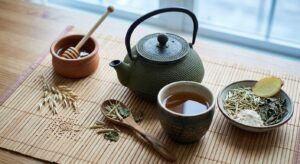
Skullcap, also called blue skullcap or mad-dog skullcap, is a small perennial of the mint family that grows in damp meadows and along stream banks across North America. The name comes from the shape of its tiny blue-violet flowers, which resemble a medieval helmet. In the 1700s, American physicians and folk healers used it to treat nervous disorders, and early Eclectic physicians of the 19th century included it in their materia medica as a nervine, a plant that supports and soothes the nervous system.
In Western herbalism, skullcap is reached for when the mind will not switch off at night: the racing thoughts, tight shoulders, and restless jitters that follow a long day. Herbalists often describe it as a gentle relaxant that calms without heavy sedation. The dried aerial parts, harvested while the plant is in flower, brew into a pale golden-green tea with a pleasantly bitter, grassy character.
What makes skullcap special is its place in the evening ritual. Preparing it slowly, inhaling the warm herbal steam, and sipping it without a screen in sight can turn a simple cup into a boundary between the working day and the quiet hours. The herb supports the ritual, and the ritual supports the herb.
2
cups
Ingredients
- 2 tspdried skullcap herb (Scutellaria lateriflora)
- 480 mlwater (95°C / 203°F for hot brew)
- —raw honey or maple syrup to taste (optional)
- —a few dried lemon balm leaves or a slice of lemon to soften the bitterness (optional)
How to Brew
Click on an item below to shop for the recommended items for this recipe on Amazon.
As an Amazon Associate, we earn from qualifying purchases.
- Bring fresh filtered water to a near boil, then let it rest for about 30 seconds so it sits at roughly 95°C (203°F).
- Place 1 teaspoon of dried skullcap per 240 ml of water into a tea infuser, teapot, or directly into your mug.
- Pour the hot water over the herb, then immediately cover the cup with a small saucer or lid to hold in the steam.
- Steep for 10 to 15 minutes. Skullcap is a leafy aerial herb, so a longer steep draws out its full character without turning harsh.
- Strain out the herb, stir in honey or a few lemon balm leaves if you like, and sip slowly about 30 to 60 minutes before bed.
- In a clean glass jar, combine 2 tablespoons of dried skullcap with 1 liter of cool filtered water.
- Stir gently for 10 seconds to saturate the herb, then seal the jar with its lid.
- Refrigerate for 8 to 12 hours, ideally overnight, so the herb extracts slowly in the cold.
- Strain through a fine mesh sieve or a cloth-lined funnel to remove all plant matter.
- Pour over ice or drink straight from the fridge. Keep refrigerated and finish within 48 hours, since cold infusions spoil faster than hot ones.
- Measure 4 tablespoons of dried skullcap into a heatproof jar or teapot.
- Pour 500 ml of just-boiled water over the herb and cover tightly to preserve the aromatics.
- Steep for a full 20 minutes, giving the jar a gentle swirl halfway through.
- Strain thoroughly into a clean bottle or jar, pressing the herb lightly to release the last of the liquid.
- Store in the refrigerator for up to 3 days. To serve, stir 2 to 3 tablespoons of concentrate into a mug of hot water, or into a glass of sparkling water over ice for a calming evening spritz.
Health Benefits
Skullcap’s flavonoids, especially baicalin and wogonin, appear to modulate GABA activity, the brain’s main calming neurotransmitter. A small human trial found improved mood and reduced anxiety without a drop in cognitive performance.
Traditionally used as a nervine for overactive minds at night, skullcap may help quiet mental chatter and prepare the body for sleep. Human evidence is limited, but its traditional use is long-standing and consistent.
Herbalists have long used skullcap for tight shoulders and jaw clenching tied to stress. Its mild relaxant properties likely work through the same calming pathways that ease nervous agitation.
Skullcap’s flavonoids neutralize free radicals in laboratory models, and compounds like scutellarin show neuroprotective potential. Clinical significance in humans remains under study.
🧪 Key Bioactive Compounds
The Science Behind Skullcap
The calming reputation of skullcap rests largely on its flavonoids, particularly baicalin, baicalein, and wogonin. Laboratory and animal studies suggest these compounds interact with the GABA-A receptor, the same inhibitory pathway targeted by many anti-anxiety medications, though skullcap acts much more gently. This mechanism may explain why the herb has been associated with reduced anxiety and a quieter mind without strong sedation.
A small, randomized, placebo-controlled human study found that participants who took American skullcap reported improved overall mood and lower anxiety, with no significant impairment of energy or cognition. While encouraging, the sample was small, and larger trials are needed. Much of the supporting research is preclinical, so skullcap is best viewed as a traditional herb with promising, but still emerging, scientific backing.
It is worth noting that two different plants share the name skullcap. American skullcap (Scutellaria lateriflora) is the nervine used in this tea, while Chinese skullcap (Scutellaria baicalensis, or Huang Qin) is a separate medicinal root used in traditional Chinese medicine, richer in baicalin and typically prepared as a decoction. Both contain related flavonoids, but their traditional uses and strengths differ, so check the label before you brew.
Brewing Tips
- Cover your cup while steeping. Skullcap’s aromatic compounds are volatile, and a lid or saucer keeps them in the tea instead of the air.
- Start with 1 teaspoon per cup and adjust. Skullcap is naturally bitter, so begin mild and build up as your palate adjusts.
- Build a ritual around it: dim the lights, put away screens, and drink your tea 30 to 60 minutes before bed for the best wind-down effect.
- Store dried skullcap in an airtight, light-proof jar and use within a year. Old herb loses its green aroma and much of its character.