Long before it appeared on health food shelves, slippery elm was a staple of Native American plant medicine. The Ojibwe, Cherokee, Iroquois, and other nations peeled the inner bark of the red elm tree (Ulmus rubra) and used it to soothe wounds, calm sore throats, and settle upset stomachs. The bark earned its name honestly: when moistened, it releases a slick, gel-like substance that feels almost like silk against the tongue.
European settlers quickly adopted the remedy. During the American Revolution, slippery elm gruel was reportedly given to soldiers at Valley Forge as an easily digested food when little else was available. By the 19th century, it was a fixture in the Eclectic medical tradition, and it remains a common ingredient in lozenges and digestive formulas today. The inner bark is harvested carefully, since stripping the outer bark and cambium can kill a tree, and responsible suppliers matter more than ever as elm populations face pressure from Dutch elm disease.
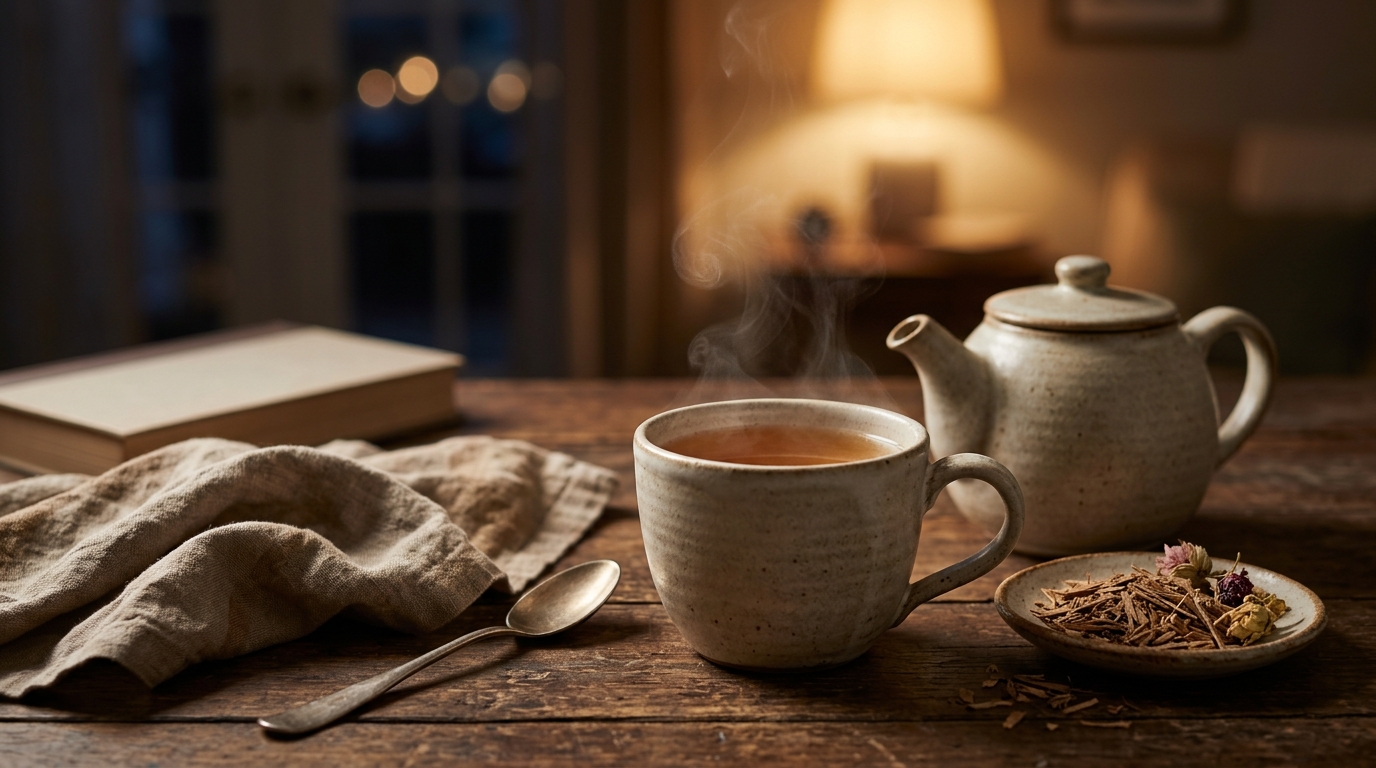
As an evening tea, slippery elm is unlike any other herbal brew. It is thick, gently sweet, and faintly reminiscent of maple and oatmeal. Rather than a thin, aromatic infusion, you get a warm, velvety drink that coats the throat and settles the stomach. For anyone whose evenings are interrupted by reflux, a burning stomach, or a dry scratchy throat, it makes a deeply comforting nightcap.
1
cups
Ingredients
- 1 tspslippery elm inner bark powder
- 240 mlwater (90°C / 194°F)
- 60 mlcold water, for making the slurry
- —raw honey or maple syrup to taste (optional)
- —pinch of cinnamon or ground ginger (optional)
How to Brew
Click on an item below to shop for the recommended items for this recipe on Amazon.
As an Amazon Associate, we earn from qualifying purchases.
- Measure 1 teaspoon of slippery elm powder into your mug. For a thicker, more soothing drink, use up to 2 teaspoons.
- Add about 60 ml of cold water to the powder and stir with a spoon or small whisk until you have a smooth, lump-free paste. This step prevents clumping.
- Heat fresh water to just below boiling, around 90 to 95°C (194 to 203°F), then pour about 180 ml over the paste while stirring continuously.
- Let the tea sit, covered, for 5 to 10 minutes. It will thicken gradually as the mucilage hydrates, reaching a consistency between a thin broth and a light porridge.
- Stir once more, then sweeten with honey or maple syrup and add a pinch of cinnamon or ginger if you like. Sip slowly while warm.
- Add 1 teaspoon of slippery elm powder to a clean glass jar with a tight-fitting lid.
- Pour in 60 ml of cool water first and stir or shake vigorously until the powder is fully suspended with no dry pockets.
- Add another 180 ml of cool water, seal the jar, and shake well for 30 seconds.
- Refrigerate for 4 to 8 hours or overnight, shaking the jar briefly once or twice if you remember. The liquid will thicken slightly and turn a soft, cloudy beige.
- Shake again before serving. Drink it cold as a chilled digestive tonic, or gently warm it in a saucepan over low heat for 1 to 2 minutes, without boiling, if you prefer it warm. Use within 24 hours.
- Combine 1 to 2 tablespoons of slippery elm powder with 4 tablespoons of cold water in a small saucepan and whisk into a smooth paste.
- Slowly pour in 240 ml of water or milk of choice (oat or almond milk works well) while whisking constantly to keep the mixture smooth.
- Place the pan over low to medium heat and bring to a gentle simmer, stirring continuously. Do not let it boil hard, which can scorch the starches and make it gummy.
- Simmer for 5 to 8 minutes, stirring often, until the gruel thickens to the texture of thin porridge or warm custard.
- Remove from heat and stir in a little honey or maple syrup, a pinch of cinnamon, and optionally a drop of vanilla. Let it cool for a minute or two before eating or sipping from a bowl.
Health Benefits
The mucilage forms a protective film over the mucous membranes of the gut. Traditional use is supported by the demulcent mechanism, though clinical trials in humans remain limited.
By coating the esophagus and stomach lining, slippery elm may reduce the burning sensation of reflux. Many people report relief, though more rigorous research is needed.
Demulcent herbs like slippery elm are widely used in lozenges and teas because the gel moistens and protects irritated throat tissue, easing dryness and cough.
A small pilot trial in people with IBS-related constipation found a slippery elm-containing formula improved bowel function, likely through its soft bulking and lubricating effect.
The starch content makes slippery elm gruel easy to digest, giving a source of mild calories when appetite is low or the stomach is sensitive.
🧪 Key Bioactive Compounds
The Science Behind Slippery Elm
The therapeutic reputation of slippery elm rests largely on a single feature: mucilage. This complex mixture of polysaccharides, built from sugars like galactose, rhamnose, and galacturonic acid, swells dramatically in water to form a thick, slippery gel. Pharmacologists classify herbs that do this as demulcents. When swallowed, the gel is thought to spread across the mucous membranes of the mouth, throat, esophagus, and stomach, forming a temporary protective layer over tissue that has been irritated by acid, dryness, or inflammation.
There is also a proposed reflex mechanism. Some researchers suggest that mucilage-rich herbs may stimulate nerve endings in the digestive tract, prompting an increase in protective mucus secretion further down the gut. This idea has been discussed for decades, but it is based more on mechanistic reasoning and traditional observation than on large clinical trials. Honest evidence is modest: a few small human studies and a long history of traditional use support slippery elm, but it has not been tested as extensively as many pharmaceutical reflux treatments.
The bark also contains tannins and phytosterols, which contribute mild astringent and anti-inflammatory activity, and some antioxidant capacity has been measured in laboratory studies. Combined with its digestible starch content, slippery elm functions as both a soothing agent and a gentle food, which explains its enduring role in recovery diets and evening digestive rituals.
Brewing Tips
- Always make a cold-water paste first, because slippery elm powder clumps into stubborn gel balls if dumped straight into hot water.
- Drink your cup at least an hour away from medications or supplements, since the mucilage can slow their absorption.
- Start with 1 teaspoon and adjust upward gradually, as a thicker brew is more soothing but can feel heavy if you are not used to it.
- Buy powder from suppliers that harvest sustainably from inner bark only, and avoid products that source from wild-stripped trees.
- Prepare a fresh cup each time, because the gel continues to thicken and the flavor flattens when left standing for hours.