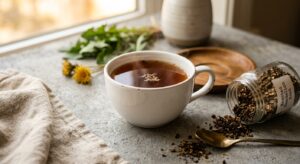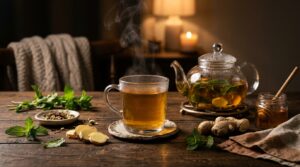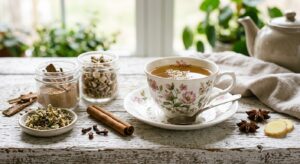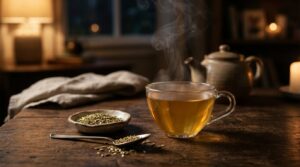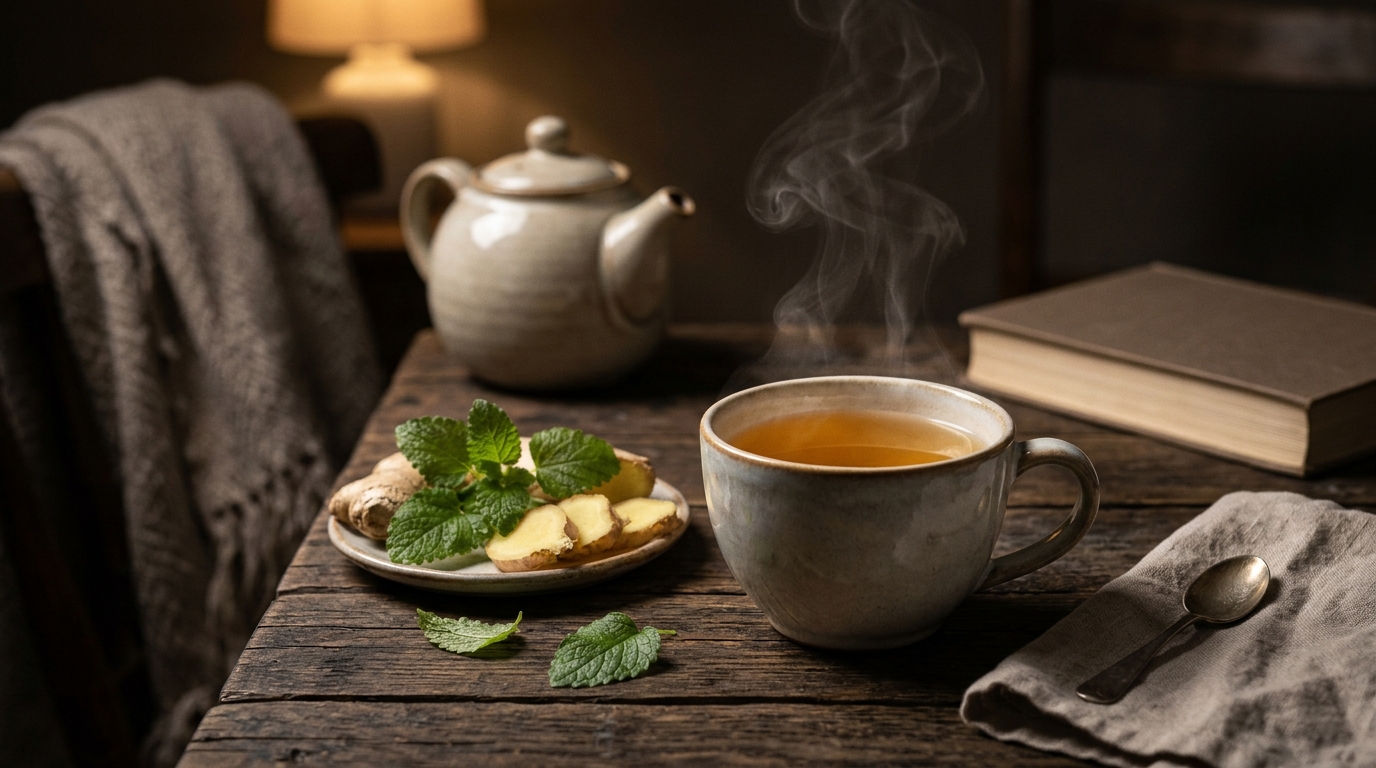
Few herbal pairings feel as natural as ginger and lemon balm. Ginger (Zingiber officinale) has been cherished for thousands of years across India, China, and Southeast Asia as a digestive tonic, used to settle nausea, warm the belly, and stimulate sluggish digestion. Lemon balm (Melissa officinalis), a bright member of the mint family, has an equally long history in the Mediterranean and Europe. Medieval monks brewed it as a cordial to lift the spirits, and the 17th-century herbalist Nicholas Culpeper praised it for driving away melancholy and soothing the stomach.
What makes this combination so appealing is how the two herbs balance one another. Ginger brings heat, spice, and a tingling warmth that encourages the digestive system to move things along. Lemon balm brings a cool, citrusy softness that smooths ginger’s sharper edges while adding its own calming, antispasmodic touch. One speaks to the gut, the other to the nervous system, and since stress and digestion are so closely tied, the pairing works as a whole-body evening ritual.
Sipped after dinner, this tea helps ease the heaviness of a big meal and signals to the body that the day is winding down. The aroma alone, fresh lemon peel layered over warm, peppery ginger, is enough to slow your breathing and invite you to unclench your shoulders.
2
cups
Ingredients
- 2 tbspfresh ginger root, thinly sliced
- 3 tbspdried lemon balm leaves (or 1/2 cup fresh leaves, loosely packed)
- 480 mlfiltered water
- —raw honey to taste (optional)
- —fresh lemon slice for serving (optional)
How to Brew
Click on an item below to shop for the recommended items for this recipe on Amazon.
As an Amazon Associate, we earn from qualifying purchases.
- Slice about 2 tablespoons of fresh ginger root into thin coins, leaving the skin on if the root is organic and well washed. Thinner slices expose more surface area and release more of their warming compounds.
- Bring 480 ml of filtered water to a full boil, then pour it over the ginger slices in a teapot or heatproof pitcher. Cover and let the ginger steep alone for 5 minutes so the gingerols and essential oils can infuse into the water.
- Let the water cool for a minute or two off the heat, to roughly 85°C (185°F). Stir in 3 tablespoons of dried lemon balm leaves, or a generous handful of bruised fresh leaves.
- Cover again and steep for another 5 to 7 minutes. Keeping the lid on traps the aromatic oils that give lemon balm its signature scent.
- Strain into two mugs. Stir in a small spoonful of raw honey if you like, and add a thin lemon slice. Sip slowly while it is still warm.
- Slice 2 tablespoons of fresh ginger into thin coins and lightly bruise them with the back of a spoon to help release their flavor into cool water.
- Place the ginger and 3 tablespoons of dried lemon balm (or a loose handful of fresh leaves) into a clean glass jar. Add 480 ml of cold filtered water and stir gently.
- Cover the jar and refrigerate for 8 to 10 hours, or overnight. Avoid steeping longer than 12 hours, as ginger can turn sharp and slightly bitter.
- Strain through a fine mesh sieve into a clean pitcher, pressing gently on the herbs to extract the last of the liquid.
- Serve over ice with a lemon wheel and a drizzle of honey if desired. Keep refrigerated and drink within 2 days.
- Slice 2 tablespoons of fresh ginger very thinly, or roughly grate it, since a tougher root benefits from maximum surface area when simmered.
- Combine the ginger and 480 ml of filtered water in a small saucepan. Bring to a boil, then immediately reduce the heat to low so the water barely bubbles.
- Cover and simmer gently for 15 minutes. The liquid will turn a deeper gold and the kitchen will fill with a spicy, warming aroma.
- Remove the pan from the heat and stir in 3 tablespoons of dried lemon balm. Cover and steep for 5 minutes. The leaves are delicate and should never be simmered.
- Strain into mugs, pressing the ginger to release any remaining liquid. Sweeten with honey and finish with a squeeze of fresh lemon if you like.
Health Benefits
Ginger’s gingerols and shogaols help speed gastric emptying and calm the stomach, and clinical trials support its use for nausea from motion, pregnancy, and post-operative recovery.
Both herbs are traditional carminatives. Ginger encourages digestive movement while lemon balm’s volatile oils relax smooth muscle in the gut, helping trapped gas to pass.
Small human studies suggest lemon balm extracts can improve calmness and mood, likely through rosmarinic acid and effects on GABA and acetylcholine pathways.
By easing both digestive discomfort and nervous tension, this tea helps remove two common obstacles to falling asleep. Lemon balm is also traditionally paired with sleep herbs for gentle relaxation.
Ginger’s phenolic compounds and lemon balm’s rosmarinic acid both show antioxidant and anti-inflammatory activity in laboratory and early clinical research.
🧪 Key Bioactive Compounds
The Science Behind Ginger
The gut-soothing power of this tea begins with ginger’s pungent phenolic compounds. Gingerols, found abundantly in fresh root, and shogaols, which form when ginger is heated or dried, interact with receptors in the digestive tract, including serotonin 5-HT3 receptors involved in the nausea response. Research suggests they also help stimulate gastric emptying and intestinal motility, which may explain why ginger is so effective for the heavy, stalled feeling after a large meal. Its anti-inflammatory activity, linked to the inhibition of pro-inflammatory enzymes, adds further support for the gut lining.
Lemon balm contributes a different but complementary set of actions. Its leaves are rich in rosmarinic acid and volatile oils such as citral and citronellal. Laboratory and early human studies indicate that lemon balm extracts may inhibit the enzyme GABA transaminase, which breaks down the calming neurotransmitter GABA, and may also modulate acetylcholine activity. This helps explain its traditional reputation for easing nervous tension and lifting mood. In the gut, its volatile oils appear to have antispasmodic effects, relaxing smooth muscle and easing cramping.
It is worth noting that much of the human evidence for lemon balm comes from small trials using concentrated extracts, so a cup of tea is best viewed as a gentle, supportive ritual rather than a treatment. Still, the combined effects of warming digestive stimulation from ginger and calming nervous-system support from lemon balm make this a thoughtful pairing, and the act of slowly sipping a warm cup in the evening carries its own measurable benefit for stress reduction.
Brewing Tips
- Use fresh ginger whenever possible. Dried ginger powder tastes harsher and muddy, and it will cloud the tea.
- Never boil lemon balm. Its lemony oils are highly volatile, so add the leaves off the heat and keep the lid on while steeping.
- Freeze a knob of ginger and grate it straight into the pot. It is easier to grate than fresh root and keeps for months.
- If you grow lemon balm, harvest the leaves in the morning after the dew dries, when the essential oil content is at its highest.
- Adjust the ratio to taste: more ginger for a stronger digestive kick, more lemon balm for a softer, calming cup.