Few herbs carry as much history as licorice root. Fragments of it were found in the tomb of Tutankhamun, and ancient Egyptians brewed it into a sweet drink called mai-sus. In Traditional Chinese Medicine, licorice (gan cao) is called the great harmonizer and appears in a huge share of classical formulas, where it softens the harshness of other herbs and soothes the throat and lungs. Greek and Roman physicians, including Theophrastus and Dioscorides, recommended it for coughs, dry throats, and stomach complaints.
What makes licorice root special is its remarkable natural sweetness. The root contains glycyrrhizin, a compound roughly 30 to 50 times sweeter than sugar, which is why a simple cup of licorice tea needs no honey at all. Beyond sweetness, the root is rich in mucilaginous polysaccharides and flavonoids that form a soft, protective film over irritated mucous membranes. This is the demulcent quality herbalists prize for scratchy, inflamed throats.
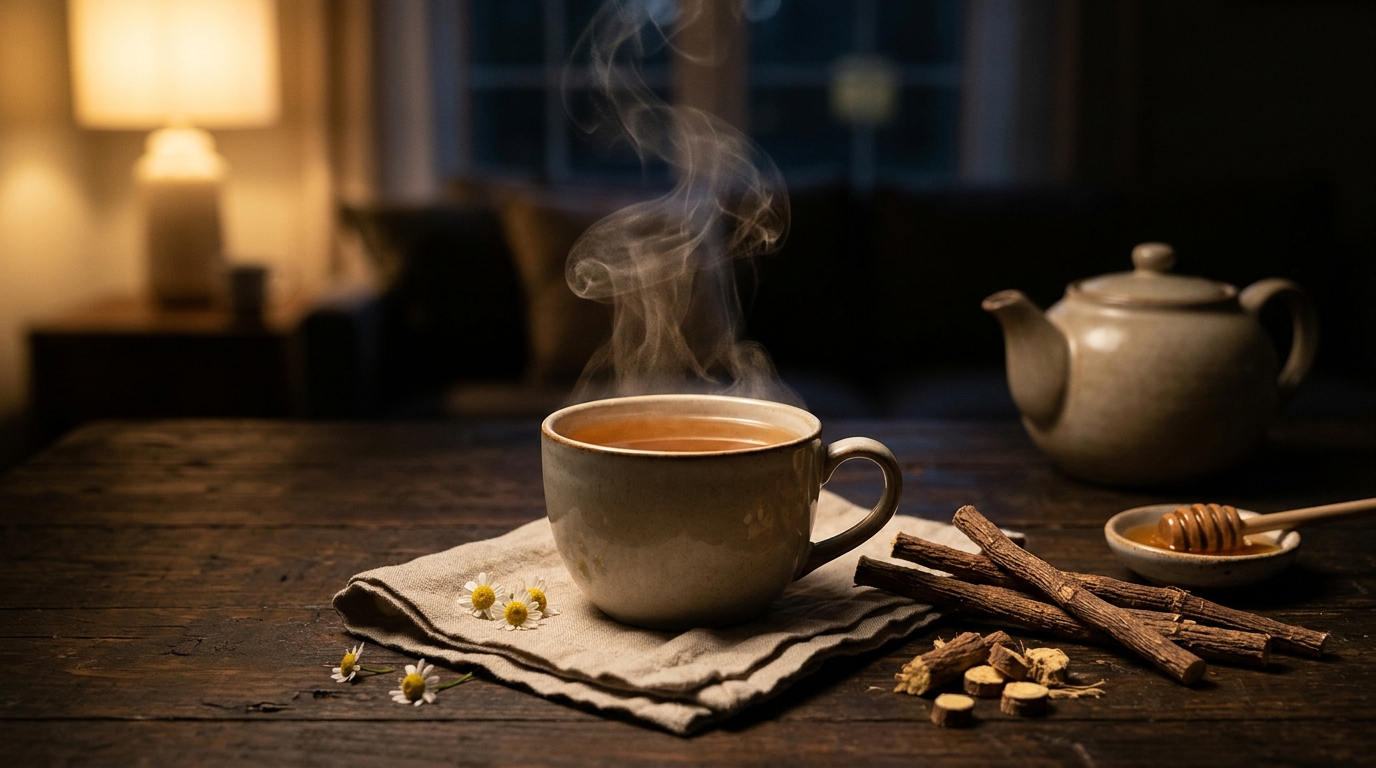
As a nightcap, licorice root is ideal. It is naturally caffeine-free, warming without being stimulating, and carries a deep, rounded sweetness with a hint of anise that feels like a hug in a mug. Many people reach for it at the first sign of a tickle in the throat, pairing it with a quiet evening routine to help the body settle before sleep. Because of its potency, licorice is best enjoyed in moderation, and the cautions below are worth reading before making it a daily habit.
2
cups
Ingredients
- 2 tspdried licorice root, cut and sifted
- 480 mlwater (95°C / 203°F)
- —a thin slice of fresh ginger (optional)
- —squeeze of fresh lemon (optional)
How to Brew
Click on an item below to shop for the recommended items for this recipe on Amazon.
As an Amazon Associate, we earn from qualifying purchases.
- Measure 2 teaspoons of cut and sifted dried licorice root into a teapot or large mug with a lid. Cut root works far better than fine powder, which can turn the tea cloudy and bitter.
- Bring fresh water to a full boil, then let it rest for about 30 seconds so it sits near 95°C (203°F).
- Pour the hot water over the root, cover immediately to trap the aromatic volatile compounds, and steep for 10 to 15 minutes. Longer steeping yields a sweeter, more demulcent cup.
- Strain through a fine mesh strainer into two cups. The tea should look deep golden and smell sweet and woody.
- Sip slowly while warm. If you like, add a thin slice of ginger during steeping or a small squeeze of lemon at the end for brightness.
- Add 2 tablespoons of cut licorice root to a clean glass jar. This is a slightly higher ratio than hot brew to compensate for the gentler extraction.
- Pour in 1 liter of cold, filtered water and stir once so all the root is submerged.
- Seal the jar and refrigerate for 8 to 12 hours, or overnight. Shake gently once or twice if you are nearby.
- Strain through a fine mesh strainer or a coffee filter to remove all root particles.
- Serve over ice or straight from the fridge. The result is mellow, naturally sweet, and noticeably less woody than the hot version. Keep refrigerated and drink within 3 days.
- Place 1 tablespoon of cut licorice root and 500 ml of cold water into a small saucepan. Starting with cold water helps draw out the root’s compounds gradually.
- Bring slowly to a gentle boil over medium heat, then immediately reduce to the lowest simmer.
- Cover the pan and simmer for 15 to 20 minutes. The liquid will reduce slightly and turn a rich, dark amber.
- Remove from the heat, keep covered, and let the decoction rest for 5 minutes so the flavors settle.
- Strain carefully into a mug. This tea is thicker and silkier than a standard infusion, with a pronounced sweetness. A little goes a long way, so a single small cup is plenty.
Health Benefits
The mucilage in licorice root coats the throat lining, easing the scratchy, raw feeling of colds and dry air. Studies of licorice-containing gargles and lozenges have found reduced post-operative sore throat, supporting its traditional use.
Glycyrrhizin and flavonoids like liquiritin appear to have antitussive and expectorant effects, helping loosen mucus and quiet a tickly cough. It has long been a staple in traditional cough remedies.
Licorice has traditionally been used for heartburn and stomach upset, and research on deglycyrrhizinated licorice (DGL) suggests it may help protect the stomach lining. Standard root tea still contains glycyrrhizin, so use is best kept occasional.
Flavonoids such as glabridin and isoliquiritigenin have demonstrated antioxidant and anti-inflammatory activity in laboratory research, which may contribute to licorice’s soothing reputation.
🧪 Key Bioactive Compounds
The Science Behind Licorice Root
The star compound in licorice root is glycyrrhizin, a triterpenoid saponin that makes up roughly 2 to 9 percent of the dried root. Beyond delivering that signature sweetness, glycyrrhizin has been studied for anti-inflammatory and antiviral activity. It is also the compound responsible for licorice’s main safety concern, since it inhibits an enzyme that normally breaks down cortisol in the kidneys, which can lead to fluid retention and elevated blood pressure with heavy or prolonged use.
The throat-soothing action people feel from a warm cup comes largely from licorice’s mucilaginous polysaccharides. When steeped in hot water, these long-chain sugars swell and form a slippery gel that coats the mucous membranes, reducing friction and shielding irritated tissue. This demulcent effect is mechanical as much as chemical, which is why even a plain warm cup feels comforting on a sore throat.
Licorice also contains a diverse group of flavonoids, including liquiritin, isoliquiritigenin, and glabridin, which show antioxidant and anti-inflammatory properties in laboratory and some clinical studies. Clinical evidence is strongest for licorice gargles and lozenges in reducing sore throat discomfort, and more research is needed on tea specifically. Used thoughtfully and in moderation, it remains one of the most beloved and time-tested herbs for the throat.
Brewing Tips
- Choose cut and sifted root rather than powder for a clearer, smoother, less bitter cup.
- Because licorice is so naturally sweet, skip the honey and sugar and let the root do the work.
- Blend with warming herbs like ginger, cinnamon, or fennel for a layered evening tea, but keep the licorice portion small.
- Store dried root in an airtight jar away from light and heat to preserve its aroma and potency.