For more than two thousand years, the root of Angelica sinensis has held a central place in Chinese herbal medicine. Known as dang gui, a name often translated as ‘state of return’ or ‘proper return,’ dong quai was traditionally prescribed to bring the body back into balance after childbirth, illness, or periods of depletion. Classical texts such as the Shennong Bencao Jing describe it as a blood-nourishing herb, and it appears in countless formulas, most famously Si Wu Tang (Four Substances Decoction), a staple of women’s health care across East Asia.
In the Traditional Chinese Medicine framework, dong quai is considered sweet, acrid, and warm. Practitioners reach for it when a woman presents with signs of ‘blood deficiency’ or ‘blood stagnation,’ such as irregular cycles, menstrual cramping, pale complexion, cold hands and feet, and fatigue. This is why dong quai earned its nickname as the ‘female ginseng,’ even though it is botanically unrelated to true ginseng. Where ginseng is stimulating, dong quai is grounding and nourishing, which makes it a natural fit for an evening ritual.
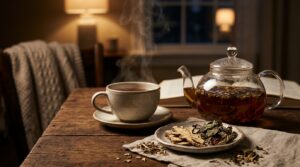
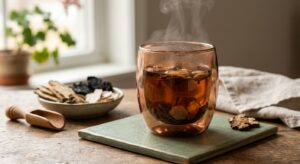
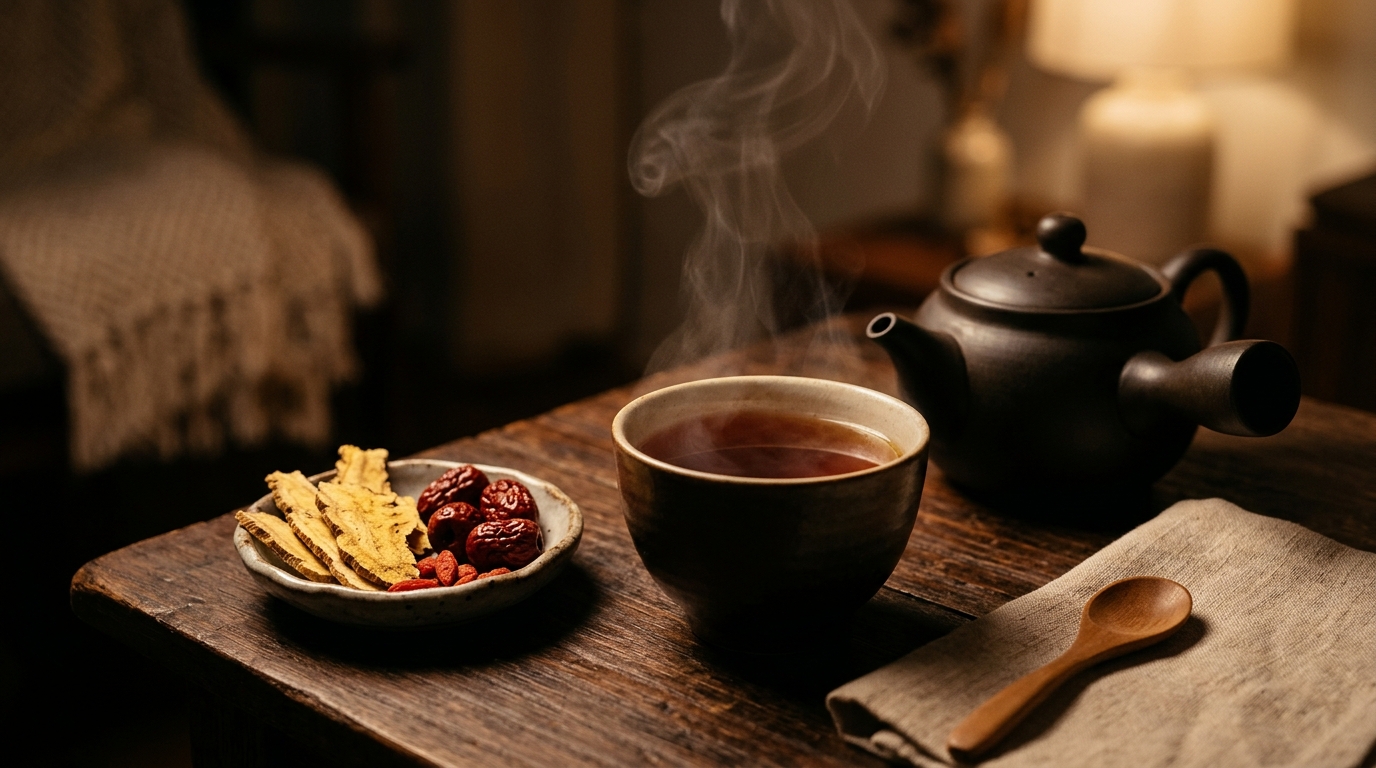
In the cup, dong quai is surprisingly lovely. The dried root slices release a warm, celery-like sweetness with herbal, almost curry-leaf undertones, and a gentle bitterness that rounds out on the finish. Brewed slowly in the quiet hours after dinner, it becomes less a beverage and more a small ceremony: a warm, fragrant pause that marks the end of the day.
2
cups
Ingredients
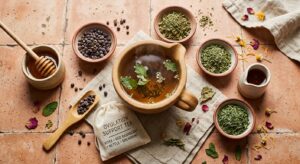
- 4 gdried dong quai root slices
- 500 mlwater (95°C / 203°F)
- 2 piecesdried jujube (red dates), pitted and halved
- 2 slicesfresh ginger
- —raw honey or rock sugar to taste (optional)
How to Brew
Click on an item below to shop for the recommended items for this recipe on Amazon.
As an Amazon Associate, we earn from qualifying purchases.
- Rinse the dried dong quai slices briefly under cool running water to remove any dust, then drain.
- Place the dong quai, halved jujubes, and ginger slices into a teapot or heatproof pot.
- Bring fresh water to a full boil, let it rest for about 30 seconds, then pour 500 ml over the herbs.
- Cover the pot to trap the volatile aromatics and steep for 10 to 15 minutes, until the liquid turns a deep golden amber.
- Strain into two mugs, pressing the jujube gently to release its sweetness.
- Sweeten with a little honey or rock sugar if desired, and sip slowly about an hour before bed.
- Rinse 6 g of dong quai slices under cool water and place them in a clean glass jar with 1 slice of ginger.
- Pour in 500 ml of cool filtered water, stir gently, and seal the jar with a lid.
- Refrigerate for 8 to 12 hours, ideally overnight, shaking the jar gently once or twice if you pass by.
- Strain through a fine mesh sieve into a clean glass or bottle, discarding the root slices.
- Serve over ice or at cool room temperature. Because this tea is traditionally considered warming, many people let it sit out for 15 minutes before drinking rather than serving it ice cold.
- Store any extra in the refrigerator and drink within 48 hours.
- Rinse 6 g of dong quai slices and place them in a small non-reactive pot (stainless steel, glass, or ceramic) with 2 jujubes and 2 slices of ginger.
- Add 600 ml of cool water and let the herbs soak for 15 to 20 minutes to soften the dense root.
- Bring the pot to a boil over medium-high heat, then immediately reduce to the lowest simmer.
- Cover with a lid slightly ajar and simmer gently for 20 to 30 minutes, until the liquid has reduced by roughly a third and turned a rich, dark amber.
- Strain through a fine sieve into a warmed mug, pressing the solids lightly.
- Sip warm. The leftover herbs can be simmered a second time with fresh water for a milder second cup.
Health Benefits
Traditionally used for cramping and irregular cycles, dong quai’s phthalides appear to relax uterine smooth muscle. Some small clinical studies and TCM trials show benefit, though high-quality Western evidence remains limited.
Compounds like ferulic acid and ligustilide promote vasodilation and healthy blood flow, which may explain the traditional use for cold extremities and ‘blood deficiency’ patterns.
While dong quai is not a sedative, its warming, nourishing character and the ritual of a slow evening brew help signal the body to unwind. Its mild antispasmodic effects may also reduce physical tension.
Ferulic acid and coumarins show antioxidant and anti-inflammatory activity in laboratory studies, contributing to dong quai’s reputation as a restorative herb.
Dong quai is widely used for hot flashes and menopausal discomfort in TCM, usually in combination formulas. Clinical evidence for dong quai alone is mixed, so it is best viewed as a gentle traditional support rather than a proven treatment.
🧪 Key Bioactive Compounds
The Science Behind Dong Quai
Dong quai’s reputation rests on a complex phytochemical profile. Its signature aroma and many of its pharmacological effects come from phthalides, especially Z-ligustilide and butylidenephthalide. In laboratory and animal studies, these compounds relax smooth muscle, including uterine tissue, and promote vasodilation. This offers a plausible explanation for the herb’s traditional use in easing menstrual cramps and improving circulation.
Ferulic acid, another key constituent, is a well-studied antioxidant that scavenges free radicals and may protect blood vessels from oxidative damage. Meanwhile, the polysaccharide fraction of Angelica sinensis has been shown in preclinical research to support immune function and stimulate the production of blood cells, which resonates with the TCM concept of ‘nourishing the blood.’ Coumarins, including osthole, add anti-inflammatory activity but also account for the herb’s cautions around anticoagulants and photosensitivity.
It is worth being honest about the state of the evidence. Much of the supporting research is preclinical or based on traditional-use formulas rather than dong quai alone, and rigorous human trials for menopause and menstrual conditions have produced mixed results. A cup of dong quai tea is best understood as a gentle, time-honored wellness practice rather than a clinical treatment, and it works best as part of a broader approach to rest, nutrition, and self-care.
Brewing Tips
- Choose whole, sliced dong quai root with a pale yellow-brown color and a strong, sweet aroma. Dull, grey, or musty-smelling slices are past their prime.
- Brew in the early evening, about an hour or two before bed, so the ritual itself becomes part of your wind-down routine.
- Reuse the same root slices for a second, milder infusion. Dong quai is dense enough to give two good steeps.
- Store dried dong quai in an airtight, opaque container away from heat and light to protect its volatile aromatic oils.
- Start with a weaker cup (about 3 g) to see how your body responds before moving to a stronger brew or decoction.