
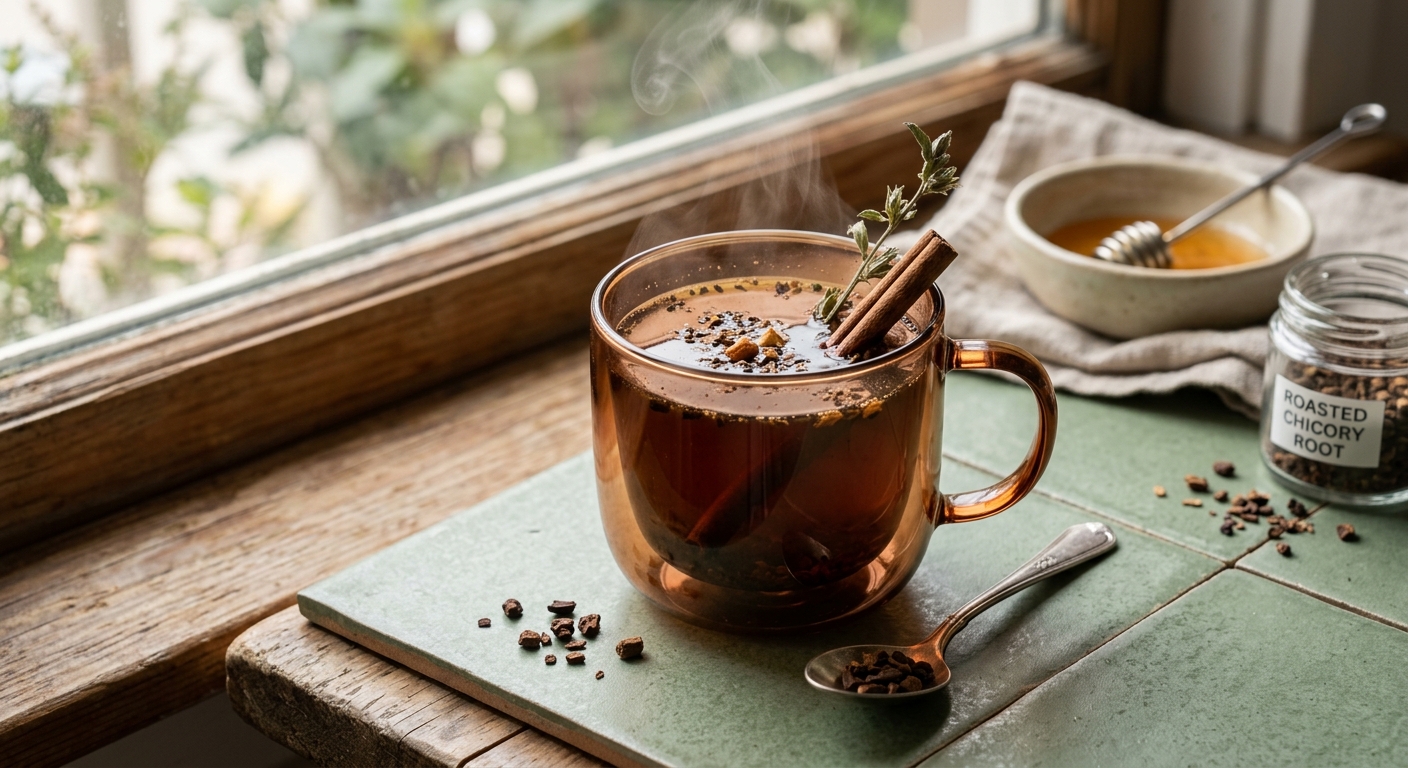
Long before coffee conquered the morning routine, chicory root was roasting in European hearths and brewing in clay pots across the ancient Mediterranean. Cichorium intybus, the humble blue-flowered plant that lines roadsides and country fields, has served as a digestive aid and liver tonic for at least two thousand years. Ancient Egyptian papyri reference chicory as a medicinal plant, and Roman naturalist Pliny the Elder praised it for its ability to cleanse the blood and settle the stomach. During the Napoleonic era, when trade blockades cut off coffee imports to continental Europe, roasted chicory root became the go-to substitute, a tradition that endures most famously in the cafe au lait culture of New Orleans to this day.
What makes chicory root tea genuinely remarkable is not just its bold, roasted flavor but its extraordinary fiber content. The root is one of the richest natural sources of inulin, a soluble prebiotic fiber that feeds Lactobacillus and Bifidobacterium species in the colon. Unlike most herbal teas that deliver volatile oils or polyphenols, chicory delivers a structural benefit: it literally changes the microbial landscape of your gut with every cup. Traditional herbalists across Europe and the Middle East prescribed chicory root decoctions for sluggish digestion, liver congestion, and as a gentle bitter tonic to stimulate bile flow before meals.
Brewed as a tea or decoction, chicory root produces a deep amber to mahogany liquor with a flavor profile that surprises most first-time drinkers. It is roasty, slightly bitter, and earthy, with a subtle nuttiness and a smooth, almost syrupy body that coffee drinkers find instantly comforting. It pairs beautifully with warming spices like cinnamon and cardamom, and it accepts a splash of plant-based milk with remarkable grace. Whether you are looking to support your gut microbiome, reduce your caffeine intake, or simply explore one of humanity’s oldest botanical traditions, chicory root tea is a deeply satisfying place to begin.
2
cups
Ingredients
- 2 tbsproasted chicory root pieces or granules
- 500 mlwater (for hot brew)
- —cinnamon stick (optional)
- —raw honey or maple syrup to taste (optional)
- —milk or plant-based milk to taste (optional)
How to Brew
Click on an item below to shop for the recommended items for this recipe on Amazon.
As an Amazon Associate, we earn from qualifying purchases.
- Add 2 tablespoons of roasted chicory root pieces or granules to a small saucepan along with 500 ml of cold, filtered water. If using a cinnamon stick for added warmth and sweetness, add it now.
- Place the saucepan over medium-high heat and bring the water to a full boil, stirring once. Watch the liquid darken to a deep amber almost immediately as the roasted compounds are released.
- Reduce the heat to low and allow the chicory to simmer gently for 10 to 15 minutes. A longer simmer (closer to 15 minutes) produces a stronger, more bitter brew; 10 minutes gives a milder, roastier cup. Do not cover the pot, as this concentrates bitterness quickly.
- Remove from heat and allow the decoction to rest for 2 minutes, then strain through a fine mesh strainer or cheesecloth into mugs, pressing the root pieces gently to extract remaining liquid.
- Add honey or maple syrup to taste and a splash of milk or oat milk if desired. Serve immediately while hot.
- Combine 3 tablespoons of roasted chicory root granules or finely chopped root pieces with 600 ml of cold, filtered water in a glass jar or pitcher. The slightly higher root-to-water ratio compensates for cold water’s lower extraction efficiency.
- Stir well to ensure all root particles are fully submerged and not clumped together. Place a loose lid or a clean cloth secured with a rubber band over the jar to prevent the brew from absorbing refrigerator odors.
- Leave the jar at room temperature for the first 30 minutes to allow the chicory to begin hydrating, then transfer to the refrigerator and allow it to cold brew for 12 to 14 hours, or overnight. Avoid steeping longer than 16 hours, as very prolonged cold extraction can develop off-flavors.
- Strain the cold brew through a fine mesh strainer lined with cheesecloth or a coffee filter into a clean jar or pitcher, pressing gently. The resulting liquid should be a smooth, deep mahogany with low bitterness.
- Serve over ice in tall glasses. Add cold oat milk or coconut milk for a creamy chicory latte experience, or sweeten lightly with a simple syrup made from honey dissolved in warm water.
- Add 4 tablespoons of roasted chicory root to a small saucepan with 400 ml of cold, filtered water. Optionally add 2 cardamom pods, lightly cracked, and half a cinnamon stick for a spiced concentrate.
- Bring to a full boil over medium-high heat, then immediately reduce to a low simmer. Allow the liquid to reduce slowly over 25 to 30 minutes, stirring occasionally. The concentrate is ready when the volume has reduced by roughly one-third and the liquid is very dark, syrupy in texture, and intensely aromatic.
- Remove from heat and allow the concentrate to cool for 5 minutes before straining through a fine mesh strainer lined with a coffee filter into a clean glass bottle or jar with a tight lid. Press the root pieces firmly to extract every drop of liquid.
- Label the jar with the date and store in the refrigerator for up to 7 days. To serve hot, dilute 60 to 80 ml of concentrate with 180 to 200 ml of hot water or steamed milk in a mug. To serve iced, dilute 60 ml of concentrate with 200 ml of cold milk or water over a glass packed with ice.
Health Benefits
Chicory root contains the highest natural concentration of inulin of any widely consumed plant, with dried root containing up to 48% inulin by weight. Clinical trials have consistently shown that regular inulin intake significantly increases populations of beneficial Bifidobacterium and Lactobacillus in the colon while simultaneously reducing pathogenic bacteria, improving overall gut microbial diversity.
The bitter compounds in chicory root, particularly lactucopicrin, activate bitter taste receptors that trigger a cascade of digestive responses including increased saliva production, gastric acid secretion, and bile release from the gallbladder. This bitter tonic action, well recognized in European herbal medicine and validated by modern pharmacology, primes the digestive system to process fats and proteins more efficiently.
Multiple randomized controlled trials have demonstrated that inulin from chicory root significantly increases stool frequency and softness compared to placebo in adults with functional constipation. The prebiotic fiber draws water into the colon and bulks stool while fermentation by gut bacteria produces gases and short-chain fatty acids that stimulate intestinal motility.
Traditional herbalists across European, Ayurvedic, and Arabic traditions classified chicory as a primary liver herb. Modern research supports this reputation: animal studies show that chicory extracts reduce oxidative stress markers in liver tissue, decrease liver enzyme elevations associated with inflammation, and protect against chemically induced liver damage, effects attributed primarily to the coumarin compounds esculetin and scopoletin.
Inulin is a non-digestible fiber that slows carbohydrate absorption in the small intestine, blunting post-meal blood glucose spikes. Additionally, chicoric acid has shown insulin-sensitizing effects in cell-based studies. A 2015 clinical study published in the journal Diabetes and Metabolism found that chicory root extract supplementation improved fasting blood sugar and delayed the progression of pre-diabetes in adults over a 12-week period.
🧪 Key Bioactive Compounds
The Science Behind Chicory Root
The digestive benefits of chicory root are anchored in one of the most extensively researched prebiotic compounds in nutritional science: inulin. Inulin is a type of fructooligosaccharide, a long-chain carbohydrate composed of fructose units linked in a way that human digestive enzymes cannot break apart. It therefore passes intact through the stomach and small intestine and arrives in the colon, where it acts as a selective food source for beneficial bacteria. A 2017 meta-analysis published in the British Journal of Nutrition analyzing 26 clinical trials confirmed that chicory-derived inulin consistently and significantly increases Bifidobacterium populations in the gut, with measurable changes observed after just two weeks of regular intake. These bacteria ferment inulin into short-chain fatty acids, principally butyrate, propionate, and acetate, compounds that nourish colon cells, regulate intestinal immune responses, and help maintain the integrity of the gut lining.
Beyond inulin, chicory root’s bitter sesquiterpene lactones, particularly lactucopicrin and its metabolite lactucin, play a distinct and important pharmacological role. These compounds are potent agonists of the TAS2R family of bitter taste receptors, which are expressed not only on the tongue but throughout the gastrointestinal tract and even in liver and gallbladder tissue. Activation of these receptors triggers a reflex release of gastrin and cholecystokinin, hormones that stimulate gastric acid secretion and gallbladder contraction respectively. This explains the traditional use of chicory as a bitter digestive tonic: it chemically primes the digestive system in ways that measurably improve fat digestion and reduce symptoms of functional dyspepsia such as bloating and post-meal heaviness.
The polyphenol chicoric acid and the coumarins esculetin and scopoletin contribute the plant’s antioxidant and hepatoprotective properties. Chicoric acid has been shown in cell culture studies to inhibit key inflammatory signaling pathways, including NF-kB activation, and to improve insulin receptor sensitivity. Esculetin and scopoletin, meanwhile, demonstrate hepatoprotective activity in animal models by reducing lipid peroxidation in liver tissue and modulating the activity of liver detoxification enzymes. While large-scale human clinical trials specifically on chicory tea are still limited compared to isolated inulin supplementation studies, the phytochemical breadth of the whole root preparation suggests it delivers a synergistic combination of prebiotic, bitter tonic, antioxidant, and liver-supportive effects that no single compound can replicate alone.
Brewing Tips
- Start with one tablespoon of chicory root per cup rather than two if you are new to inulin-rich foods, as jumping in with a full serving can cause noticeable gas and bloating while your gut bacteria adjust over one to two weeks.
- For the most pronounced digestive benefit, drink your hot chicory decoction about 15 to 20 minutes before a meal as a traditional bitter aperitif, rather than during or after, so the bitter compounds have time to stimulate bile and digestive enzyme production before food arrives.
- Store roasted chicory root in an airtight glass jar away from light and heat; the volatile aromatic compounds responsible for its rich, coffee-like aroma degrade quickly once the package is opened, so a fresh-smelling root will always brew a more flavorful and aromatic cup than one that has been sitting open for weeks.