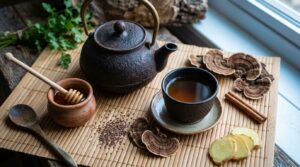
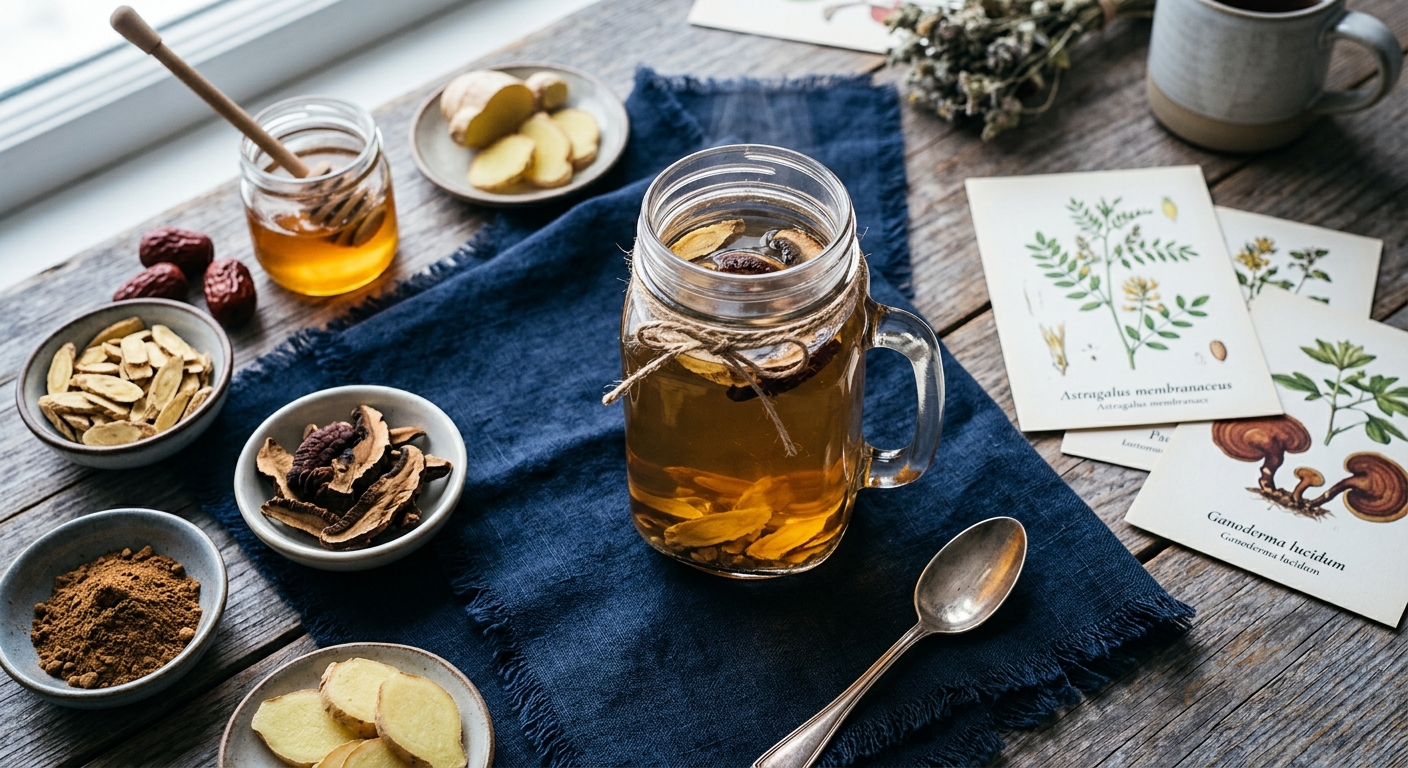
Few herbal pairings carry the weight of history and clinical interest that astragalus root and reishi mushroom share. Astragalus membranaceus, known in Chinese medicine as Huang Qi or “yellow leader,” has been a cornerstone of immune-supporting tonics for over 2,000 years. Revered as one of the superior herbs in the classical text Shennong Bencao Jing, it was prescribed to tonify the Wei Qi, the protective energy believed to shield the body from external pathogens. Reishi mushroom (Ganoderma lucidum), called Ling Zhi or “mushroom of immortality,” was so prized in ancient China that it was reserved for emperors and was thought to promote longevity, vitality, and spiritual calm alongside robust physical health.
Together, these two botanicals create a tea that is far greater than the sum of its parts. Astragalus contributes polysaccharides and saponins that prime the immune system and support energy metabolism, while reishi brings a complex array of triterpenes and beta-glucans that modulate immune response, reduce inflammation, and calm the nervous system. The result is a tea that works on two complementary levels: actively preparing the body to fight off illness and quietly reducing the physiological stress that leaves us vulnerable in the first place. This makes the blend particularly valuable during the colder months, periods of high stress, or any time the immune system needs a steady, long-term boost rather than a quick intervention.
The sensory experience of this tea is one of grounded warmth. Astragalus root lends a mild sweetness reminiscent of fresh hay and legumes, while reishi adds a deep, woody earthiness with a characteristic pleasant bitterness on the finish. The brew is a rich amber-brown, almost broth-like in its depth, and pairs beautifully with a small drizzle of raw honey or a thin slice of fresh ginger. Whether you are sipping it as a morning ritual to start the day with immune support or as an evening tonic to restore and replenish, this blend invites slow, intentional drinking.
2
cups
Ingredients
- 2 tspdried astragalus root slices
- 2 tspdried reishi mushroom slices or powder
- 500 mlwater (95 to 100°C / 203 to 212°F)
- —raw honey or jujube dates to taste (optional)
- —fresh ginger slice (optional)
How to Brew
Click on an item below to shop for the recommended items for this recipe on Amazon.
As an Amazon Associate, we earn from qualifying purchases.
- Add 500 ml of cold, filtered water to a small saucepan along with 2 teaspoons of dried astragalus root slices and 2 teaspoons of dried reishi mushroom slices or powder. If using a fresh ginger slice for warmth, add it now.
- Bring the water to a gentle boil over medium heat, then reduce the heat to a low simmer. The water should maintain a steady, light bubble without a rolling boil.
- Simmer uncovered for 20 to 30 minutes, allowing the liquid to reduce slightly and deepen in color to a rich amber-brown. The longer you simmer (up to 45 minutes for very dense root slices), the more concentrated and medicinally active the brew becomes.
- Remove from heat and allow the decoction to rest for 2 to 3 minutes. Pour through a fine mesh strainer into two warmed mugs, pressing the solids gently with the back of a spoon to extract the last of the liquid.
- Sweeten with raw honey or add two pitted jujube dates during simmering for a natural sweetness that also complements the immune-supporting blend. Serve immediately and sip slowly.
- Add 3 teaspoons of dried astragalus root slices and 3 teaspoons of dried reishi mushroom slices or powder to a large glass jar. Slightly increase the herb ratio compared to hot brew to compensate for the lower extraction efficiency of cold water.
- Pour 600 ml of cold, filtered water over the herbs, ensuring all plant material is fully submerged. Stir gently with a long spoon to distribute the herbs evenly.
- Cover the jar loosely with a lid or cloth and allow it to sit at room temperature for 2 hours to begin extraction. Then move the jar to the refrigerator and continue steeping for a further 10 to 14 hours, or overnight.
- When the steep is complete, strain the cold brew through a fine mesh strainer lined with cheesecloth into a clean pitcher or jar. The cheesecloth captures fine reishi powder particles that would otherwise cloud the drink.
- Pour over ice into tall glasses and serve chilled. Add a squeeze of fresh lemon juice or a few drops of raw honey stirred directly into the cold liquid. The cold brew keeps refrigerated for up to 48 hours.
- Combine 4 tablespoons of dried astragalus root slices and 4 tablespoons of dried reishi mushroom slices with 1 liter of cold, filtered water in a medium saucepan. Optionally add 4 pitted jujube dates and 2 to 3 slices of fresh ginger for additional depth and natural sweetness.
- Bring to a gentle boil over medium heat, then reduce to a low simmer. Simmer uncovered for 45 to 60 minutes, stirring occasionally, until the liquid has reduced to roughly 300 to 350 ml. The concentrate should be a deep, dark amber color with a rich, almost broth-like consistency.
- Remove from heat and allow the concentrate to cool for 10 minutes. Strain through a fine mesh strainer lined with cheesecloth into a clean glass jar, pressing the solids firmly to extract all remaining liquid.
- Allow the concentrate to cool completely before sealing the jar. Store in the refrigerator for up to 5 days. Label the jar with the date of preparation.
- To serve, dilute 2 to 3 tablespoons of concentrate into 200 ml of hot water or warm oat milk, adjusting to taste. Stir well, sweeten with honey if desired, and consume once daily as an ongoing immune tonic.
Health Benefits
Astragalus polysaccharides and reishi beta-glucans work synergistically to prime innate immune defenses while preventing the overactivation that leads to chronic inflammation. Multiple clinical trials have demonstrated that regular astragalus supplementation increases the count and activity of T-lymphocytes and natural killer cells.
Several randomized controlled trials have found that astragalus root extract significantly reduces the incidence of upper respiratory tract infections when taken as a long-term preventive tonic rather than an acute treatment. The antiviral properties of astragalosides further support the body’s ability to resist common respiratory pathogens.
Both herbs are classified as adaptogens, meaning they help normalize the body’s stress response over time. Reishi in particular has been shown in clinical studies to reduce fatigue and anxiety scores, partly by modulating cortisol rhythms and supporting healthy sleep architecture, which in turn preserves immune resilience.
Ganoderic acids in reishi and flavonoids in astragalus contribute to robust antioxidant activity, neutralizing free radicals that contribute to oxidative stress and cellular damage. This antioxidant action supports both cardiovascular health and a healthy inflammatory baseline.
Traditional Chinese Medicine prescribes astragalus specifically for deficiency fatigue, and modern research supports its role in improving mitochondrial efficiency and ATP production in immune cells. Regular consumption of this blend is associated with sustained energy levels without the stimulant effect of caffeine.
🧪 Key Bioactive Compounds
The Science Behind Astragalus And Reishi
The immune-supporting power of this blend is rooted in two distinct but complementary mechanisms. Astragalus polysaccharides (APS) are among the most extensively studied plant-derived immunomodulators in modern research. They work by binding to pattern recognition receptors on macrophages and dendritic cells, triggering the upregulation of cytokines such as interleukin-2 (IL-2) and interferon-gamma (IFN-γ). These signaling molecules recruit and activate T-lymphocytes and natural killer cells, enhancing the body’s ability to identify and destroy both infected cells and early-stage abnormal cells. Importantly, astragalus does not simply stimulate immune activity indiscriminately; it helps normalize and balance immune responses, which is why it is categorized as an immunomodulator rather than a pure stimulant.
Reishi mushroom’s primary active compounds, the beta-glucans and ganoderic acids, operate through overlapping but distinct pathways. Reishi beta-glucans are recognized by Dectin-1 receptors on immune cells, initiating a signaling cascade that enhances phagocytosis and promotes the maturation of dendritic cells, the immune system’s most powerful antigen-presenting cells. The ganoderic acids, a family of over 100 lanostane-type triterpenes, have demonstrated inhibitory effects on inflammatory enzymes including cyclooxygenase and 5-lipoxygenase in preclinical studies. They also suppress the NF-κB inflammatory pathway, which is implicated in chronic low-grade inflammation associated with metabolic disease, fatigue, and immune dysregulation. Together, these compounds help the immune system remain alert without becoming hyperreactive.
The adaptogenic dimension of this blend adds a critical third layer of protection. Chronic psychological or physiological stress suppresses immune function through the sustained release of cortisol, which directly inhibits lymphocyte proliferation and natural killer cell activity. Both astragalus and reishi have demonstrated hypothalamic-pituitary-adrenal (HPA) axis modulating properties in animal and human studies, helping normalize cortisol rhythms and reduce allostatic load. A 2012 randomized controlled trial published in the Journal of Ethnopharmacology found that reishi extract significantly reduced fatigue and improved immune markers in breast cancer survivors, highlighting its potential to restore immune competence even under significant physiological stress. This dual action, supporting immune cell activity while simultaneously reducing the hormonal suppression of immunity, is what makes the astragalus and reishi combination so compelling as a long-term wellness practice.
Brewing Tips
- Always buy whole dried astragalus root slices rather than pre-ground powder for the hot brew and concentrate methods. The slices are easier to strain and less likely to produce a gritty sediment, and their texture gives you a visual cue for freshness.
- Reishi mushroom has a naturally strong, bitter edge that intensifies the longer it simmers. If you find the flavor too intense, reduce the reishi quantity slightly and increase astragalus, or add a larger piece of fresh ginger and one or two jujube dates to naturally balance the bitterness.
- This tea is a long-term tonic, not a quick fix. Traditional Chinese Medicine practitioners recommend taking astragalus-based formulas in courses of 6 to 8 weeks, especially in autumn and winter, to gradually strengthen Wei Qi. Consistency over weeks is more beneficial than occasional high-dose brewing.