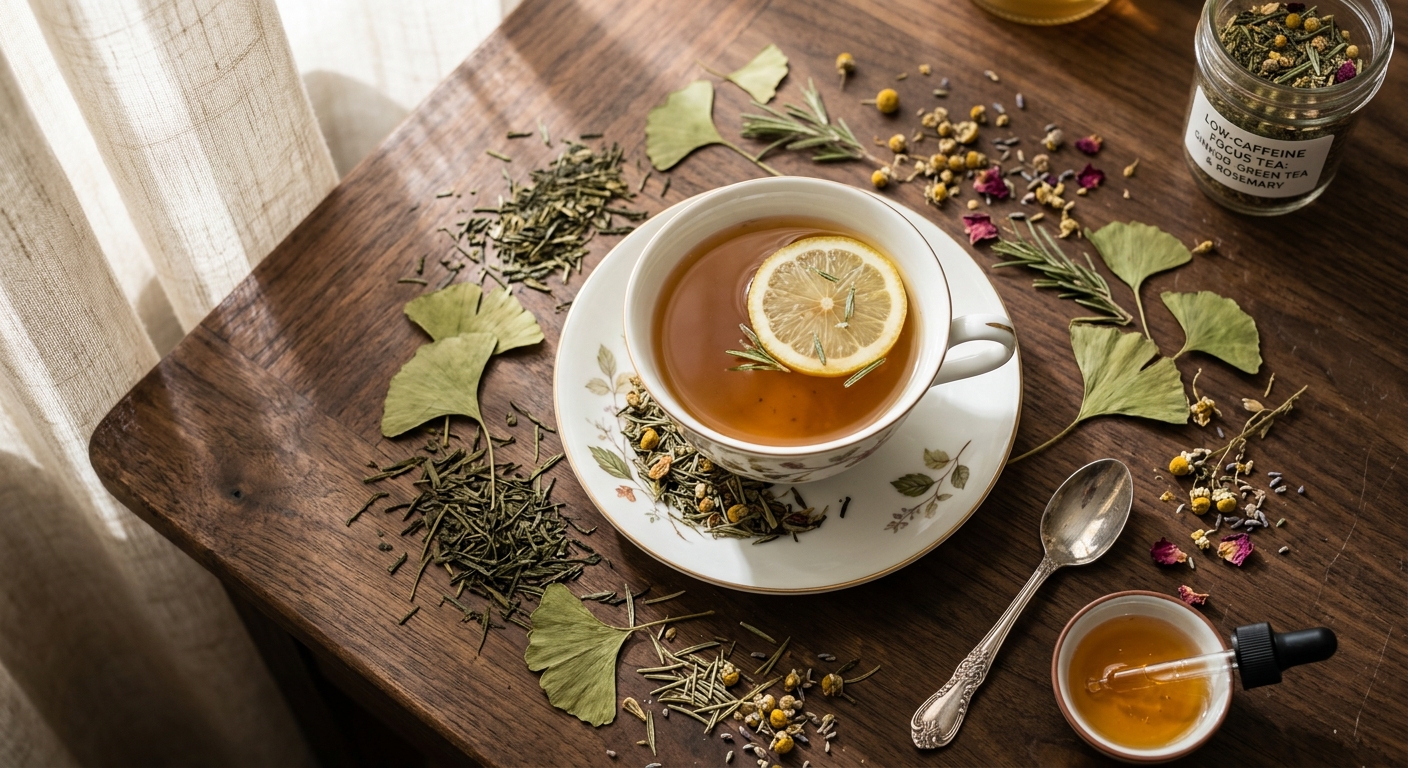
Long before nootropic supplements lined pharmacy shelves, herbalists and healers around the world were brewing plants for mental clarity. Ginkgo biloba, one of the oldest living tree species on Earth, has been used in Traditional Chinese Medicine for over 5,000 years to support memory and cognitive circulation. Rosemary, revered by ancient Greek scholars who wore garlands of it during examinations, was historically linked to remembrance and mental acuity. Green tea, the backbone of this blend, has been sipped by monks and scholars across East Asia for centuries as a tool for alert, meditative focus. Together, these three botanicals form a synergistic trio that has deep roots in plant medicine traditions across multiple continents.
What sets this blend apart from a standard cup of green tea is the intentional layering of complementary mechanisms. Green tea contributes a modest dose of caffeine alongside L-theanine, an amino acid that smooths out caffeine’s stimulating edge into something more focused and composed. Ginkgo biloba brings improved cerebral blood flow to the equation, helping oxygen and glucose reach the brain more efficiently. Rosemary, aromatic and resinous, adds a sharp sensory dimension and delivers its own suite of cognitive-supporting compounds. The result is a tea that feels genuinely clear-headed rather than artificially wired.
This is the ideal brew for long work sessions, creative projects, exam preparation, or any afternoon where you need your mind sharp but your nervous system calm. It brews beautifully both hot and cold, adapts well to concentrate preparation, and carries a flavor profile that is grassy, piney, and pleasantly herbaceous with a clean, bright finish. Whether you are new to herbal focus blends or a seasoned tea drinker looking for a smarter alternative to coffee, this low-caffeine focus tea deserves a place in your daily ritual.
2
cups
Ingredients
- 2 tsploose-leaf green tea (sencha or dragonwell)
- 1 tspdried ginkgo biloba leaves
- 1 tspfresh or dried rosemary leaves
- 480 mlwater (80°C / 176°F)
- —raw honey or light agave to taste (optional)
- —thin lemon slice for garnish (optional)
How to Brew
Click on an item below to shop for the recommended items for this recipe on Amazon.
As an Amazon Associate, we earn from qualifying purchases.
- Heat filtered water to 78 to 82°C (172 to 180°F). If you do not have a temperature-controlled kettle, bring water to a full boil and allow it to rest for 3 to 4 minutes before pouring.
- Add the green tea, dried ginkgo biloba leaves, and rosemary into a tea infuser or strainer basket. Use fresh rosemary if available, lightly bruising the sprig between your fingers to release its aromatic oils before adding it.
- Place the infuser in your mug or teapot and pour the measured hot water slowly over the herbs, ensuring all plant material is fully submerged.
- Steep for exactly 3 to 4 minutes. Do not over-steep: green tea becomes bitter quickly, and rosemary can overwhelm the blend if left too long. Set a timer.
- Remove the infuser promptly. If desired, stir in a small amount of raw honey or light agave. Garnish with a thin lemon slice and sip slowly while the tea is warm.
- Measure double the standard herb quantities into a clean glass jar: 4 tsp green tea, 2 tsp dried ginkgo biloba leaves, and 2 tsp rosemary. Cold brew dilutes flavor, so the higher ratio compensates without adding bitterness.
- Pour 480 ml of cold, filtered water (room temperature is fine) directly over the herbs in the jar. Do not use hot water at any stage, as this method relies entirely on cold extraction.
- Gently stir to ensure all herbs are saturated, then seal the jar with a lid. Allow it to sit at room temperature for 30 minutes, then transfer to the refrigerator.
- Let the blend steep undisturbed in the refrigerator for 8 to 10 hours, ideally overnight. The slow, cold extraction draws out smooth, layered flavors and preserves heat-sensitive catechins in the green tea.
- Strain the liquid through a fine-mesh strainer or cheesecloth into a clean glass, pressing gently on the herbs to extract all liquid. Serve over ice with a sprig of fresh rosemary as garnish and a squeeze of lemon if desired.
- Use triple the standard herb quantities for a concentrate: 6 tsp green tea, 3 tsp dried ginkgo biloba leaves, and 3 tsp rosemary. This will yield roughly 480 ml of concentrate from 480 ml of water.
- Heat filtered water to 78 to 82°C (172 to 180°F) and add all herbs to a fine-mesh strainer or a large infuser set inside a heatproof jug or teapot.
- Pour the hot water over the herbs and steep for 5 to 6 minutes. The concentrate can handle slightly longer steeping than a standard cup since it will be diluted before drinking, but avoid going beyond 7 minutes to prevent excessive bitterness.
- Remove the infuser and allow the concentrate to cool to room temperature. Pour into a sealed glass jar and refrigerate. It will keep well for up to 3 days.
- When ready to drink, combine equal parts concentrate and cold water (or an unsweetened oat or almond milk alternative for a creamier texture) in a glass over ice. Stir well, add honey if desired, and serve immediately.
Health Benefits
The combination of L-theanine and caffeine from green tea has been demonstrated in multiple randomized controlled trials to improve sustained attention, working memory, and task-switching speed compared to caffeine alone. Ginkgo biloba adds further benefit by improving cerebrovascular circulation.
Ginkgolides in ginkgo biloba have been shown in clinical studies to improve peripheral and cerebral microcirculation by inhibiting platelet aggregation and reducing blood viscosity, helping the brain receive more consistent oxygen and nutrient delivery.
Rosmarinic acid and 1,8-cineole from rosemary have been shown in human trials to reduce perceived mental fatigue and improve speed of mental processing, making this blend well suited to long work or study sessions.
EGCG from green tea and bilobalide from ginkgo both exert significant antioxidant and anti-inflammatory effects in neural tissue, protecting neurons from reactive oxygen species that contribute to cognitive decline over time.
Because this blend uses a relatively low-caffeine green tea base and pairs it with L-theanine, it produces a state of alert relaxation rather than overstimulation. Studies consistently show the L-theanine and caffeine combination produces fewer side effects than caffeine alone, including less anxiety, fewer heart palpitations, and no post-stimulant crash.
🧪 Key Bioactive Compounds
The Science Behind Ginkgo Biloba
The cognitive effects of this blend are grounded in three distinct but complementary mechanisms. In green tea, L-theanine and caffeine interact synergistically at the neurological level. Caffeine blocks adenosine receptors, reducing the perception of fatigue and increasing dopamine and norepinephrine activity. L-theanine, meanwhile, elevates alpha brain wave production, a state associated with relaxed alertness that is measurably similar to the mental state achieved during meditation. Multiple double-blind crossover trials published in journals including Nutritional Neuroscience and Biological Psychology have confirmed that this combination produces measurably better performance on attention tasks and reduced subjective anxiety compared to caffeine alone.
Ginkgo biloba’s primary mechanism involves its terpenoid lactones, specifically ginkgolides A and B and bilobalide. Ginkgolides are potent inhibitors of platelet-activating factor (PAF), a phospholipid mediator involved in platelet aggregation and inflammatory signaling. By inhibiting PAF, ginkgo improves the fluidity of blood in cerebral capillaries, increasing the delivery of oxygen and glucose to neurons. Bilobalide, a compound unique to ginkgo with no structural analog elsewhere in the plant kingdom, protects mitochondria in neurons from oxidative stress and has been shown in animal models to reduce glutamate-induced excitotoxicity. A 2016 meta-analysis in Journal of Psychiatric Research found that standardized ginkgo extract produced statistically significant improvements in cognitive function in both healthy adults and those experiencing age-related cognitive decline.
Rosemary contributes through two separate pathways. Rosmarinic acid acts as a reversible inhibitor of acetylcholinesterase, the enzyme responsible for breaking down acetylcholine in synaptic junctions. By slowing this degradation, more acetylcholine remains available for transmission, enhancing the cholinergic signaling pathways critical to attention, memory consolidation, and learning. Separately, the volatile compound 1,8-cineole is fat-soluble and small enough to cross the blood-brain barrier directly when inhaled or absorbed through the gut. A landmark study by Moss and Oliver (2012) found a statistically significant correlation between 1,8-cineole plasma levels and performance on speed and accuracy tasks in human subjects, making it one of the few herbal aromatic compounds with direct measured cognitive impact in living humans.
Brewing Tips
- Always use filtered or spring water when brewing this blend. Chlorine and heavy minerals in tap water interact poorly with the delicate catechins in green tea, producing a flat, slightly metallic flavor.
- Lightly bruise fresh rosemary between your palms before adding it to the infuser. This ruptures the oil glands in the leaves and releases significantly more 1,8-cineole and rosmarinic acid into your brew.
- For the best cold brew results, use a glass jar rather than plastic. Rosemary’s essential oils can absorb into plastic containers during long cold steeps, both weakening the tea’s flavor and potentially leaching trace compounds from the container into the brew.