Long before modern pharmacology gave us names like ‘curcumin’ and ‘gingerol,’ healers across South Asia, the Middle East, and East Africa were reaching for ginger and turmeric whenever illness crept into the household. In Ayurvedic tradition, turmeric is known as haridra, a sacred herb used in everything from wound poultices to ceremonial drinks, while ginger, or shunthi in its dried form, has been prescribed in classical texts like the Charaka Samhita as a digestive tonic and warming agent for over 2,500 years. Their pairing is no accident: these roots complement each other both medicinally and culinarily, and together they form one of the most enduring combinations in plant medicine history.
What makes this blend so compelling in the modern era is that traditional wisdom has been met with serious scientific scrutiny. Turmeric’s curcumin and ginger’s gingerols have each accumulated substantial bodies of research examining their effects on inflammation, immune modulation, and oxidative stress. The result is a tea that occupies a rare space: genuinely ancient in origin, yet increasingly validated by contemporary research. Adding a pinch of black pepper to the blend, a trick long used in Ayurvedic formulas, dramatically increases curcumin’s bioavailability through the action of piperine, making every sip more effective.
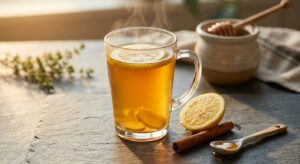
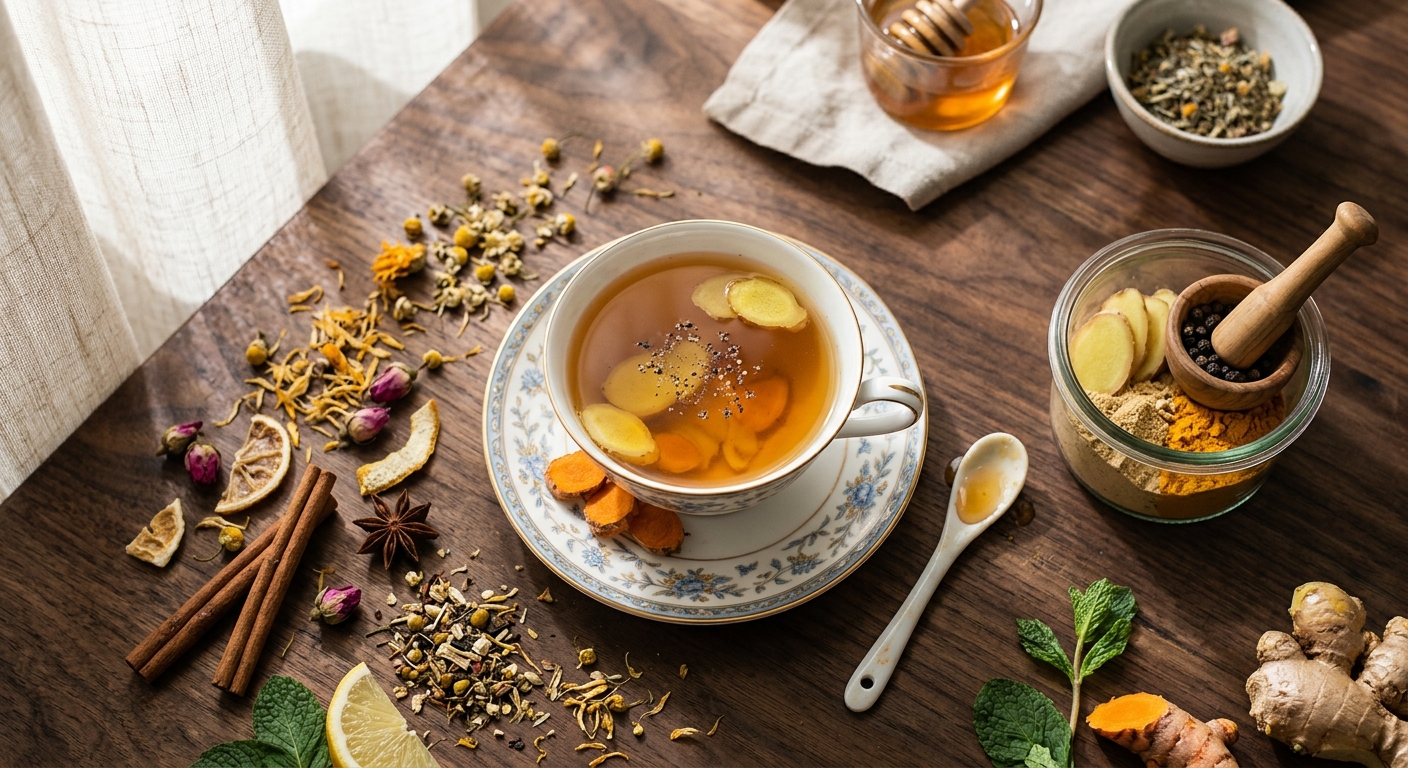
Sensory experience matters too, and this tea delivers on every front. The brew pours a deep, glowing amber-gold that almost seems to radiate warmth before the mug even reaches your lips. The aroma is assertive and complex, with ginger’s sharp citrus-spice rising first, followed by turmeric’s softer, mustard-like earthiness. On the palate, the heat builds gradually, and a well-chosen sweetener like raw honey or a squeeze of lemon transforms this functional blend into something genuinely pleasurable. Whether you are drinking it to support your immune system through a long winter, soothe post-exercise inflammation, or simply warm up on a cold afternoon, this golden blend rewards every occasion.
2
cups
Ingredients
- 1 tbspfresh ginger root, peeled and thinly sliced (or 1 tsp dried ground ginger)
- 1 tspfresh turmeric root, peeled and thinly sliced (or 1/2 tsp dried ground turmeric)
- 480 mlwater (100°C / 212°F)
- 1 pinchfreshly ground black pepper
- —raw honey or maple syrup to taste (optional)
- —fresh lemon juice to taste (optional)
How to Brew
Click on an item below to shop for the recommended items for this recipe on Amazon.
As an Amazon Associate, we earn from qualifying purchases.
- Peel and thinly slice 1 tablespoon of fresh ginger root and 1 teaspoon of fresh turmeric root. If using dried ground versions, measure 1 teaspoon ginger and 1/2 teaspoon turmeric per 480 ml of water. Thinner slices mean greater surface area and a more potent brew.
- Add the sliced roots (or ground spices) and 480 ml of cold water to a small saucepan. Add a generous pinch of freshly cracked black pepper now, before heating, to ensure even distribution throughout the decoction.
- Bring the water to a full rolling boil over medium-high heat, then immediately reduce the heat to a gentle simmer. Simmer uncovered for 10 minutes for a lighter brew, or up to 15 minutes for a more intense, deeply warming cup.
- Remove the saucepan from heat and allow the decoction to rest for 2 minutes. This brief rest lets any remaining particulate settle and allows the temperature to drop slightly before serving.
- Pour the liquid through a fine-mesh strainer or cheesecloth into two warmed mugs, pressing the solids gently to extract the last of the liquid. Stir in raw honey or maple syrup to taste, and finish with a small squeeze of fresh lemon juice to brighten the flavor and add vitamin C.
- Peel and slice 1.5 tablespoons of fresh ginger and 1.5 teaspoons of fresh turmeric into thin coins. Because cold water is less efficient at extraction, use approximately 50 percent more root than you would for a hot brew. Add a generous pinch of black pepper to the jar as well.
- Combine the sliced roots, black pepper, and 480 ml of cold filtered water in a clean glass jar with a lid. Stir briefly to ensure the pepper is distributed and the roots are fully submerged. If you are using dried ground spices instead, add them and stir well to combine.
- Leave the jar at room temperature for 1 hour to begin extraction, then seal the lid and transfer to the refrigerator. Allow to steep for a minimum of 8 hours, or ideally overnight for 10 to 12 hours.
- Remove the jar from the refrigerator and strain the liquid through a fine-mesh strainer or cheesecloth into a pitcher or directly into two glasses filled with ice. Press the solids firmly to extract the full yield.
- Sweeten with a small drizzle of honey or a splash of agave syrup (both dissolve easily in cold liquid), add a squeeze of lemon or orange juice for brightness, and serve immediately over ice. The cold brew keeps refrigerated for up to 3 days.
- Peel and roughly chop 4 tablespoons of fresh ginger and 2 tablespoons of fresh turmeric root. For a concentrate, rough chopping works better than slicing because you will be reducing the liquid significantly and the larger pieces are easier to strain out. Add 1/2 teaspoon of whole black peppercorns for sustained piperine release.
- Combine the chopped roots, peppercorns, and 700 ml of cold filtered water in a small saucepan. Bring to a rolling boil over medium-high heat, then reduce to a steady, active simmer. The goal is a visible, consistent simmer rather than a gentle steam.
- Simmer uncovered for 25 to 30 minutes, stirring occasionally, until the liquid has reduced by roughly half and taken on a deep, intensely golden-orange color. Watch the pan during the last 5 minutes to prevent excessive reduction or scorching.
- Remove from heat and stir in 3 tablespoons of raw honey or pure maple syrup while the liquid is still hot. This not only sweetens the concentrate but also helps preserve it. Stir until fully dissolved.
- Strain through a fine-mesh strainer lined with cheesecloth, pressing the solids firmly to extract every drop. Pour the finished concentrate into a sterilized glass jar or bottle and allow to cool completely before sealing.
- Store in the refrigerator for up to 14 days. To serve, stir 1 to 2 tablespoons into 200 to 250 ml of hot or cold water, golden milk, or sparkling water. Shake or stir well before each use, as natural settling may occur.
Health Benefits
Both ginger and turmeric modulate innate immune responses by regulating cytokine production and reducing inflammatory signaling. Several clinical studies suggest regular consumption may reduce the frequency and duration of upper respiratory infections.
Curcumin from turmeric inhibits the NF-kB inflammatory pathway, while gingerols and shogaols from ginger suppress COX-2 enzyme activity. Together, they address inflammation through complementary mechanisms, making the blend particularly effective for chronic low-grade inflammation.
Ginger has one of the strongest evidence bases for any herbal remedy, with multiple clinical trials confirming its ability to reduce nausea from motion sickness, pregnancy, and chemotherapy. Turmeric additionally supports bile production, easing fat digestion and reducing bloating.
Both roots are rich in phenolic compounds that neutralize free radicals and reduce oxidative stress. Curcumin in particular activates the Nrf2 pathway, upregulating the body’s own antioxidant enzyme systems for a compounding protective effect.
Several randomized controlled trials have found curcumin supplementation comparable to ibuprofen for reducing osteoarthritis pain scores, while ginger’s shogaols have shown similar anti-inflammatory effects on joint tissue. Regular consumption of this blend may offer meaningful support for those with inflammatory joint conditions.
🧪 Key Bioactive Compounds
The Science Behind Ginger And Turmeric
The science behind ginger and turmeric’s health effects centers on their ability to modulate inflammation at the molecular level, a mechanism that underpins a wide range of chronic and acute health conditions. Turmeric’s most studied compound, curcumin, works primarily by inhibiting the transcription factor NF-kB, which acts as a master switch for hundreds of inflammatory genes. When NF-kB is suppressed, the cascade of pro-inflammatory cytokines including interleukin-1 beta, interleukin-6, and tumor necrosis factor alpha is significantly dampened. Curcumin simultaneously inhibits the COX-2 enzyme pathway, the same target as common nonsteroidal anti-inflammatory drugs, but through a gentler, food-based mechanism that does not carry the same gastrointestinal risks.
Ginger’s primary bioactives, the gingerols in fresh root and the shogaols in dried or heated root, operate through overlapping but complementary pathways. Gingerols have been shown to inhibit prostaglandin and leukotriene biosynthesis, two key mediators of both pain and immune hypersensitivity. Shogaols, which are more potent than gingerols due to structural changes that occur during heating, have demonstrated broader anti-inflammatory activity in in vitro and animal studies, with emerging research pointing toward neuroprotective potential as well. Together, these compounds create a multi-target anti-inflammatory effect that single-compound pharmaceuticals rarely achieve.
One of the most practically important pieces of science behind this blend is the role of piperine, the alkaloid in black pepper. Curcumin is notorious for poor oral bioavailability. It is poorly absorbed from the gastrointestinal tract, rapidly metabolized, and quickly eliminated. Studies published in journals such as Planta Medica have demonstrated that co-administration of piperine at just 20 milligrams per dose increases curcumin’s bioavailability in human subjects by up to 2,000 percent by inhibiting intestinal glucuronidation and slowing hepatic first-pass metabolism. Because turmeric’s fat-soluble curcuminoids also absorb more readily in the presence of dietary fats, combining this tea with a small amount of coconut oil, whole milk, or consumed alongside a meal transforms it from a pleasant herbal drink into a genuinely bioavailable delivery system for these powerful compounds.
Brewing Tips
- Use fresh roots whenever possible rather than dried powder. Fresh ginger and turmeric contain a broader spectrum of volatile aromatic compounds and higher concentrations of moisture-sensitive actives that are partially degraded during the drying process.
- Do not skip the black pepper. Even a small pinch, roughly one-eighth of a teaspoon per serving, contains enough piperine to substantially boost curcumin absorption. It becomes nearly imperceptible in the flavor of the final brew but makes a meaningful difference in efficacy.
- Wear gloves or handle fresh turmeric over a sink. The curcumin in turmeric root stains skin, cutting boards, and cloth a vivid yellow-orange that can be difficult to remove. A brief scrub with soap and lemon juice will lift most stains from skin.