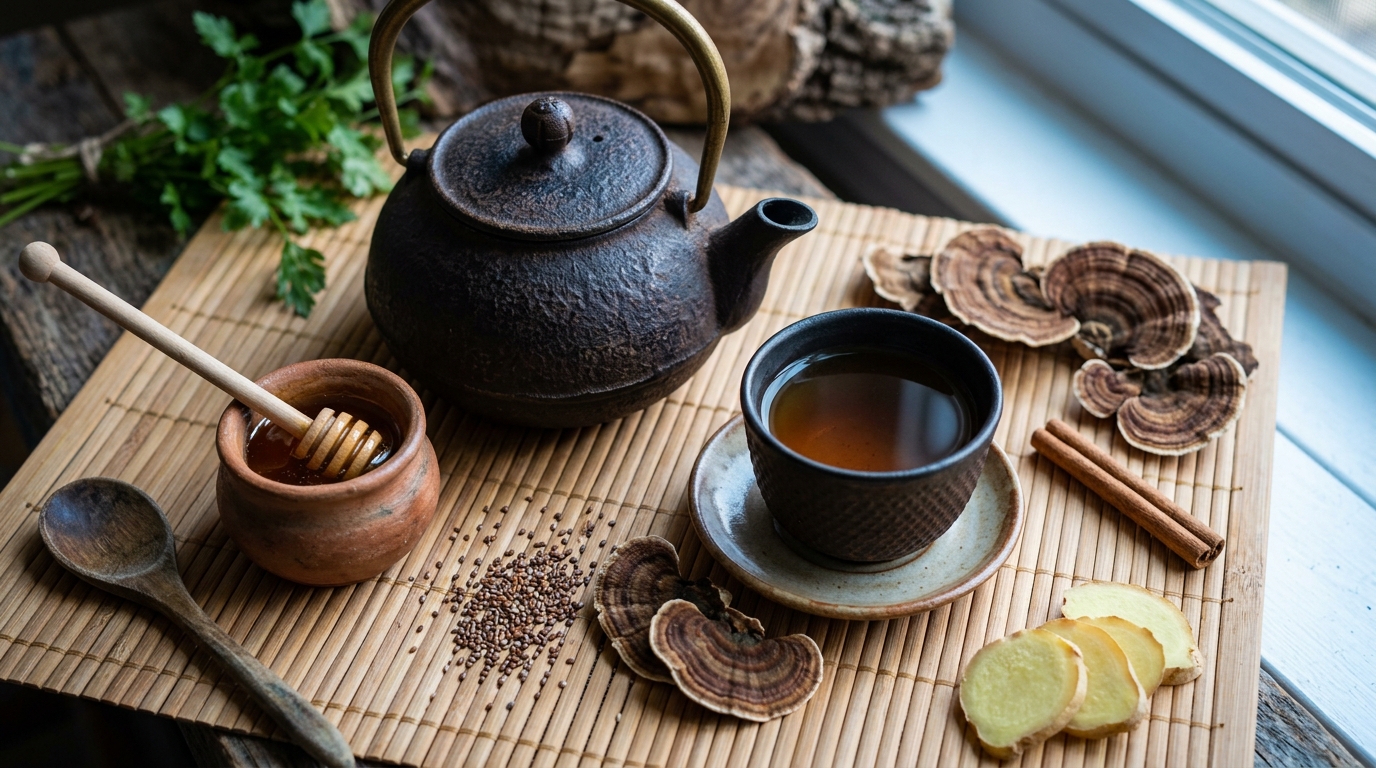
Deep in temperate forests across Asia, North America, and Europe, the turkey tail mushroom (Trametes versicolor) fans out in concentric rings of rust, brown, and cream across fallen logs and aging trees. Named for its striking resemblance to the fanned tail feathers of a wild turkey, this bracket fungus has been prized in Traditional Chinese Medicine for over two thousand years, where it is known as Yun Zhi, or Cloud Mushroom. Practitioners brewed it into long-simmered decoctions believed to tonify the lungs, support the liver, and fortify the body’s vital energy, known as Qi.
What sets turkey tail apart from most other herbal teas is its extraordinary scientific pedigree. Unlike many folk remedies that await rigorous study, turkey tail has been the subject of serious clinical and preclinical research for decades. Two of its key polysaccharide compounds, PSK and PSP, are so well established that PSK has been approved in Japan as an adjunct cancer therapy since the 1980s. This makes turkey tail one of the rare herbs that bridges ancient wisdom and modern immunology with genuine credibility.
As a tea, turkey tail delivers a grounding, woodland experience. The brew is mild but complex, with notes of damp earth, a whisper of bitterness, and a subtle umami depth that distinguishes it from floral or citrus-forward herbal teas. Because the mushroom’s cell walls are composed of tough chitin, a proper decoction or extended hot extraction is essential to unlock its active compounds. This guide will walk you through every method, from a classic stovetop decoction to a slow cold brew, so you can find the ritual that fits your day.
2
cups
Ingredients
- 10 gdried turkey tail mushroom slices or pieces
- 600 mlfiltered water
- —1 cinnamon stick (optional, for warmth and sweetness)
- —2 slices fresh ginger (optional, for brightness)
- —raw honey or maple syrup to taste (optional)
How to Brew
Click on an item below to shop for the recommended items for this recipe on Amazon.
As an Amazon Associate, we earn from qualifying purchases.
- Place 10 g of dried turkey tail mushroom pieces into a small saucepan. Add 600 ml of filtered water along with any optional additions such as a cinnamon stick or ginger slices.
- Bring the water to a full rolling boil over medium-high heat, then immediately reduce to a gentle simmer over low heat. Cover the saucepan with a lid to retain volatile aromatic compounds and prevent excessive evaporation.
- Simmer uncovered for the final 5 minutes to allow the liquid to reduce slightly and concentrate flavors, targeting a final volume of approximately 400 ml for two servings.
- After 25 to 40 minutes of total simmering time, remove the saucepan from heat. The liquid should be a rich amber-to-brown color with a noticeable earthy aroma.
- Strain the liquid through a fine mesh strainer into two warmed mugs, pressing gently on the mushroom pieces to extract all remaining liquid. Discard the spent mushroom solids or compost them.
- Allow to cool for 2 minutes until comfortable to drink. Stir in raw honey or maple syrup to taste if desired, and serve immediately.
- Grind or break 15 g of dried turkey tail mushroom pieces into smaller fragments using a spice grinder or by placing them in a zip-lock bag and crushing with a rolling pin. Smaller surface area dramatically improves cold extraction efficiency.
- Place the ground mushroom material into a clean glass jar. Pour 700 ml of cold filtered water over the mushroom material, ensuring all pieces are submerged. Stir briefly to disperse.
- Cover the jar loosely with a lid or cloth and allow it to rest at room temperature for 2 hours to begin the initial extraction, then transfer to the refrigerator.
- Allow the jar to cold brew in the refrigerator for a further 10 to 16 hours. The brew is ready when the liquid has turned a light amber color and carries a gentle earthy aroma.
- Strain the cold brew through a fine mesh strainer lined with a coffee filter into a clean pitcher or bottle, pressing gently on the solids to release all liquid. Discard the spent grounds.
- Serve over ice in tall glasses. Stir in a splash of apple juice or a squeeze of lemon to brighten the earthy notes. Store remaining cold brew in the refrigerator for up to 3 days.
- Combine 25 g of dried turkey tail mushroom pieces with 1 liter of filtered water in a medium saucepan. Add 1 cinnamon stick and 4 slices of fresh ginger for flavor complexity if desired.
- Bring to a full rolling boil over medium-high heat, then reduce immediately to the lowest possible simmer. Cover the pot and allow the mushrooms to slowly decoct for 60 to 90 minutes, checking every 20 minutes and adding small amounts of water if the level drops below 400 ml.
- After 60 to 90 minutes, remove the lid and increase heat slightly to reduce the liquid to approximately 300 to 350 ml of rich, dark concentrate. This concentrated volume represents roughly 6 to 8 single-serving doses.
- Strain the concentrate through a fine mesh strainer into a clean glass jar or bottle, pressing firmly on the mushroom solids to extract every drop. Allow to cool completely before sealing.
- Label the jar with the date and store in the refrigerator for up to 7 days. To serve, measure 40 to 50 ml of concentrate into a mug and top with 150 to 200 ml of hot water, or pour over ice and top with cold water. Sweeten to taste.
Health Benefits
The PSK and PSP compounds in turkey tail act as biological response modifiers, selectively upregulating immune cell populations including natural killer cells, macrophages, and T-lymphocytes. Multiple human clinical trials, particularly in cancer patients receiving chemotherapy, have shown measurable improvements in immune markers following PSK supplementation.
Turkey tail’s beta-glucans and polysaccharides function as prebiotics, selectively feeding beneficial gut bacteria including Lactobacillus and Bifidobacterium species. A 2014 human pilot study published in ISRN Oncology found that turkey tail consumption significantly altered gut microbiome composition in a direction associated with improved immune function.
Turkey tail contains a broad spectrum of phenolic compounds, including quercetin and baicalein, that scavenge free radicals and reduce oxidative stress. Research has measured the total antioxidant capacity of turkey tail extracts as comparable to or exceeding that of many commonly consumed antioxidant-rich foods.
In Traditional Chinese Medicine, Yun Zhi has been used for centuries to address lung weakness and chronic cough. Modern research suggests its immunomodulatory effects may help the respiratory tract mount more effective responses to common pathogens during cold and flu season.
PSK derived from turkey tail is one of the most rigorously studied natural compounds in oncology. Multiple randomized controlled trials conducted in Japan and China have shown that PSK supplementation alongside standard chemotherapy improved survival rates in patients with gastric, colorectal, and breast cancers, prompting its approval as an adjunct therapy in Japan.
🧪 Key Bioactive Compounds
The Science Behind Turkey Tail Mushroom
The immune-supporting reputation of turkey tail mushroom rests on a remarkably solid scientific foundation, anchored primarily by two polysaccharide-protein complexes: PSK (polysaccharide-K, also called Krestin) and PSP (polysaccharide-peptide). Both are large, water-soluble molecules composed of a beta-glucan polysaccharide backbone bound to protein side chains. When ingested, they interact with pattern recognition receptors on innate immune cells, particularly Dectin-1 receptors on macrophages and dendritic cells, triggering a cascade of cytokine production that effectively primes the body’s first-line defenses. This mechanism is called immunomodulation rather than simple stimulation because PSK and PSP can upregulate immune activity when it is suppressed while also helping to normalize overactive inflammatory responses.
Beta-glucans, the structural polysaccharides that give turkey tail its prebiotic character, play a dual role in the gut and in systemic immunity. In the gut, they resist digestion in the small intestine and arrive intact in the colon, where they selectively feed beneficial bacterial populations. A healthier microbiome composition correlates with stronger mucosal immunity, lower systemic inflammation, and improved production of short-chain fatty acids that regulate immune cell behavior throughout the body. Systemically, beta-glucans that cross the gut lining interact with immune cells in lymphoid tissue, sustaining the broad immunomodulatory effects observed in clinical trials. A 2014 study by Pallav et al. published in ISRN Oncology confirmed meaningful microbiome shifts in human subjects consuming turkey tail powder, validating this dual-action model.
Turkey tail also contains a notable array of phenolic antioxidants, including quercetin, kaempferol, and baicalein, which contribute to its total antioxidant capacity and offer independent anti-inflammatory activity. Quercetin in particular has been studied for its ability to inhibit the NLRP3 inflammasome and suppress NF-kB signaling pathways, two central regulators of chronic inflammation. Ergosterol, the fungal precursor to vitamin D2, adds another layer of immune relevance, as vitamin D receptors are expressed on virtually every immune cell type and adequate vitamin D status is strongly associated with both innate and adaptive immune competence. Together, these compounds create a tea that offers genuine, multi-pathway immune support grounded in two millennia of traditional use and an expanding body of rigorous modern science.
Brewing Tips
- Always use a kitchen scale rather than volume measurements for dried mushroom material, as pieces vary dramatically in density and size, and accurate dosing matters for therapeutic consistency.
- Do not discard spent turkey tail pieces after your first decoction. The solids can be re-simmered a second time with fresh water for 20 minutes to yield a lighter but still beneficial secondary brew, a practice known as second flush extraction.
- Source your turkey tail from reputable suppliers who test for heavy metals and verify species identity by DNA analysis, as the dried mushroom market contains frequent misidentification and contamination from wild-sourced or poorly regulated products.